Are you struggling with weak signals and limited range? Your device's poor performance might be due to an antenna with the wrong frequency. This mismatch can completely ruin your connection.
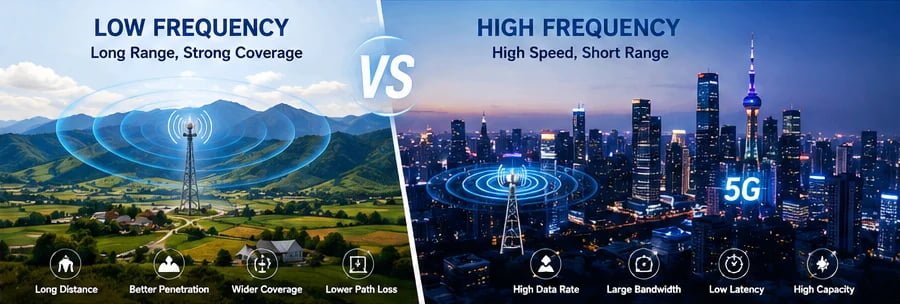
Antenna frequency is the most important factor for signal coverage. Lower frequencies travel farther and penetrate obstacles better, giving you wider coverage. Higher frequencies have shorter ranges but can support much higher data speeds.
This might sound a bit technical, but the idea is actually quite simple. Over my 20 years in the antenna business, I've seen countless projects succeed or fail based on this one choice. Understanding this principle is the first step to selecting the right antenna. Let me show you why lower frequencies are the long-distance runners of the radio world.
Why Do Lower Frequencies Provide Better Coverage?
Have you ever noticed your 4G signal is strong in the countryside, but a 5G signal is hard to find? This isn't a coincidence. The frequency is the key, and it directly causes these range differences.
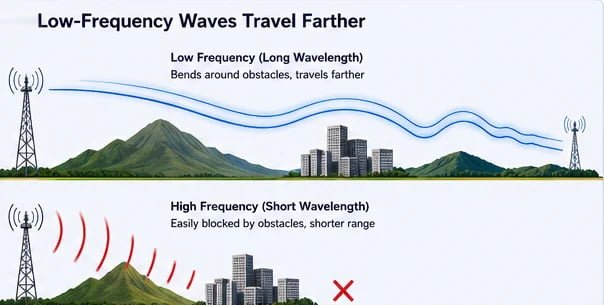
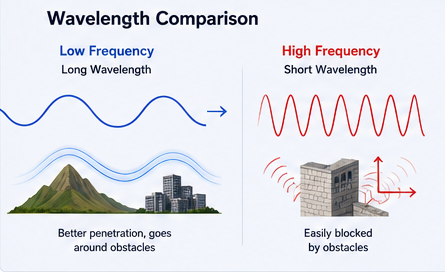
Lower frequencies have longer wavelengths. These long waves can travel greater distances with less signal loss. They also bend around obstacles like hills and buildings more easily. This provides more reliable and widespread coverage, especially in tricky environments.
Let's dive a little deeper into this. Think of frequency and wavelength as two sides of the same coin. When the frequency is low, the wave itself is physically longer. This is a huge advantage for wireless communication.
The Power of Wavelength
Imagine you're trying to get a message over a large hill. A long radio wave, like one from a low-frequency antenna, behaves like a large wave in the ocean. It can bend and flow around the obstacle without losing much energy. A short, high-frequency wave is more like a small, fast ripple. It tends to get blocked or reflected by the same hill. This is why low-frequency bands are often used for applications that need to cover vast areas, like rural broadband or long-range IoT networks.
Lower Path Loss, Longer Reach
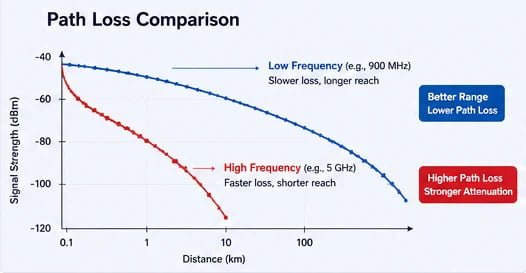
Every radio signal gets weaker as it travels away from its source. We call this "path loss." For low-frequency signals, this loss happens much more slowly. They hold onto their strength for a longer distance. This means you need fewer towers to cover the same amount of land, which is a big reason why they are so valuable for carriers and for wide-area applications like LoRaWAN.
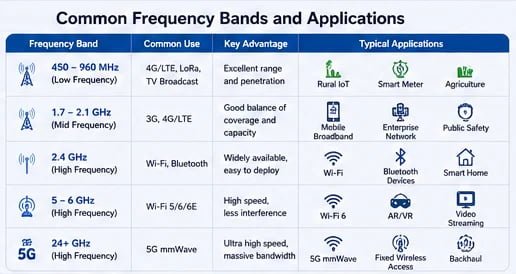
Comparing Low-Frequency Bands
| Frequency Band | Common Use | Key Advantage |
|---|---|---|
| 450-960 MHz | 4G/LTE, LoRa, TV Broadcast | Excellent range and building penetration |
| 1.7-2.1 GHz | 3G, 4G/LTE | Good balance of coverage and capacity |
| 2.4 GHz | WiFi, Bluetooth | Widely available, but can be crowded |
What Are the Advantages of High-Frequency Antennas Then?
Do you need incredibly fast data speeds but find your signal drops just a few rooms away? High-frequency bands are built for speed, but their limited range can be a real challenge for coverage.
High-frequency antennas support much wider bandwidths. This allows them to carry a lot more data, which results in faster download and upload speeds. They are perfect for dense, high-capacity networks like 5G in cities or high-speed Wi-Fi systems.
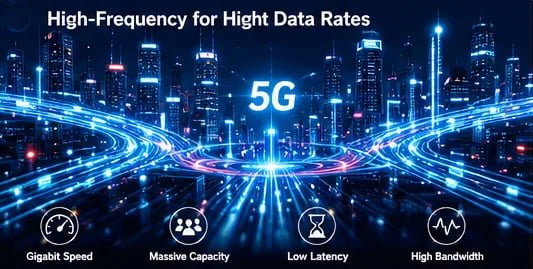
So if lower frequencies are so good at coverage, why do we even use high frequencies? The answer is simple: speed. High-frequency signals are the sprinters of the radio world.
Bandwidth: The Data Highway
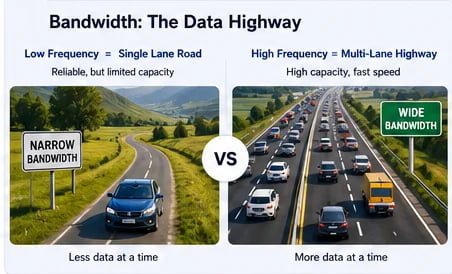
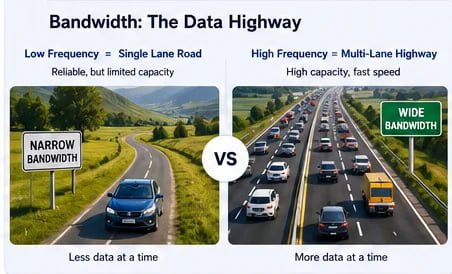
Think of bandwidth as the number of lanes on a highway. A low-frequency signal is like a single-lane country road. It's reliable for getting from point A to point B, but you can't move much traffic on it. A high-frequency signal is like a massive, eight-lane superhighway. It can handle a huge volume of data traffic at once. This is why technologies like 5G and Wi-Fi 6 use these higher frequencies. They need that huge bandwidth to deliver the gigabit speeds required for video streaming, online gaming, and other data-heavy tasks.
The Speed vs. Range Trade-Off
This brings us to the fundamental trade-off in wireless communication: speed versus range. You can't have the best of both. High-frequency signals deliver incredible speed, but their short wavelengths mean they get blocked easily by walls, trees, and even rain. This is why your 5GHz Wi-Fi signal is often weaker than your 2.4GHz signal one room over. To provide consistent high-frequency coverage, you need many more access points or cell towers placed closer together.
Common High-Frequency Applications
How Do I Choose the Right Antenna Frequency for My Project?
Choosing the wrong antenna frequency is like bringing the wrong key for a lock. It simply won't work, no matter how good the antenna is. This one mistake can derail your entire project.
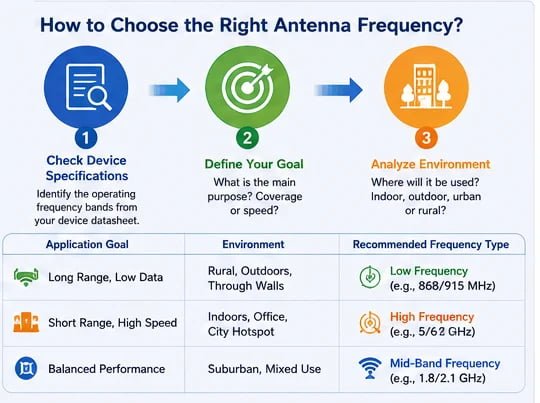
First, you must identify the operating frequency of your device or network. This is not negotiable. Then, think about your main goal. Do you need wide coverage or high data speed? Always match the antenna to the device's exact frequency band for it to function.
In my experience, this is the most critical step. I often use an analogy with my clients. Think of it like a charger. A high-power charger can work with a low-power device, but not the other way around. But if the charger has a special, private protocol, it won't charge anything else. It's the same with antennas. The frequencies must match perfectly.
The "Handshake" Rule: Matching is Key
An antenna is a passive component. It doesn't create a signal; it just transmits and receives it efficiently at a specific frequency it was built for. If your radio module operates at 915 MHz for a LoRa application, using a 2.4 GHz Wi-Fi antenna will give you terrible, if any, performance. The antenna and the radio must "handshake" at the same frequency. This is the first and most important rule.
A Step-by-Step Selection Guide
Here is a simple process I recommend to all our customers.
- Check Device Specifications: Look at the datasheet for your radio module or cellular modem. What frequency bands does it support?
- Define Your Goal: What is the main purpose of your product? Is it a long-range IoT sensor where battery life and coverage are key? Or is it a 5G router where speed is everything?
- Analyze the Environment: Where will the device be used? In an open field, a dense city with tall buildings, or inside a factory with a lot of metal machinery?
Environment Matters
| Application Goal | Environment | Recommended Frequency Type |
|---|---|---|
| Long Range, Low Data | Rural, Outdoors, Through Walls | Low Frequency (e.g., 868/915 MHz) |
| Short Range, High Speed | Indoors, Office, City Hotspot | High Frequency (e.g., 5/6 GHz) |
| Balanced Performance | Suburban, Mixed Use | Mid-Band Frequency (e.g., 1.8/2.1 GHz) |
Conclusion
Choosing the correct antenna frequency is critical. You must match your device's frequency first. Then, you can balance the need for wide coverage with the demand for high speed to get optimal performance.