I've seen many businesses struggle when upgrading from 4G to 5G. They buy new equipment, but the signal quality disappoints them. The problem often lies in antenna selection, not the network itself.
Choosing the right antenna for 5G migration is not just about compatibility—it's about understanding frequency coverage, physical design, and your specific deployment environment. The wrong antenna can limit your 5G benefits, while the right one ensures seamless connectivity and future-proof performance.
When I help customers transition to 5G, they often ask me the same questions: "Will my old antennas work?" or "What makes a 5G antenna different?" These are valid concerns. Let me walk you through the key factors you need to consider to make this transition smooth and successful.
4G to 5G Upgrade: How to Choose the Right Antenna?
Upgrading to 5G is more than just changing your modem. The antenna plays a critical role. Many people assume their 4G antenna will work fine with 5G equipment. This is a costly mistake.
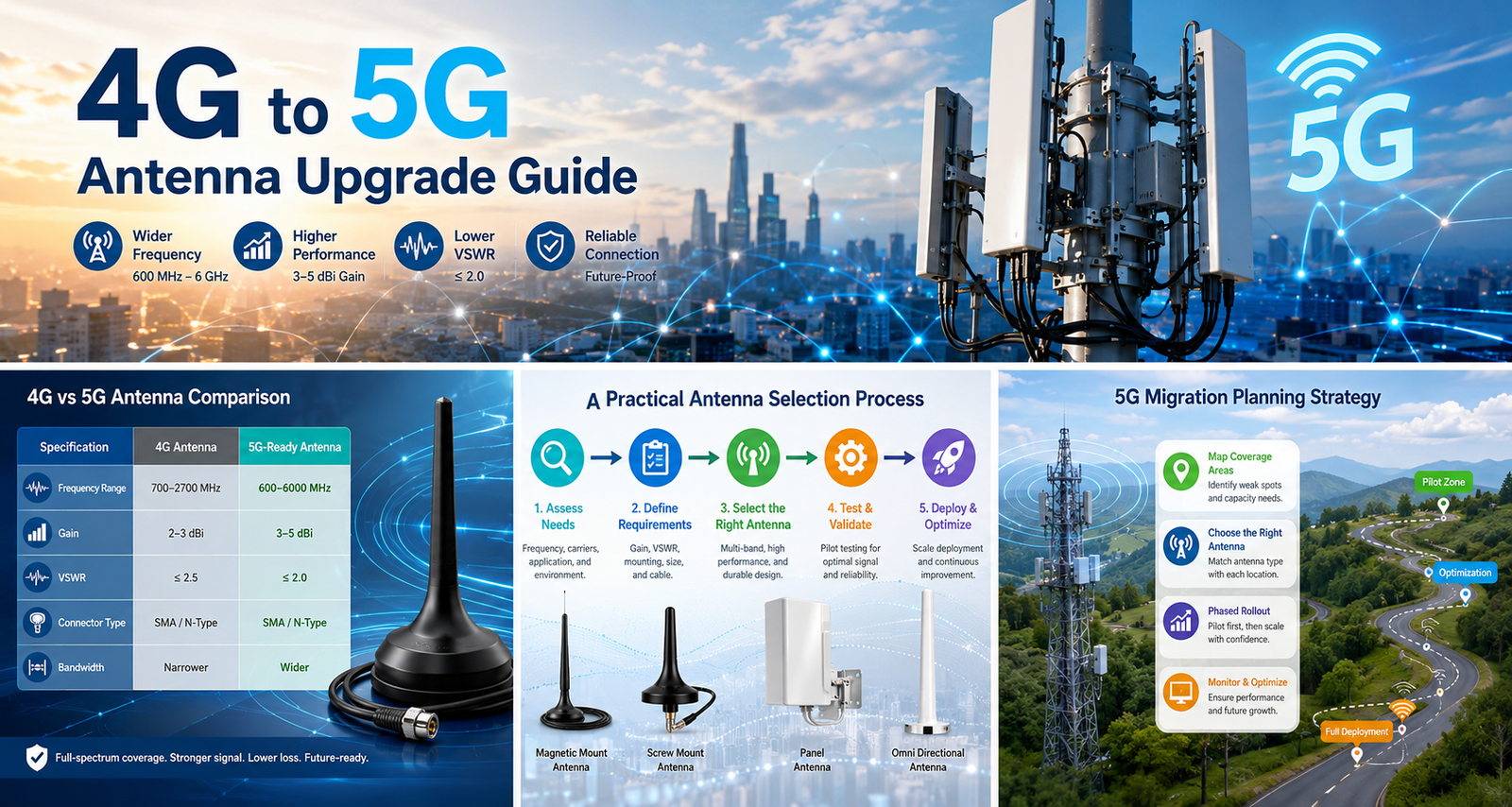
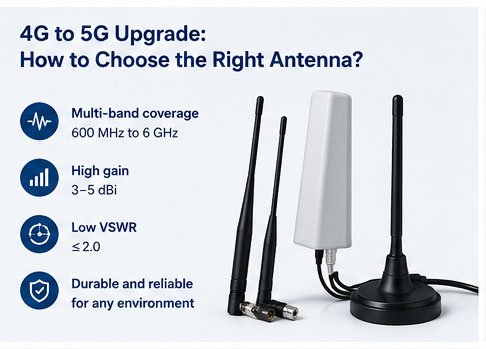
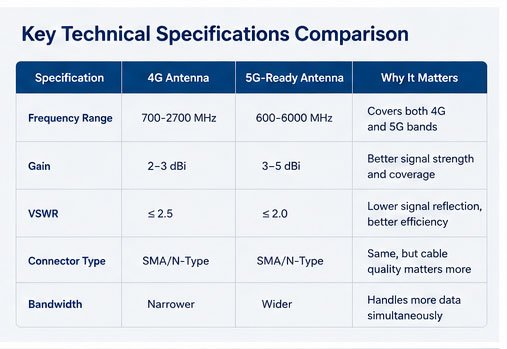
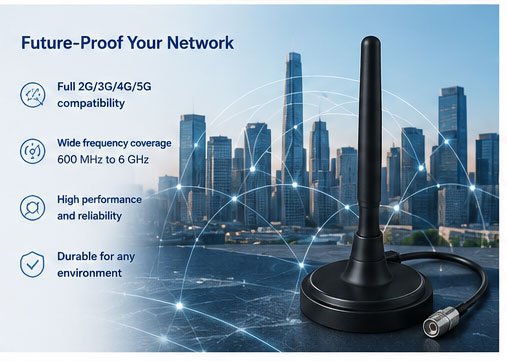
You need an antenna that covers both sub-6 GHz 5G frequencies and legacy 4G bands. Look for multi-band antennas with wide frequency ranges (600 MHz to 6 GHz), high gain (3-5 dBi), and low VSWR (≤2.0) to ensure optimal signal quality across all network generations.
The technical requirements for 5G antennas differ significantly from 4G. While 4G primarily uses frequencies between 700 MHz and 2600 MHz, 5G expands into higher frequency ranges. In my experience manufacturing antennas for over 17 years, I've learned that the material quality directly impacts signal transmission efficiency.
Key Technical Specifications Comparison
| Specification | 4G Antenna | 5G-Ready Antenna | Why It Matters |
|---|---|---|---|
| Frequency Range | 700-2700 MHz | 600-6000 MHz | Covers both 4G and 5G bands |
| Gain | 2-3 dBi | 3-5 dBi | Better signal strength and coverage |
| VSWR | ≤2.5 | ≤2.0 | Lower signal reflection, better efficiency |
| Connector Type | SMA/N-Type | SMA/N-Type | Same, but cable quality matters more |
| Bandwidth | Narrower | Wider | Handles more data simultaneously |
I always recommend using pure copper conductor antennas. Why? Copper reduces signal loss and improves reception sensitivity. This becomes even more critical when you're dealing with 5G's higher frequencies, which are more susceptible to attenuation. Some manufacturers use copper-clad aluminum to cut costs, but this compromises long-term performance. You won't notice the difference immediately, but signal degradation appears over time, especially in harsh weather conditions.
A Practical Guide to Antenna Selection for 5G Migration?
When planning your 5G migration, you need a practical approach. I've worked with hundreds of customers through this process. The ones who succeed follow a systematic method instead of random purchasing.
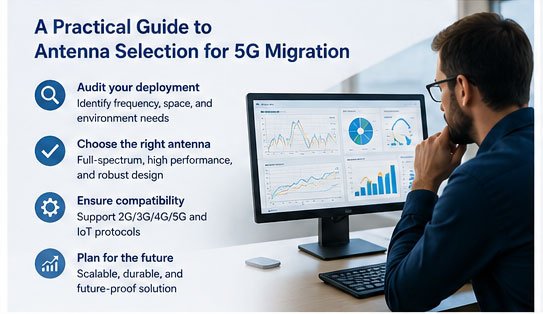
Start by auditing your current deployment: identify frequency requirements, physical mounting constraints, and environmental conditions. Then select antennas that support full-spectrum coverage (2G/3G/4G/5G), offer flexible mounting options, and are certified for outdoor use if needed.
The first step is understanding your frequency needs. In most countries, carriers use different 5G bands. In China, for example, the three major operators cover different frequency ranges. If your antenna doesn't support all of them, you'll have coverage gaps. This is why I always suggest full-spectrum antennas that cover 600 MHz to 6 GHz. This approach gives you flexibility and future-proofs your investment.
Practical Selection Checklist
Here's what I tell my customers to evaluate:
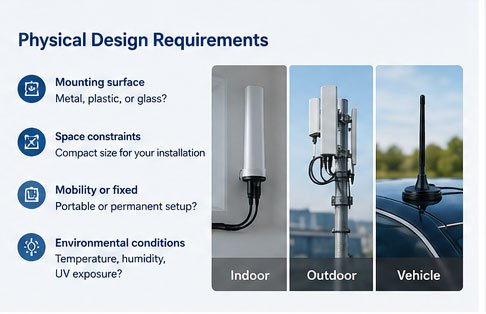
Physical Design Requirements:
- What is your mounting surface? Metal, plastic, or glass?
- How much space do you have? Traditional antennas are often 100mm+ tall
- Do you need mobility or fixed installation?
- What are the weather conditions? Temperature range, humidity, UV exposure?
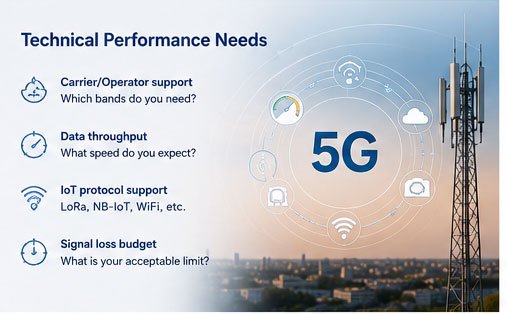
Technical Performance Needs:
- Which carriers/operators will you support?
- What is your expected data throughput?
- Do you need IoT protocol support (LoRa, NB-IoT, WiFi)?
- What is your acceptable signal loss budget?
Operational Considerations:
- What is your deployment timeline?
- Do you need custom cable lengths or connectors?
- What are your budget constraints per unit?
- Do you need certifications (CE, FCC, RoHS)?
I recently helped a customer deploying AGV robots in a warehouse. They needed compact antennas that wouldn't interfere with low ceilings and narrow aisles. Traditional 100mm+ magnetic base antennas were too bulky. We provided a compact design that reduced the antenna volume by about 60% while maintaining full 5G coverage. This shows that physical design matters as much as technical specifications.
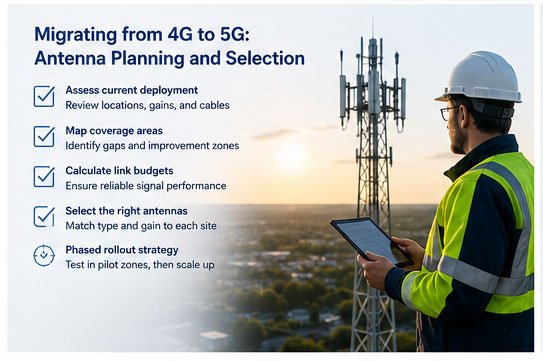
Migrating from 4G to 5G: Antenna Planning and Selection?
Planning makes the difference between successful migration and costly failures. I've seen companies waste months because they didn't plan their antenna requirements properly before ordering equipment.
Effective migration planning requires mapping your coverage areas, calculating link budgets, selecting appropriate antenna types for each location, and establishing a phased rollout strategy. Don't replace everything at once—test in pilot zones first.
When we help customers plan their migration, we follow a structured approach. First, we assess their current 4G deployment. Where are the antennas located? What gain levels are they using? What cable types and lengths? This information is critical because 5G signals experience more cable loss than 4G. If you're using a 10-meter cable, you might lose 3-4 dB at 5G frequencies compared to 1-2 dB at 4G frequencies.
Phased Migration Strategy
Phase 1: Assessment and Testing (Weeks 1-2)
- Conduct site surveys for existing antenna locations
- Test current signal strength and coverage
- Identify problem areas with poor 4G performance
- Select 2-3 pilot locations for 5G testing
Phase 2: Pilot Deployment (Weeks 3-4)
- Install 5G-compatible antennas at pilot sites
- Test signal quality across all frequency bands
- Measure throughput and latency improvements
- Gather user feedback on connectivity
Phase 3: Full Rollout (Weeks 5-12)
- Prioritize high-traffic or critical locations
- Install antennas in batches, not all at once
- Monitor performance after each installation
- Keep backup 4G equipment until 5G stabilizes
Phase 4: Optimization (Ongoing)
- Fine-tune antenna positioning and orientation
- Adjust to carrier frequency changes
- Replace underperforming units
- Document best practices for future expansions
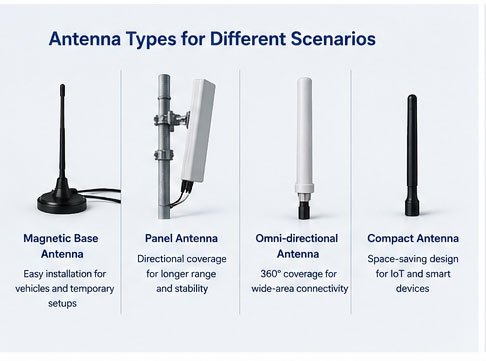
One common mistake I see is underestimating the importance of the magnetic base. If you're installing antennas on vehicles or mobile equipment, a strong magnetic base is essential. We use injection-molded magnetic bases with strong absorption force. These can firmly fix on metal surfaces and resist corrosion, aging, and extreme temperatures. This matters because loose antennas cause intermittent signal loss, which is difficult to troubleshoot.
5G Network Evolution: Choosing Antennas for a Smooth Transition?
The 5G network landscape keeps changing. New frequency bands are being allocated, and carriers are constantly optimizing their networks. Your antenna choice needs to account for this evolution.
Choose antennas that support the full 5G roadmap, including both current FR1 (sub-6 GHz) and emerging mid-band frequencies. Avoid narrow-band antennas that only cover your current carrier's frequencies—they'll become obsolete as networks expand.
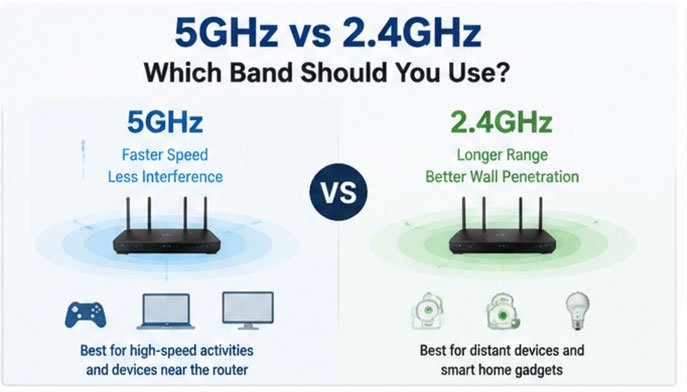
When I design antennas, I think about what frequencies carriers might add in the next 3-5 years. This is why our antennas cover such a wide range. In China, we support all three major operators' 5G/4G/3G/2G bands. But we also include LoRa, NB-IoT, and WiFi 2.4G/5.8G bands. This might seem like overkill, but it future-proofs your deployment.
5G Frequency Evolution by Region
| Region | Current 5G Bands | Planned Additions | Recommended Coverage |
|---|---|---|---|
| North America | n71, n41, n260, n261 | n77, n78, n79 | 600 MHz - 6 GHz |
| Europe | n78, n28, n1, n3 | n77, n40 | 700 MHz - 4 GHz |
| Asia-Pacific | n77, n78, n79, n41 | n1, n3, n40 | 600 MHz - 6 GHz |
| China | n41, n78, n79 | n1, n3, n28 | 600 MHz - 6 GHz |
The IoT protocols are especially important. Many 5G deployments involve IoT devices. If your antenna doesn't support LoRa or NB-IoT, you'll need separate antennas for those devices. This adds cost, complexity, and potential points of failure. A single multi-band antenna that handles everything simplifies your system architecture significantly.
From 4G to 5G: Essential Antenna Selection Strategies?
Strategy matters more than specifications. I've seen customers buy technically perfect antennas that failed in real-world deployment because they didn't match the actual use case.
Your selection strategy should prioritize versatility, durability, and vendor support. Choose antennas with proven track records in similar deployments, strong warranties, and manufacturers who provide technical assistance throughout installation and operation.
Let me share three strategic principles that guide my customer recommendations:
Strategy 1: Versatility Over Specialization
Many people want specialized antennas for each application. They buy one antenna for outdoor base stations, another for indoor routers, and another for mobile equipment. This creates inventory complexity and increases costs. Instead, I recommend versatile antennas that work across multiple scenarios. Our compact magnetic base antennas, for example, work equally well on AGV robots, mobile robots, vehicles, routers, and security cameras. This reduces your SKU count and simplifies procurement.
Strategy 2: Durability as a Cost Factor
The cheapest antenna is not the most economical. I've seen customers buy low-cost antennas that fail within 6 months, especially in outdoor or mobile applications. The replacement cost—including labor, downtime, and shipping—far exceeds the initial savings. Look for antennas with weatherproof ratings (IP65+), UV-resistant materials, and temperature ranges that match your environment (-40°C to +85°C is standard for serious applications).
Strategy 3: Vendor Partnership Approach
Don't just buy antennas—build relationships with suppliers who understand your business. When you have a reliable antenna supplier, you can quickly get custom solutions, fast prototyping, and technical support when problems arise. We've been manufacturing antennas for over 17 years, and our long-term customers value our ability to customize frequency ranges, cable lengths, and connector types. This flexibility accelerates your product development and market entry.
Antenna Selection Best Practices for 4G-to-5G Deployments?
Best practices come from real-world experience, not just theory. I want to share what actually works in deployment scenarios, not what sounds good on paper.
Follow these proven practices: always test before mass deployment, document your antenna configurations and locations, implement a regular maintenance schedule, and establish clear performance metrics to measure success.
Best Practice 1: Test in Real Conditions
Lab tests don't tell the full story. An antenna that performs well on a spectrum analyzer might fail in your actual environment. Before ordering 100 units, buy 5-10 samples and test them where you'll actually deploy them. Test at different times of day, in different weather conditions, and with actual equipment configurations. I've had customers discover that metal shelving in warehouses creates interference they didn't anticipate in lab testing.
Best Practice 2: Document Everything
Create a simple spreadsheet with antenna locations, installation dates, cable types, connector types, and initial signal strength measurements. This documentation saves tremendous time when troubleshooting. When a customer reports signal issues, I can quickly reference their setup and identify potential problems. Without documentation, you're starting from zero every time something goes wrong.
Best Practice 3: Standardize Where Possible
Use the same antenna model across similar applications. Don't mix different manufacturers or models unless absolutely necessary. Standardization reduces training requirements, simplifies troubleshooting, and streamlines maintenance. It also gives you better negotiating power for volume pricing.
Best Practice 4: Plan for Growth
Install antennas that can handle more bandwidth than you currently need. 5G networks are still maturing, and data throughput will increase over time. An antenna that barely meets your current needs will become a bottleneck within a year. This is especially true for high-traffic applications like video surveillance or industrial automation.
Antenna Maintenance Schedule
| Maintenance Task | Frequency | Why It Matters |
|---|---|---|
| Visual inspection | Monthly | Detect physical damage early |
| Connector tightness check | Quarterly | Prevent signal loss from loose connections |
| VSWR measurement | Semi-annually | Identify performance degradation |
| Cable condition assessment | Annually | Replace before failure occurs |
| Mounting security verification | After extreme weather | Ensure antennas haven't shifted |
Preparing for 5G: A Complete Antenna Migration Guide?
Preparation determines success. The companies that struggle with 5G migration are the ones who treat it as a simple hardware swap instead of a planned transformation.
A complete migration requires inventory assessment, budget planning, vendor evaluation, training, and a contingency plan. Allocate at least 30% more time than you initially estimate—unexpected issues always arise.
Let me walk you through a complete preparation process based on what works for my customers:
Step 1: Inventory Your Current Setup
List every antenna in your deployment. Note the frequency ranges, gain levels, mounting types, and cable specifications. Identify which antennas are truly obsolete and which might be reusable. Some 4G antennas that already cover wider frequency ranges might work for early 5G bands, allowing you to phase your investment.
Step 2: Calculate Your Budget Realistically
Don't just count antenna costs. Include cables, connectors, installation labor, testing equipment, and a contingency fund. In my experience, the total cost is typically 40-60% higher than the antenna purchase price alone. For a 100-antenna deployment, if each antenna costs $50, expect to spend $70-80 per location when you factor in all associated costs.
Step 3: Evaluate Multiple Vendors
Don't commit to a single supplier without comparing options. Request samples from 3-4 manufacturers. Test them side-by-side in your actual environment. Compare not just technical specs but also lead times, minimum order quantities, customization capabilities, and after-sales support. We offer flexible MOQs and fast delivery, which matters when you're testing or doing phased rollouts.
Step 4: Train Your Installation Team
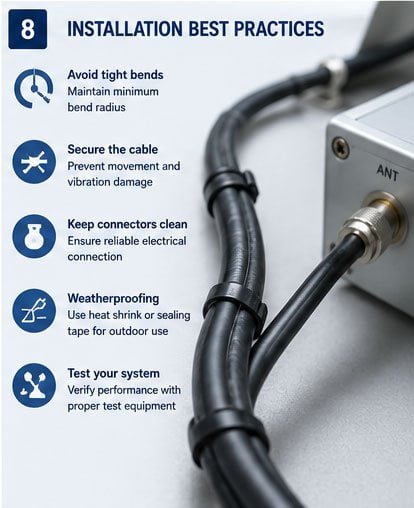
5G antenna installation has specific requirements that differ from 4G. The orientation matters more because 5G uses MIMO technology. Cable quality is more critical because signal loss increases at higher frequencies. Spend time training your team on proper installation techniques, measurement tools, and troubleshooting procedures.
Step 5: Create a Contingency Plan
What happens if your new antennas don't perform as expected? Can you quickly revert to 4G? Do you have backup units available? Can you get expedited support from your supplier? I've seen migrations fail not because of bad antennas, but because companies had no backup plan when issues arose.
Optimizing Your 5G Upgrade with the Right Antenna Solution?
Optimization is an ongoing process, not a one-time event. Even after successful installation, you can improve performance through careful tuning and adjustment.
Optimization involves fine-tuning antenna positioning, adjusting gain levels for different zones, minimizing cable losses, and regularly updating firmware on connected devices. Small improvements compound into significant performance gains.
I want to share some specific optimization techniques that deliver measurable results:
Positioning Optimization
The exact location and orientation of your antenna can change signal strength by