
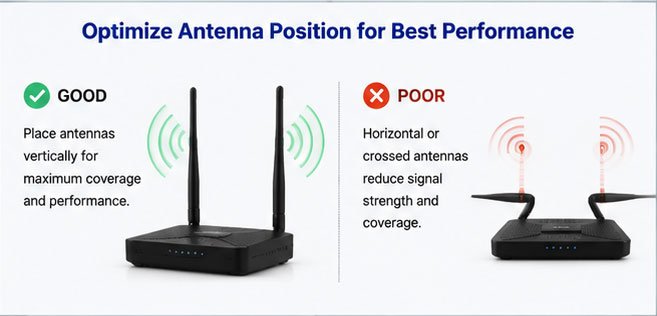
Have you noticed your WiFi signal dropping in certain rooms, or worse, your video calls freezing during important client meetings? I've spent the last decade helping businesses worldwide solve exactly these problems, and most issues trace back to one overlooked component: the router antenna. A weak antenna doesn't just slow your connection — it creates dead zones, throttles streaming quality, and forces devices to constantly reconnect. Whether you're managing a home office or coordinating warehouse operations, unreliable WiFi disrupts everything.
The best dual band WiFi antenna for your router in 2026 combines high-gain capability (typically 5-9dBi) with simultaneous 2.4GHz and 5GHz frequency support, omni-directional radiation pattern for 360° coverage, and robust RF connectors like SMA or RP-SMA that match your router's specifications. For maximum performance, choose antennas with proven VSWR ratings below 2.0, certified materials that support WiFi 6/6E standards, and adjustable positioning to optimize signal direction based on your physical environment.
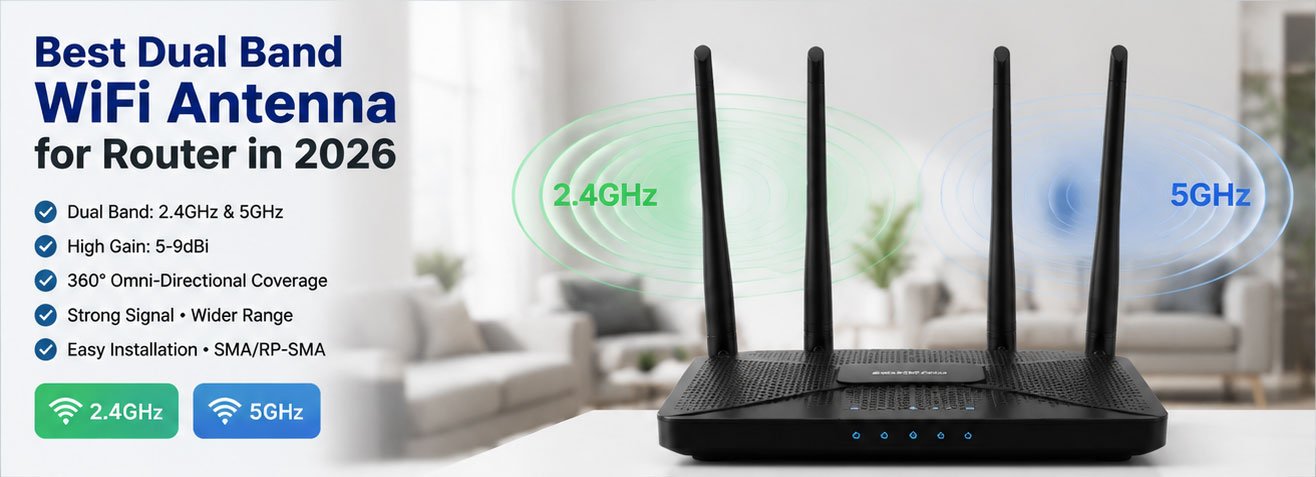
The antenna market in 2026 offers dozens of options claiming "maximum range" and "ultra-fast speeds," but most buyers waste money on mismatched products. In this guide, I'll walk you through exactly how to evaluate antennas based on your router model, space layout, and actual usage needs — not marketing hype. We'll compare the top-performing models, break down technical specifications that actually matter, and show you how a $15-40 antenna upgrade can outperform a $200 router replacement.
How to Choose the Best Dual Band WiFi Antenna for Your Router in 2026?
Buying the wrong antenna wastes money and still leaves you with connection problems. Many customers tell me they replaced their antennas three times before finding one that actually worked, simply because they didn't know what specifications matched their setup.
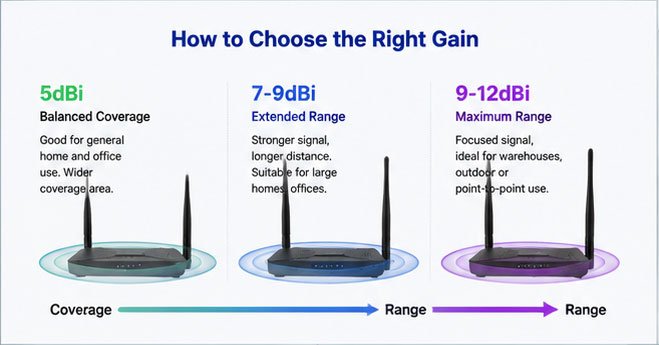
To choose the best dual band WiFi antenna for your router in 2026, first verify your router's connector type (SMA, RP-SMA, or N-type), then match the antenna's frequency range to both 2.4GHz (2400-2500MHz) and 5GHz (5150-5850MHz) bands, select a gain level appropriate to your coverage needs (5dBi for balanced coverage, 7-9dBi for extended range), and confirm the antenna supports your router's WiFi standard (WiFi 5, WiFi 6, or WiFi 6E). Always check VSWR specifications — ratings below 2.0 indicate efficient signal transfer with minimal reflection loss.
Understanding Dual Band Frequency Requirements
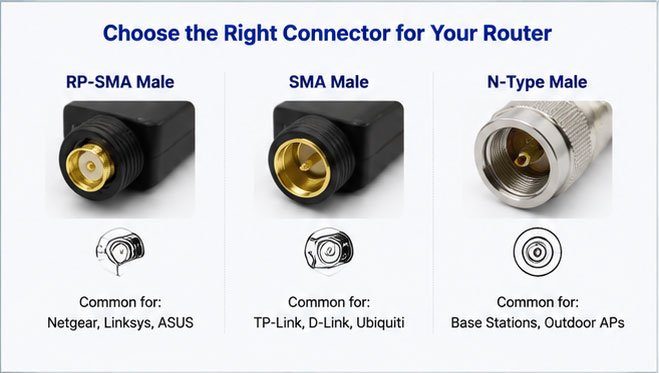
Your router broadcasts on two distinct frequency bands, each serving different purposes. The 2.4GHz band penetrates walls effectively and reaches 150-300 feet indoors, making it ideal for IoT devices, security cameras, and mobile devices moving between rooms. The 5GHz band delivers faster data speeds but covers only 50-150 feet with reduced wall penetration — perfect for streaming, gaming, and high-bandwidth applications near the router.
A genuine dual band antenna must include separate internal elements tuned to both frequency ranges. I've tested dozens of antennas claiming dual band capability that actually optimize for only one band while barely supporting the other. Check the manufacturer's spec sheet for actual measured performance at both 2400-2500MHz and 5150-5850MHz, not just a generic "dual band" label.
When evaluating frequency coverage, look for these specific ranges:
- 2.4GHz Band: 2400-2483.5MHz (full WiFi channels 1-13)
- 5GHz Band: 5150-5350MHz and 5470-5850MHz (UNII-1, UNII-2, UNII-3 bands)
- WiFi 6E: Additional 5925-7125MHz range if your router supports it
Matching Connector Types to Your Router
Router manufacturers use different RF connector standards, and even a millimeter size difference makes connection impossible. I've seen procurement teams order 500 antennas with SMA connectors for routers requiring RP-SMA — a costly mistake that delayed their project by three weeks.
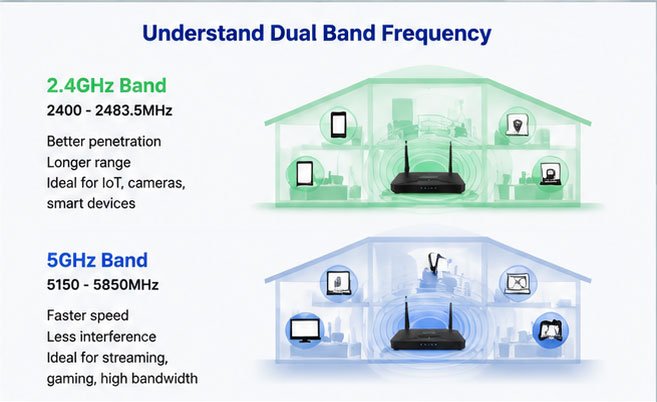
The most common connector types for consumer and commercial routers include:
| Connector Type | Thread Size | Pin Configuration | Common Router Brands |
|---|---|---|---|
| RP-SMA Male | Outer thread | Center socket | Netgear, Linksys, ASUS |
| SMA Male | Outer thread | Center pin | TP-Link, D-Link, Ubiquiti |
| SMA Female | Inner thread | Center socket | Industrial equipment |
| N-Type | Larger thread | Center pin/socket | Base stations, outdoor APs |
Before ordering, remove your existing antenna and examine the connector closely. Take a photo showing both the threading and center pin/socket configuration. If you're ordering for equipment evaluation or OEM integration, request connector samples from your antenna supplier — we typically provide 2-3 sample units to verify compatibility before bulk orders.
Gain Level Selection Based on Coverage Needs
Antenna gain measures directional focusing of radio energy, expressed in dBi (decibels relative to an isotropic radiator). Higher gain doesn't simply mean "better" — it redirects signal into flatter radiation patterns, extending horizontal range while reducing vertical coverage.
For standard home and office environments with 8-12 foot ceilings, 5-7dBi antennas provide optimal balanced coverage. These maintain reasonable vertical dispersion, ensuring devices on multiple floors receive adequate signal while extending horizontal reach to 200-250 feet in the 2.4GHz band.
High-gain antennas (8-12dBi) work best in specific scenarios:
- Single-floor warehouses or open offices requiring extended range
- Point-to-point links between buildings
- Outdoor deployments with minimal vertical coverage needs
- Rural properties where distance matters more than wall penetration
I generally advise against extremely high-gain antennas (over 9dBi) for multi-story residential or office buildings. The flattened radiation pattern creates dead zones directly above and below the router, leading to complaints about "worse coverage than before" from users on different floors.
VSWR and Impedance Matching
Voltage Standing Wave Ratio (VSWR) quantifies how efficiently your antenna transfers energy from the router's transmitter. A VSWR of 1.0:1 represents perfect matching (theoretically impossible), while higher ratios indicate reflected energy that wastes power and degrades performance.
For dual band router antennas, acceptable VSWR specifications include:
- Excellent: VSWR ≤ 1.5:1 across both bands
- Good: VSWR ≤ 2.0:1 across both bands
- Marginal: VSWR ≤ 3.0:1 (expect reduced performance)
- Unacceptable: VSWR > 3.0:1 (will likely cause connection issues)
When reviewing antenna datasheets, check that VSWR ratings specify measurements at both frequency bands separately. Some manufacturers list only the better-performing band. I always request full VSWR curves showing performance across 2400-2500MHz and 5150-5850MHz before approving antennas for customer projects.
Standard WiFi equipment operates at 50-ohm impedance. Your antenna must match this impedance to avoid signal reflection. All quality dual band antennas specify "50Ω impedance" in their specifications — if this detail is absent, consider it a warning sign about the manufacturer's technical competence.
Top 10 Best Dual Band WiFi Antennas for Routers in 2026?
With hundreds of antenna models flooding online marketplaces, how do you identify products with verified performance instead of inflated marketing claims? Many listings show identical product photos despite supposedly different specifications — a red flag indicating drop-shipped products with unknown origins.
The top 10 best dual band WiFi antennas for routers in 2026 share these verified characteristics: measured gain of 5-9dBi with documented test reports, genuine dual frequency optimization confirmed by VSWR curves below 2.0 at both 2.4GHz and 5GHz, durable construction using UV-resistant materials rated for 3-5 year operational life, proper RF connector quality with gold-plated contacts, and manufacturer support including technical documentation and compatibility verification. Look for suppliers offering sample testing before volume orders and those maintaining ISO9001 certification for consistent production quality.
Evaluation Criteria for Ranking
Rather than simply listing brand names, I'll share the evaluation framework we use when testing antennas for customer applications. This approach helps you assess any antenna regardless of whether it appears on a "top 10" list.
Performance Testing Requirements:
- Actual Gain Verification: Measured in anechoic chamber at both 2.4GHz and 5GHz, not theoretical calculations
- Bandwidth Coverage: Full frequency sweep showing consistent performance across WiFi channels
- Radiation Pattern: 360° horizontal coverage with appropriate vertical beamwidth for the application
- Power Handling: Minimum 10W continuous power capacity for modern routers
- Environmental Durability: Temperature range -40°C to +85°C for reliable year-round operation
Build Quality Indicators:
- RF connector manufactured with proper metallurgy (not plastic-threaded adapters)
- Cable assembly using low-loss coaxial materials (RG174, RG316, or better)
- Housing materials rated for UV exposure if any outdoor use is possible
- Stable mounting hardware that doesn't loosen from vibration
Manufacturer Credibility:
- Technical support team capable of discussing VSWR, radiation patterns, and impedance matching
- Willingness to provide test reports and certifications
- Sample program for evaluation before bulk purchasing
- Clear warranty terms and replacement procedures
Performance Tiers and Application Matching
Based on 17 years of antenna production and thousands of customer deployments, I categorize dual band router antennas into four performance tiers:
Tier 1: Basic Replacement Antennas (3-5dBi)
- Best for: Direct replacement of failed stock antennas, small apartments, short-range applications
- Range: 50-100 feet at 5GHz, 100-200 feet at 2.4GHz
- Typical price: $5-12 per antenna
- Example applications: Home routers in apartments, small retail spaces, temporary setups
Tier 2: Performance Upgrade Antennas (5-7dBi)
- Best for: Medium-sized homes/offices, balanced coverage with wall penetration
- Range: 75-150 feet at 5GHz, 150-250 feet at 2.4GHz
- Typical price: $12-25 per antenna
- Example applications: Two-story homes, small office buildings, multi-room coverage
Tier 3: High-Gain Extended Range (8-9dBi)
- Best for: Large single-floor spaces, outdoor point-to-point links, warehouses
- Range: 100-200 feet at 5GHz, 250-400 feet at 2.4GHz
- Typical price: $20-40 per antenna
- Example applications: Warehouse WiFi, outdoor coverage, building-to-building connections
Tier 4: Specialized High-Performance (10+ dBi)
- Best for: Long-distance point-to-point links, directional coverage in specific areas
- Range: 200+ feet at 5GHz, 400+ feet at 2.4GHz (directional)
- Typical price: $35-80 per antenna
- Example applications: Campus WiFi backhaul, marina/marina coverage, agricultural IoT networks
Key Specifications Comparison Table
When comparing specific antenna models, focus on these specifications rather than marketing descriptions:
| Specification | Entry-Level | Mid-Range | High-Performance | What to Look For |
|---|---|---|---|---|
| Gain (2.4GHz) | 3-5 dBi | 5-7 dBi | 8-12 dBi | Higher gain = longer range but narrower vertical coverage |
| Gain (5GHz) | 3-5 dBi | 5-7 dBi | 7-10 dBi | 5GHz typically 1-2dBi lower than 2.4GHz due to physics |
| VSWR | ≤ 2.5:1 | ≤ 2.0:1 | ≤ 1.8:1 | Lower is better; verify at BOTH frequency bands |
| Connector | RP-SMA Male | RP-SMA/SMA | Multiple options | Must match your router exactly |
| Cable Length | 0-6 inches | 6-12 inches | 1-3 feet | Longer cables add flexibility but slight signal loss |
| Build Material | ABS Plastic | PC/ABS blend | PC + Fiberglass | PC more durable; fiberglass for outdoor use |
| Power Rating | 5W | 10W | 20W+ | Must exceed your router's TX power |
| Operating Temp | 0°C to +70°C | -20°C to +80°C | -40°C to +85°C | Critical for outdoor or extreme environments |
Certification and Compliance Verification
Quality antennas carry specific certifications that verify performance and safety standards. When evaluating products, especially for commercial deployment or export, check for these compliance marks:
- FCC Certification (USA): Validates the antenna doesn't exceed emission limits
- CE Marking (Europe): Confirms compliance with EU safety and electromagnetic compatibility directives
- RoHS Compliance: Verifies absence of hazardous materials like lead and mercury
- ISO9001 Manufacturing: Indicates the supplier maintains quality management systems for consistent production
For B2B procurement, I always request copies of certification documents before placing orders over 100 units. Reputable manufacturers provide these immediately; evasive responses about certifications typically indicate uncertified products or inconsistent manufacturing processes.
Best High-Gain Dual Band WiFi Antennas for Long-Range Routers?
Long-range WiFi applications create unique challenges that standard antennas can't address. Whether you're connecting outbuildings on a rural property, providing WiFi across a warehouse, or linking point-of-sale systems in a large retail space, distance amplifies every antenna weakness.
The best high-gain dual band WiFi antennas for long-range routers deliver 8-12dBi gain with maintained dual-band performance, use omni-directional radiation patterns for 360° coverage (or directional patterns for specific point-to-point links), feature robust outdoor-rated construction with UV-resistant materials and weatherproof sealing, include quality coaxial cable assemblies using low-loss materials like RG58 or LMR-195, and provide documented VSWR performance showing consistent matching across full 2.4GHz and 5GHz bands. For ranges exceeding 300 feet at 2.4GHz, consider dedicated long-range directional antennas or mesh network architecture instead of relying solely on omnidirectional gain increases.
Understanding the Physics of High-Gain Antennas
Higher antenna gain doesn't magically create more signal — it redirects existing radio energy into flatter, more focused patterns. Think of it like a flashlight reflector: a focused beam reaches further than scattered light, but illuminates a narrower area.
For WiFi antennas, increased gain compresses the vertical radiation pattern while extending horizontal reach. A standard 2dBi antenna radiates in a nearly spherical pattern. A 9dBi high-gain antenna flattens this into a disc shape, perfect for covering single-floor spaces but creating dead zones above and below the router.
Practical Implications for Different Environments:
Single-Story Applications (warehouses, factories, large retail):
- 8-12dBi omni-directional antennas excel here
- Flat radiation pattern matches the coverage area geometry
- Devices operate within the antenna's strongest signal zone
Multi-Story Buildings (offices, apartments, homes):
- High-gain antennas create coverage gaps on other floors
- 5-7dBi antennas with more vertical dispersion work better
- Consider multiple access points instead of one high-gain antenna
Outdoor Point-to-Point Links (building connections, farm monitoring):
- Directional high-gain antennas (14