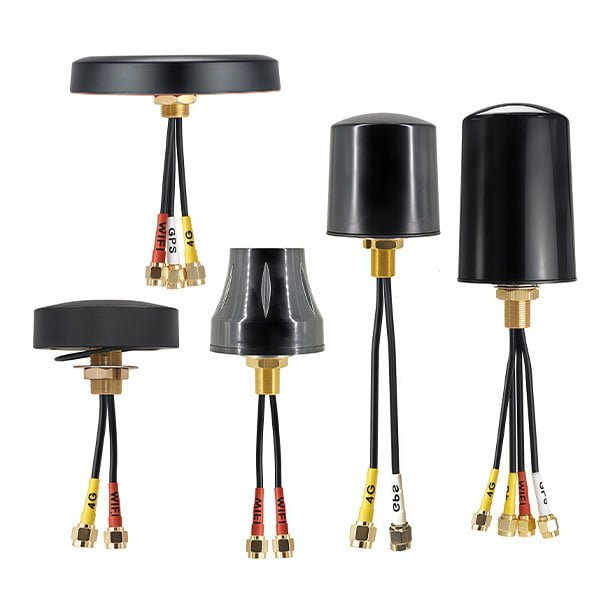
Wireless device manufacturers face a fundamental design choice that directly impacts product performance, cost, and user experience: whether to use an internal or external antenna. I've consulted with hundreds of OEMs over the past decade, and this decision consistently emerges as one of the most critical in the development process. The choice between internal and external antennas affects everything from signal reliability and manufacturing costs to regulatory compliance and customer satisfaction, making it essential to understand the trade-offs before finalizing your product design.
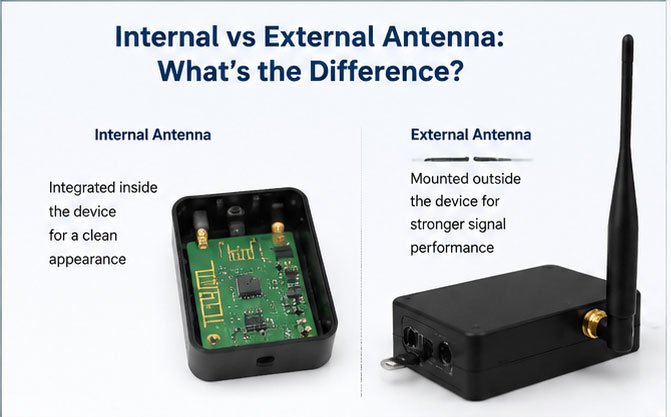
Internal antennas integrate directly inside the device housing, offering a clean aesthetic and protection from physical damage but facing potential signal degradation from enclosure materials. External antennas mount outside the device, providing superior signal radiation patterns and stronger communication performance while requiring additional installation space and impacting product appearance. The optimal choice depends on your specific application requirements, including performance targets, size constraints, operating environment, and whether your device will remain stationary or move frequently.
This comparison becomes particularly important as wireless technologies evolve and frequency bands multiply. A poor antenna decision made early in product development can necessitate expensive redesigns, delay market entry, or result in field performance issues that damage your brand reputation. Let's explore the critical differences between internal and external antennas so you can make an informed decision for your next wireless product.
Internal vs External Antenna: What's the Difference and Which Is Better?
You've probably noticed that some wireless devices have visible antennas protruding from the case while others appear completely smooth. This fundamental design difference reflects two distinct approaches to antenna integration, each with specific engineering trade-offs.
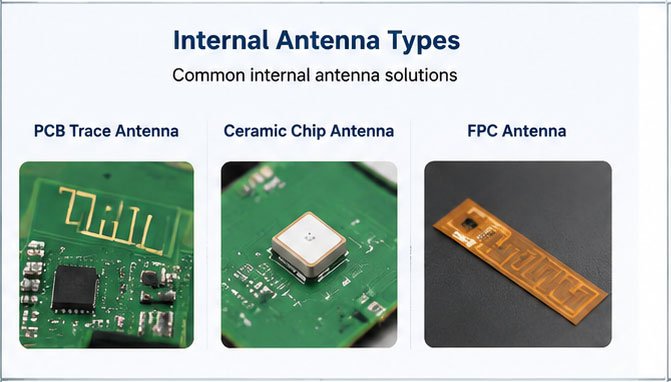
Internal antennas mount inside the device enclosure—typically as PCB traces, ceramic chips, or flexible FPC elements—keeping the exterior appearance clean. External antennas attach to the device housing through connectors, positioning the radiating element outside where it experiences minimal obstruction. Internal designs prioritize aesthetics and space efficiency, while external designs prioritize signal performance and flexibility.
The Fundamental Technical Difference
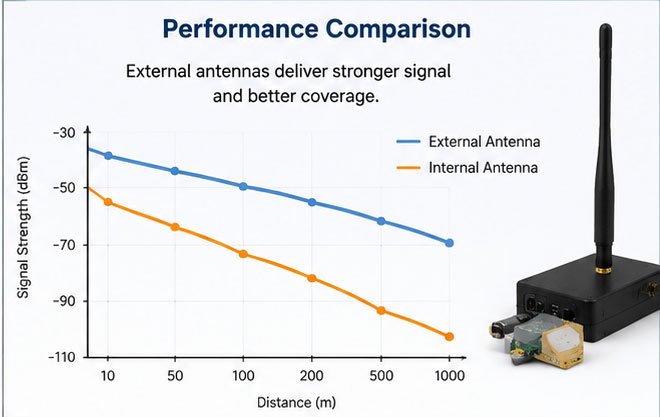
The primary distinction centers on the relationship between the antenna and the device housing. Internal antennas must radiate RF energy through the device enclosure, which inevitably causes signal attenuation—especially if the housing contains metal components, high-density plastics, or multiple layers. I've tested devices where the enclosure alone reduced signal strength by 3-8 dB compared to free-space measurements.
External antennas bypass this problem entirely. The radiating element sits outside the enclosure, giving it direct exposure to the environment. This positioning dramatically improves the antenna's radiation efficiency and pattern predictability. When I work with clients designing industrial IoT devices, this performance advantage often becomes the deciding factor for applications requiring reliable long-range communication.
Which Approach Is Better?
Neither design is universally superior—the answer depends entirely on your application priorities:
Internal antennas excel when:
- Aesthetic appearance is critical (consumer electronics, wearables)
- The device operates in controlled environments with good signal strength
- Physical durability matters (devices subject to impacts or catching hazards)
- Space constraints make external mounting impossible
- Regulatory requirements restrict visible antenna modifications
External antennas excel when:
- Maximum signal performance is non-negotiable
- The device operates in challenging RF environments (basements, metal buildings, remote areas)
- You need flexibility to optimize antenna placement after installation
- The application involves multiple frequency bands requiring specialized elements
- Field upgrades or antenna replacements may be necessary
From my experience working with communication equipment manufacturers, approximately 60% choose external antennas for industrial applications where reliability trumps aesthetics, while consumer device makers overwhelmingly favor internal designs for market appeal.
Real-World Performance Implications
The performance gap between internal and external antennas varies significantly based on implementation quality and device design. I've measured scenarios where a well-designed internal antenna in a plastic housing performed within 1-2 dB of an external antenna—acceptable for many applications. Conversely, I've seen internal antennas in metal-heavy devices suffer 10+ dB losses, making them nearly unusable without external antenna options.
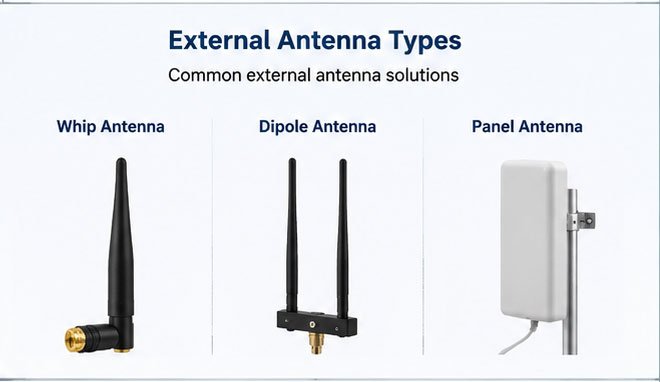
One industrial router client initially specified internal antennas to reduce manufacturing complexity. After field trials in metal warehouse environments revealed connection dropout rates of 30%, we switched to external dipole antennas with adjustable positioning. The dropout rate fell to under 2%, despite the additional $3 per unit cost and slightly more complex assembly process.
Internal Antenna vs External Antenna: A Complete Buying Guide
When evaluating antenna options for your wireless device, you need to consider multiple factors beyond simple performance metrics. I've developed a systematic evaluation framework to help procurement teams make informed decisions.
Start by defining your performance baseline requirements: minimum acceptable signal strength, maximum tolerable packet loss, operating range, and frequency bands. Then evaluate how internal versus external options meet these requirements while considering cost constraints, production volumes, installation complexity, and field service accessibility. The antenna that best balances all factors—not just RF performance—represents the optimal choice.
Critical Evaluation Factors
1. RF Performance Requirements
Establish your actual performance requirements through realistic testing, not theoretical calculations. I recommend creating a test matrix that includes:
- Minimum signal strength at maximum operating distance
- Required signal-to-noise ratio for your communication protocol
- Acceptable bit error rate or packet loss percentage
- Operating frequency bands and bandwidth requirements
- Environmental conditions (temperature, humidity, physical obstructions)
For most WiFi applications operating within 50 meters in open office environments, a quality internal antenna provides adequate performance. For cellular M2M applications requiring operation in basements or remote areas, external antennas typically become necessary.
2. Mechanical Integration Constraints
| Factor | Internal Antenna | External Antenna |
|---|---|---|
| PCB keep-out area | 15-40% of board space | Minimal (connector only) |
| Housing requirements | Non-metallic sections for antenna | Mounting boss and connector routing |
| Installation complexity | Automatic during assembly | Manual attachment step |
| Field replaceability | Not replaceable | User or technician serviceable |
Internal antennas demand careful PCB layout planning. You'll need to reserve specific board areas free from ground planes, power traces, and components that might detune the antenna. I've seen projects delayed by months because mechanical engineers didn't allocate sufficient antenna space during initial board design.
External antennas require mechanical mounting provisions—typically threaded bosses molded into the housing and cable routing channels. However, they offer significant flexibility: you can change antenna types during development without redesigning the PCB, and field technicians can replace damaged or obsolete antennas without opening the device.
3. Cost Analysis
Don't evaluate antenna cost in isolation. Consider the complete system cost:
Internal antenna system costs:
- Antenna component: $0.15-$2.50 per unit (depending on type)
- PCB area allocation: $0.05-$0.30 per unit (opportunity cost)
- Engineering time for integration and testing: $2,000-$8,000
- Potential housing modifications for optimal placement: $500-$3,000 in tooling
External antenna system costs:
- Antenna assembly: $1.50-$12.00 per unit (depending on performance level)
- Connector and cable assembly: $0.40-$1.80 per unit
- Housing modifications (mounting boss, routing): $300-$2,000 in tooling
- Assembly labor: $0.15-$0.45 per unit
- Packaging considerations: $0.05-$0.15 per unit
For high-volume consumer products (100k+ units annually), internal antennas typically offer lower total cost. For industrial products with production volumes under 10k units annually where performance is critical, external antennas often provide better value despite higher unit costs.
Supplier Evaluation Criteria
When sourcing antennas—whether internal or external—I recommend evaluating potential suppliers on these criteria:
Technical capabilities:
- Do they provide actual test data (S11 plots, radiation patterns) or just specification sheets?
- Can they customize frequency bands, cable lengths, or connectors?
- Do they offer design support for antenna integration?
- What testing equipment do they use for validation?
Manufacturing reliability:
- What quality management systems do they follow (ISO9001 minimum)?
- Can they provide sample performance data across multiple production batches?
- What's their typical lead time for samples and production orders?
- Do they support flexible MOQs for prototyping and testing?
I've worked with antenna suppliers who provided beautiful specification sheets but couldn't deliver consistent performance across production batches. Always request samples from at least three suppliers and conduct your own performance validation before committing to large orders.
Testing and Validation Approach
Regardless of which antenna type you choose, implement a rigorous validation process:
Lab testing phase:
- Measure return loss (S11) across full frequency range
- Test radiation patterns in anechoic chamber if possible
- Verify performance with your actual device housing and components
- Conduct thermal cycling to validate mechanical stability
Field testing phase:
- Test in actual installation environments (not just office environments)
- Measure real-world throughput, not just signal strength
- Evaluate performance at range extremes and through typical obstructions
- Document any performance variations across different installation scenarios
One cellular IoT client skipped comprehensive field testing and deployed 5,000 units with internal antennas. They discovered post-deployment that 30% of installations (primarily in metal buildings) experienced intermittent connectivity. The retrofit to external antennas cost over $85,000 in field service labor alone—far more than proper pre-deployment testing would have cost.
Internal or External Antenna? How to Choose the Right One
The selection process should follow a systematic methodology rather than relying on assumptions or imitating competitor products. I've developed a decision framework that accounts for both technical requirements and business constraints.
Begin by defining your application's non-negotiable requirements—the parameters where compromise isn't acceptable. These typically include minimum operating range, maximum acceptable connection dropout rate, and regulatory compliance needs. Then evaluate which antenna approach can meet these requirements while optimizing for your secondary priorities: cost, aesthetics, installation complexity, and field serviceability.
Application-Driven Decision Framework
For Stationary Indoor Devices (Routers, Access Points, Smart Home Hubs):
If the device operates in residential or office environments with strong signal availability, internal antennas often suffice for single-band applications (2.4 GHz WiFi, Bluetooth). However, I typically recommend external antennas for:
- Dual-band or tri-band routers where multiple antennas must coexist without interference
- Devices likely to be placed in cabinets or against walls
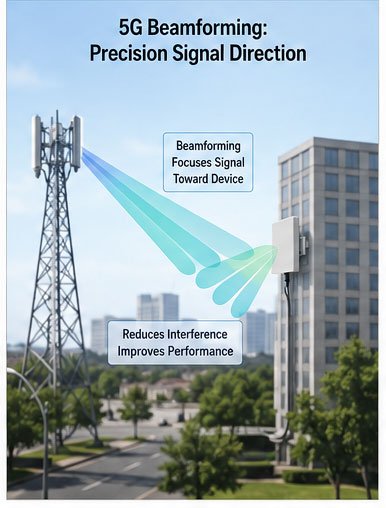
- Applications requiring beamforming or MIMO antenna arrays
- Scenarios where users might want to upgrade antenna performance later
For Mobile Devices (Handhelds, Wearables, Portable Instruments):
Internal antennas become almost mandatory due to form factor constraints and user safety concerns. Protruding antennas create catching hazards and durability issues. Focus on:
- Optimizing antenna placement in areas of the housing with minimal metal
- Using diversity antenna techniques to maintain performance during various holding positions
- Specifying high-quality antenna components despite higher costs
- Extensive testing with realistic hand-phantom models
For Vehicle-Mounted Devices (Fleet Tracking, Mobile Routers, Telematics):
External antennas strongly preferred due to the metal-rich RF environment inside vehicles. Mounting options include:
- Magnetic mount antennas for temporary installations
- Permanent roof or trunk-mount antennas for fleet vehicles
- Glass-mount antennas for minimal visual impact
- Combination antennas integrating multiple frequency bands
I've never seen an internal antenna perform acceptably in vehicle applications without significant compromises in reliability or range.
For Industrial and Remote Installations (SCADA, Agriculture, Remote Monitoring):
External antennas are typically non-negotiable. These applications demand:
- Maximum possible range and signal penetration
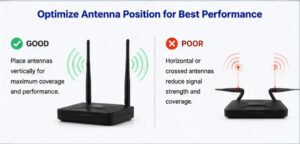
- Ability to position antennas for optimal orientation
- Weather resistance and durability
- Field replaceability without returning devices for service
One agricultural monitoring client initially specified internal antennas to save $4 per unit on 2,000 devices. Field deployment revealed that 40% of installations couldn't maintain reliable cellular connections, requiring a costly retrofit campaign that ultimately cost $28,000 in additional parts, labor, and customer support—a 350% increase over the original internal antenna cost savings.
Environmental Factor Assessment
Your operating environment dramatically influences antenna performance:
| Environment Type | Internal Antenna Viability | Key Considerations |
|---|---|---|
| Open office space | Excellent | Good signal availability, minimal obstructions |
| Dense urban area | Good to Fair | High signal availability but potential interference |
| Residential homes | Good | Variable construction materials affect performance |
| Industrial facilities | Poor | Metal structures, equipment interference |
| Vehicles | Very Poor | Faraday cage effect from metal body |
| Remote/rural areas | Poor to Fair | Limited signal availability requires maximum antenna efficiency |
| Underground/basements | Very Poor | Massive signal attenuation requires external antennas |
Budget Reality Check
Be honest about your cost constraints, but understand the total cost of ownership:
Scenario 1: Consumer product, 50,000 units/year, moderate performance requirements
- Internal antenna saves approximately $2.50 per unit = $125,000 annually
- Risk: 2-5% potential field issues due to performance limitations
- Recommendation: Internal antenna with extensive pre-deployment testing
Scenario 2: Industrial device, 3,000 units/year, mission-critical reliability
- External antenna costs additional $6.00 per unit = $18,000 annually
- Benefit: <1% field issues, minimal support costs, customer satisfaction
- Recommendation: External antenna despite higher unit cost
Scenario 3: IoT device, 20,000 units/year, diverse installation environments
- Hybrid approach: internal antenna standard, external antenna optional accessory
- Internal for 70% of installations, external for challenging 30%
- Optimizes cost while ensuring universal compatibility
The Upgrade Path Consideration
Consider your product's lifecycle and potential future needs:
Devices with internal antennas typically cannot be upgraded or improved after manufacturing. If RF performance proves inadequate in the field, your options are limited to:
- Firmware optimizations (limited impact)
- External retrofit kits (expensive and complex)
- Product recall or replacement (extremely costly)
Devices with external antenna connectors offer significant flexibility:
- Field antenna upgrades for specific challenging installations
- Support for future frequency bands through antenna replacement
- Easier troubleshooting of connectivity issues
- Extended product lifecycle through component upgrades
I worked with a building automation company that chose internal antennas for their first-generation controllers. When a major customer required deployment in older buildings with thick concrete walls, they had no upgrade path and lost a $200,000 contract. Their second-generation product included external antenna ports despite the additional cost—a decision that enabled them to win multiple large contracts requiring flexible antenna solutions.
Internal vs External Antennas: Pros, Cons, and Best Applications
Understanding the advantages and limitations of each approach helps align technical capabilities with application requirements. After seventeen years of antenna integration projects, I've compiled comprehensive lists of considerations for both options.
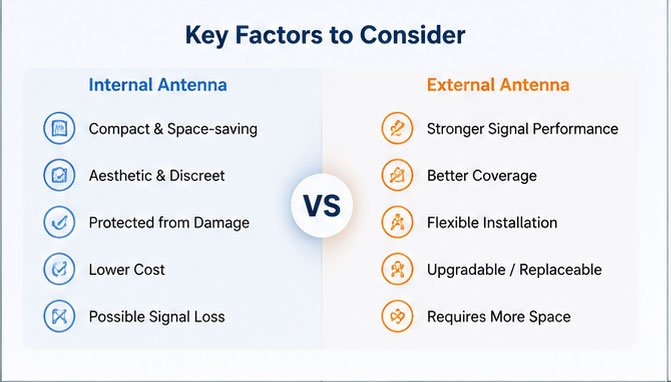
Internal antennas offer integrated aesthetics, physical protection, and simplified manufacturing at the cost of performance limitations and design complexity. External antennas deliver superior RF performance, installation flexibility, and field serviceability while requiring additional mechanical components and affecting product appearance. The optimal choice emerges from weighting these factors according to your specific application priorities.
Internal Antenna: Detailed Advantages
Aesthetic Integration The most obvious advantage: internal antennas create a clean, uncluttered product appearance. For consumer devices competing on store shelves, this matters significantly. I've seen marketing teams reject technically superior designs solely because external antennas made products look "less modern" or "too technical."
Physical Protection Internal antennas can't be broken off, snagged, or damaged through normal handling. This becomes critical for:
- Handheld devices subject to drops and impacts
- Wearables that might catch on clothing or objects
- Devices installed in high-traffic areas where protruding elements create hazards
- Products used by non-technical consumers who might mishandle external antennas
Simplified Logistics Products with internal antennas typically ship as single integrated units, simplifying:
- Packaging design and costs
- Shipping dimensional weight calculations
- Installation instructions (no antenna assembly steps)
- Inventory management (no separate antenna SKUs)
Reduced Assembly Complexity Internal antennas are typically soldered or placed during automated PCB assembly, eliminating:
- Manual antenna attachment steps
- Connector torque specifications and quality control
- Cable routing and management
- Potential assembly errors causing warranty claims
One consumer electronics client reduced their assembly line complexity by 15% by switching from external to internal antennas, though they accepted a 2 dB performance reduction as an acceptable trade-off