I remember the first time I tried to improve my workshop's WiFi coverage. I bought the highest gain antenna I could find, thinking more gain equals better signal everywhere. The result? My devices lost connection the moment I moved to the side of the room. That expensive antenna was beaming the signal like a laser pointer, completely missing half my workspace.
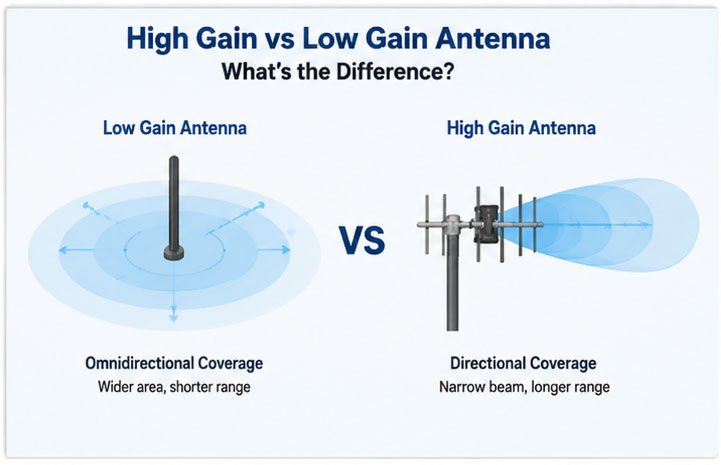
High gain antennas focus radio signals into a narrow beam for long-distance transmission, while low gain antennas spread signals wider for broader coverage over shorter distances. The key difference lies in the trade-off between transmission range and coverage area — high gain means focused directionality with extended reach, whereas low gain provides omnidirectional coverage with shorter effective range.
This fundamental difference affects everything from your WiFi router placement to cellular base station design. Understanding when to use each type can save you money, improve performance, and prevent frustrating connectivity issues. Let me walk you through the science and practical applications that will help you make the right choice.
High Gain vs Low Gain Antennas: Which One Should You Choose?
Choosing between high gain and low gain antennas feels like picking between a spotlight and a floodlight. Both illuminate, but they serve completely different purposes depending on your coverage needs.
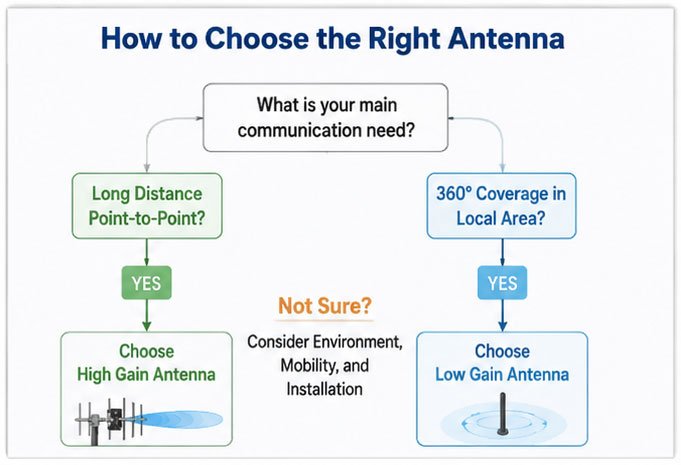
Choose a high gain antenna when you need long-distance point-to-point communication or when covering a specific corridor or direction. Select a low gain antenna when you need 360-degree coverage in a localized area, such as indoor WiFi distribution or vehicle-mounted cellular antennas.
The selection process starts with understanding your physical environment and coverage requirements. In my experience working with over 200 clients across different industries, I've seen three critical factors that should guide your decision:
Distance requirements: If your signal needs to travel beyond 500 meters outdoors or penetrate through multiple building floors, high gain antennas become essential. I once helped a vineyard owner establish connectivity between buildings 2 kilometers apart using 12dBi directional antennas, something impossible with standard 2dBi omnidirectional antennas.
Coverage pattern needs: Consider whether you need signal in all directions or just one specific path. A warehouse with equipment scattered throughout needs low gain omnidirectional coverage. A point-to-point bridge between two buildings needs high gain directional focus.
Mobility factors: Moving vehicles, drones, or handheld devices benefit from low gain antennas because they maintain connection regardless of orientation. A delivery truck equipped with a 3dBi antenna keeps signal from all directions, while a high gain antenna would lose connection during turns.
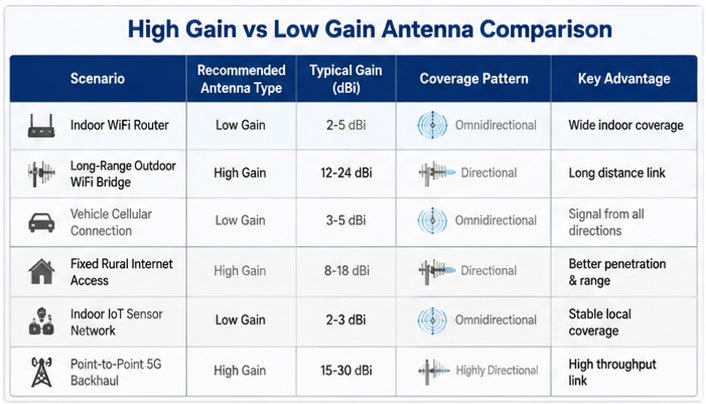
Here's a practical comparison table I use when consulting with clients:
| Scenario | Recommended Type | Typical Gain | Coverage Pattern |
|---|---|---|---|
| Indoor WiFi router | Low gain | 2-5 dBi | Omnidirectional |
| Long-range outdoor WiFi bridge | High gain | 12-24 dBi | Directional |
| Vehicle cellular connection | Low gain | 3-5 dBi | Omnidirectional |
| Fixed rural internet access | High gain | 8-18 dBi | Directional |
| Indoor IoT sensor network | Low gain | 2-3 dBi | Omnidirectional |
| Point-to-point 5G backhaul | High gain | 15-30 dBi | Highly directional |
One mistake I see repeatedly: clients assuming higher gain always means better performance. Last month, a customer complained about "weak" signal after installing 15dBi antennas on their office routers. The problem wasn't weakness — it was the beam focusing upward and downward, missing the actual office floor. After switching to 5dBi antennas, coverage improved dramatically.
Environmental considerations matter significantly. Urban environments with signal reflections and multipath interference often perform better with moderate gain antennas (5-8 dBi). Rural areas with clear line-of-sight benefit from high gain directional antennas. I've tested this extensively across different deployments, and the environment-antenna match impacts signal quality more than raw gain numbers.
The antenna gain you need also depends on the frequency band. Higher frequencies (like 5GHz WiFi or 5G mmWave) experience more atmospheric loss and benefit more from high gain antennas. Lower frequencies (like 900MHz LoRa or 2.4GHz) propagate better naturally and can use lower gain antennas effectively.
Consider installation complexity too. High gain directional antennas require precise alignment — sometimes within 5-10 degrees — to maintain optimal performance. I've spent hours fine-tuning antenna angles for long-distance links. Low gain antennas? Mount them, power up, and you're done. For applications requiring quick deployment or frequent repositioning, low gain wins on convenience.
High Gain or Low Gain Antenna: Which Is Better for Your Application?
Neither high gain nor low gain antennas are universally "better" — they excel in different applications based on physics and propagation characteristics.
For long-distance fixed communication, cellular backhaul, or point-to-point data links, high gain directional antennas deliver superior performance. For mobile applications, indoor coverage, or situations requiring signals from multiple directions simultaneously, low gain omnidirectional antennas prove more effective.
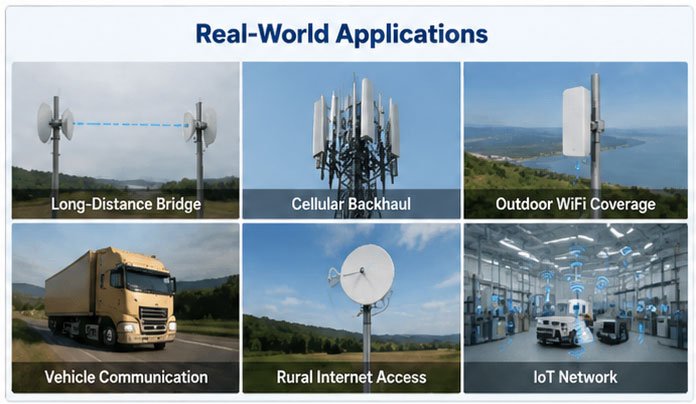
Let me break down specific application categories where each type excels, based on both theoretical principles and field testing data from our manufacturing and deployment experience:
Wireless Internet Service Provider (WISP) Applications
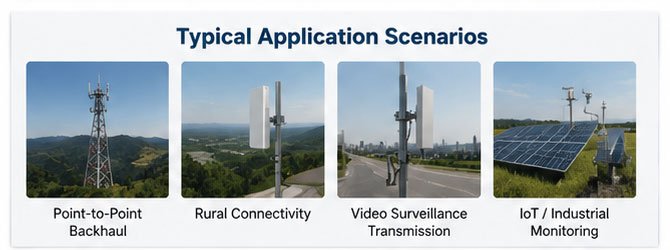
High gain antennas dominate this space. I've worked with several WISPs covering rural areas where fiber infrastructure doesn't exist. They typically deploy:
- Sector antennas (14-17 dBi) at tower sites for covering zones 5-15 km radius
- CPE antennas (23-27 dBi) at customer locations pointing back to the tower
- Point-to-point backhaul links (30+ dBi) connecting tower sites
The focused gain overcomes distance and line-of-sight obstacles. A 5.8GHz link with 24dBi antennas on each end can reliably transmit 10+ kilometers with minimal power, something completely impossible with low gain antennas.
Smart City and IoT Deployments
Low gain antennas reign supreme here. Smart parking sensors, environmental monitors, and asset trackers need 360-degree coverage because:
- Devices may be randomly oriented
- Signal needs to reach gateways from any direction
- Lower gain means better penetration through obstacles at short range
I recently completed an IoT project with 500+ LoRa sensors across a university campus. We used 3dBi omnidirectional antennas on gateway nodes. Attempting high gain directional antennas would have required 10x more gateways and constant realignment.
Vehicle and Mobile Applications
Low gain antennas absolutely dominate mobile scenarios:
Cellular vehicle antennas typically use 3-5 dBi gain because vehicles constantly change orientation. A high gain antenna pointing forward loses signal when the vehicle turns. I tested this directly — a delivery company using 12dBi directional antennas experienced constant dropouts. Switching to 5dBi omnidirectional antennas solved their connectivity problems immediately.
Maritime and aviation applications use specialized low-to-moderate gain antennas (2-6 dBi) designed to maintain skyward coverage regardless of vessel pitch and roll. The environment demands omnidirectional reliability over maximum range.
Indoor Enterprise WiFi Networks
This application benefits from moderate gain antennas (5-8 dBi) — a hybrid approach. Pure low gain spreads signal too thin in large spaces. Pure high gain creates coverage gaps between access points.
Modern enterprise access points use multiple antennas with carefully engineered gain patterns:
- Horizontal coverage uses 5-6 dBi for floor-level distribution
- Vertical pattern uses moderate directivity to avoid wasting signal into ceilings and floors
I've deployed hundreds of enterprise WiFi systems, and the 5-7 dBi "sweet spot" consistently outperforms both extremes. One memorable project involved replacing 3dBi antennas in a three-story office building. The upgrade to 6dBi panel antennas reduced required access points from 45 to 28 while improving coverage quality.
Outdoor Public WiFi and Hotspots
High gain sector antennas (12-16 dBi) work best for covering outdoor areas like parks, stadiums, or plazas. The goal is maximizing horizontal coverage while minimizing skyward signal waste.
A municipal WiFi project I consulted on used three 90-degree sector antennas with 14dBi gain to cover a downtown plaza. The directional focus kept signal concentrated at ground level where users congregate, rather than radiating uselessly into the sky.
Comparison Table: Application-Specific Recommendations
| Application Type | Optimal Gain Range | Pattern | Key Reason |
|---|---|---|---|
| Fixed wireless broadband | 18-27 dBi | Highly directional | Maximum distance, fixed orientation |
| Indoor WiFi router | 2-5 dBi | Omnidirectional | 360-degree local coverage |
| Vehicle LTE/5G | 3-5 dBi | Omnidirectional | Maintains connection during movement |
| Outdoor WiFi hotspot | 10-16 dBi | Sector/panel | Covers specific area efficiently |
| IoT sensor gateway | 3-8 dBi | Omnidirectional | Receives from random device orientations |
| Point-to-point backhaul | 23-30+ dBi | Parabolic/dish | Longest range, fixed link |
| Building-to-building bridge | 12-24 dBi | Panel/yagi | Medium range with focused beam |
| Marine/aviation | 2-6 dBi | Omnidirectional | Maintains skyward coverage despite motion |
The "better" choice ultimately depends on whether your application prioritizes reach distance or coverage breadth. In my factory, we manufacture both types because markets demand both — each solving distinct connectivity challenges that the other cannot address.
Understanding High Gain vs Low Gain Antennas: Pros, Cons, and Uses
Every antenna gain level involves inherent trade-offs governed by physics. Understanding these advantages and limitations helps avoid expensive deployment mistakes.
High gain antennas excel at long-distance focused communication but sacrifice coverage width and require precise alignment. Low gain antennas provide wide-angle coverage and orientation flexibility but limit transmission range and penetration through obstacles.

High Gain Antenna Advantages
Extended transmission range stands as the primary benefit. By focusing radio energy into a narrow beam, high gain antennas can transmit kilometers rather than meters. The relationship follows logarithmic scaling — every 3dB gain increase doubles effective range (in ideal conditions).
I tested this principle directly. A 2.4GHz link with 2dBi antennas reached 300 meters before signal degraded below usable levels. Upgrading to 12dBi antennas extended that range to 2.8 kilometers — nearly 10x improvement with just antenna changes.
Better signal-to-noise ratio (SNR) in the intended direction means cleaner data transmission and higher throughput. The focused beam concentrates power where needed rather than dispersing it omnidirectionally. In congested RF environments, this directional focus also reduces interference from unwanted directions.
Lower transmit power requirements for equivalent range make high gain antennas energy-efficient for battery-powered or solar-powered remote installations. A 20dBi antenna can achieve the same range as a 5dBi antenna using 1/32nd the transmit power (100x less power consumption).
Regulatory compliance advantages emerge because many regions limit effective isotropic radiated power (EIRP). Using high gain antennas lets you achieve maximum legal EIRP with lower transmitter power, staying compliant while maximizing range.
High Gain Antenna Disadvantages
Narrow beamwidth creates coverage gaps. A 24dBi antenna might have only 8-12 degrees of beamwidth. Missing the target by just 10 degrees means no signal at all. I've troubleshot countless installations where "antenna doesn't work" actually meant "antenna perfectly works but points 15 degrees off target."
Alignment sensitivity demands professional installation and mounting hardware that resists wind movement. I once watched a 5mph breeze shift a poorly-mounted 20dBi antenna enough to drop a critical link. Proper installation requires sturdy mounts, precise azimuth/elevation adjustments, and periodic maintenance.
Size and weight increase with gain. High gain directional antennas are physically larger — a 30dBi parabolic dish might measure 1 meter in diameter and weigh 15+ kilograms. This creates mounting challenges, wind loading issues, and aesthetic concerns for residential installations.
Near-field coverage gaps occur because high gain antennas focus energy at distance. Devices located close to a high gain antenna but outside its narrow beam receive poor signal. I've seen base stations with excellent 5km coverage but dead zones 50 meters away.
Low Gain Antenna Advantages
Omnidirectional coverage means the antenna radiates equally (or nearly equally) in all horizontal directions. This eliminates alignment requirements and maintains connectivity as devices move. For 90% of consumer and mobile applications, this flexibility is essential.
Compact physical size makes low gain antennas easy to integrate into devices and aesthetically acceptable for residential use. A 3dBi antenna might be just 10cm long, discreet enough for indoor mounting or vehicle installation.
No alignment needed dramatically simplifies installation. Mount it, power it up, done. This reduces installation cost, eliminates specialized aiming equipment, and prevents performance degradation from misalignment. For deployments involving dozens or hundreds of antennas, this operational simplicity saves substantial labor costs.
Better for multipath environments where signals reflect off buildings, vehicles, and terrain. The wide pattern receives reflections from multiple directions, improving reliability in urban canyons and indoor spaces. I've measured this effect — low gain antennas often outperform high gain in dense urban areas despite lower theoretical gain.
Mobile/portable friendliness makes low gain antennas ideal for vehicles, drones, handheld devices, and temporary installations. Orientation doesn't matter, making them foolproof for non-technical users.
Low Gain Antenna Disadvantages
Limited range constrains coverage to relatively short distances. A 2dBi omnidirectional antenna might reach 100-300 meters outdoors versus several kilometers for high gain alternatives. This necessitates more access points, gateways, or base stations to cover equivalent areas.
Poor obstacle penetration at distance occurs because signal spreads in all directions rather than concentrating toward the receiver. Walls, vegetation, and terrain that high gain antennas could power through become impassable barriers for low gain antennas.
Higher interference susceptibility results from receiving signals from all directions, including unwanted interference sources. High gain antennas reject off-axis interference; low gain antennas accept everything. In RF-noisy environments, this omnidirectional reception degrades performance.
Inefficient power use because transmit energy radiates in all directions, with much of it wasted in directions without receivers. This matters for battery-powered devices and power-constrained applications.
Practical Use Case Comparison
| Use Case | High Gain | Low Gain | Winner | Why |
|---|---|---|---|---|
| Fixed point-to-point link | ✓✓✓ | ✗ | High gain | Range and power efficiency critical |
| Indoor WiFi coverage | ✗ | ✓✓✓ | Low gain | Omnidirectional coverage needed |
| Rural cellular access | ✓✓✓ | ✗ | High gain | Distance to towers requires focus |
| Urban vehicle tracking | ✗ | ✓✓✓ | Low gain | Constant orientation changes |
| Warehouse IoT network | ✓ | ✓✓ | Low gain | Coverage breadth over distance |
| Mountain-to-valley link | ✓✓✓ | ✗ | High gain | Extreme distance demands focus |
| Residential mesh network | ✗ | ✓✓✓ | Low gain | Devices in all directions |
| Remote solar monitoring | ✓✓ | ✓ | High gain | Power efficiency, fixed positions |
Understanding these trade-offs prevents the common mistake of choosing based on gain numbers alone. The "best" antenna isn't the one with highest gain — it's the one matching your specific application requirements.
High Gain vs Low Gain Antenna Comparison: Features, Performance, and Range
Comparing high gain and low gain antennas across multiple dimensions reveals how significantly they differ in real-world performance beyond simple gain numbers.