Many people think higher antenna gain always means better performance. They assume more gain equals stronger signals and longer range. But this idea can lead to poor choices and wasted money.
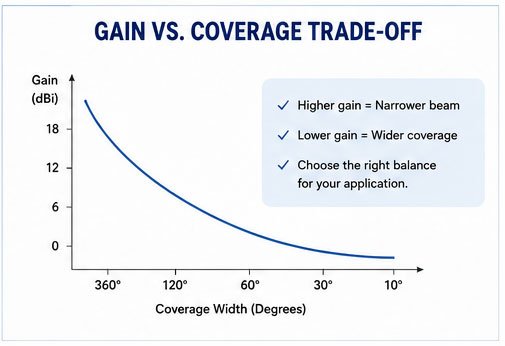
Higher antenna gain is not always better. The right gain matters more than maximum gain. A high-gain antenna offers focused power in one direction, but it sacrifices coverage width. For fixed point-to-point links, high gain works well. For mobile devices or multi-point coverage, medium or low gain antennas with wider beams perform better.
I have worked with antenna systems for over 17 years. I have seen many customers choose the wrong antenna simply because they focused on gain numbers alone. Understanding what gain really means will help you make smarter decisions.
Does a Higher Gain Antenna Always Perform Better?
No, a higher gain antenna does not always perform better. Performance depends on your specific use case. Gain is not a magic number that solves all signal problems.
A higher gain antenna performs better only when your application matches its radiation pattern. High-gain antennas focus energy in a narrow beam, which works well for long-distance point-to-point communication. However, they perform poorly when you need wide coverage or work with moving devices.
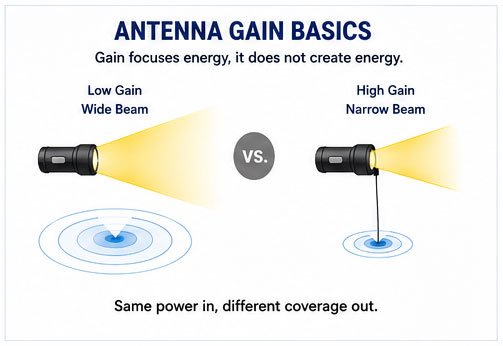
Antenna gain describes how much an antenna concentrates radio energy in a specific direction compared to a reference antenna. A higher gain antenna does not create more power. It simply focuses the available power into a tighter beam. Think of it like a flashlight. A narrow beam flashlight appears brighter in one spot, but it lights up a smaller area. A wide beam flashlight spreads light over a larger area, but each spot receives less intensity.
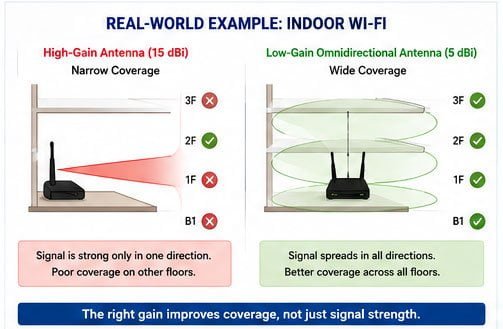
When you use a high-gain antenna in the wrong scenario, you lose coverage. I once worked with a customer who installed a 15 dBi high-gain antenna on a router inside a building. He wanted better WiFi coverage throughout the office. The result was terrible. The high-gain antenna focused the signal in a narrow horizontal plane. Rooms above and below the router had almost no signal. We replaced it with a 5 dBi omnidirectional antenna, and coverage improved across all floors.
Here is a simple comparison:
| Antenna Type | Gain Range | Beam Width | Best Use Case |
|---|---|---|---|
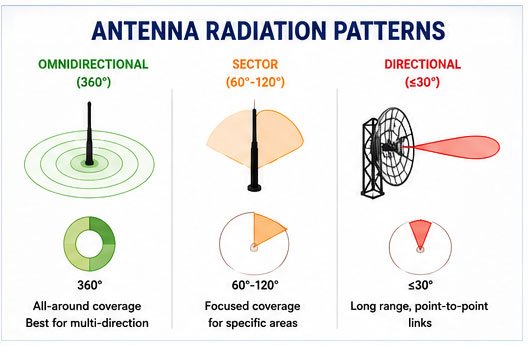
| Low Gain (2-5 dBi) | Low | Wide (360° or 120°+) | Indoor coverage, mobile devices, close-range multi-point |
| Medium Gain (6-9 dBi) | Medium | Moderate (60-90°) | Outdoor access points, medium-range coverage |
| High Gain (10+ dBi) | High | Narrow (30° or less) | Long-range point-to-point, fixed directional links |
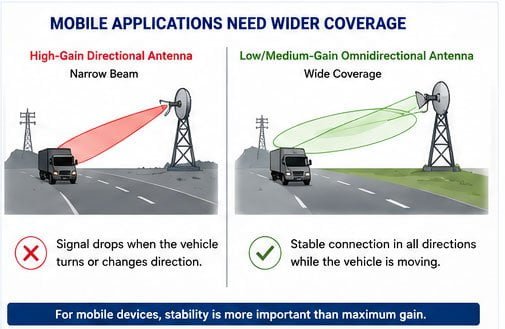
High gain antennas also require precise alignment. If the beam does not point directly at the target, the signal drops sharply. This makes them unsuitable for moving vehicles or handheld devices. A delivery truck with a high-gain antenna would lose connection every time it turned a corner. A medium-gain omnidirectional antenna keeps the connection stable as the vehicle moves.
Is More Antenna Gain Always the Right Choice?
No, more gain is not always the right choice. The right choice depends on your environment, distance, and device mobility. Choosing the highest gain antenna often leads to worse real-world performance.
More antenna gain is the right choice only for fixed long-distance links with clear line of sight. For applications involving movement, obstacles, or multi-device coverage, lower or medium gain antennas work better. The correct gain balances range, coverage width, and practical deployment conditions.
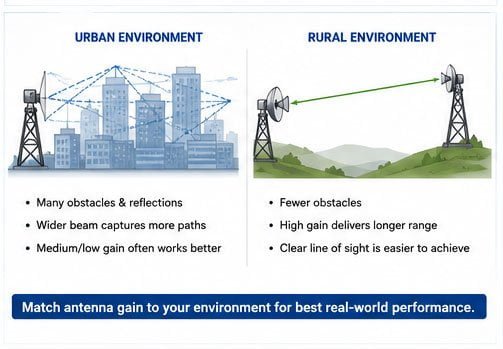
Gain is not a standalone metric. You must consider beamwidth, polarization, and the physical environment. In urban areas with buildings and obstacles, signals reflect and scatter. A high-gain narrow beam may miss reflected paths that a wider beam would capture. This reduces reliability.
I learned this lesson early in my career. A client needed coverage for an industrial site with metal structures. We initially proposed a high-gain directional antenna to reach the far end of the site. The antenna reached the far end, but many areas in between had dead zones. The narrow beam could not bend around obstacles. We switched to several medium-gain antennas positioned strategically. This provided better overall coverage with fewer dead spots.
Another factor is device type. Mobile devices like smartphones, tablets, and vehicle-mounted equipment move constantly. Their orientation changes. A high-gain antenna works only when aligned correctly. A medium-gain omnidirectional antenna maintains a stable connection regardless of device orientation. This is why most mobile routers and IoT devices use omnidirectional antennas with moderate gain.
Cable loss also matters. High-gain antennas are often installed far from the transmitter or receiver. Long cable runs introduce signal loss. If cable loss exceeds the gain advantage, you gain nothing. Sometimes, placing a lower-gain antenna closer to the device with a shorter cable performs better than a high-gain antenna far away with a long cable.
Here is a decision guide:
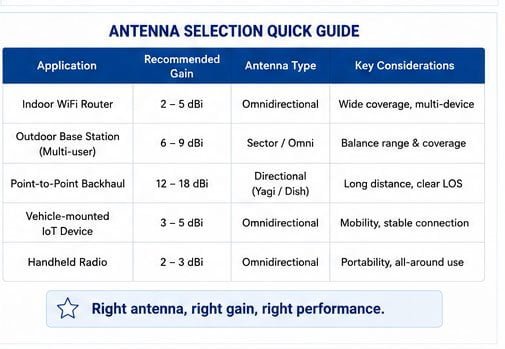
| Application Type | Recommended Gain | Antenna Type |
|---|---|---|
| Indoor WiFi router | 2-5 dBi | Omnidirectional |
| Outdoor cellular base station (multi-user) | 6-9 dBi | Sector or omnidirectional |
| Point-to-point wireless backhaul | 12-18 dBi | Directional (Yagi or dish) |
| Vehicle-mounted IoT device | 3-5 dBi | Omnidirectional |
| Handheld radio | 2-3 dBi | Omnidirectional |
Does Higher Antenna Gain Mean Better Signal?
No, higher antenna gain does not automatically mean better signal quality. Gain affects signal direction and focus, not the total transmitted power or the ability to overcome interference.
Higher antenna gain means stronger signal in the antenna's main lobe direction, but weaker or no signal outside that direction. If your receiver is not aligned with the main lobe, you may receive a weaker signal than with a lower-gain omnidirectional antenna. Gain redistributes energy, it does not create energy.
Signal quality depends on multiple factors: transmitted power, cable loss, antenna efficiency, receiver sensitivity, and environmental noise. Gain is just one piece of the puzzle. A high-gain antenna cannot fix a noisy environment. It cannot overcome severe multipath fading. It cannot replace proper transmitter power.
I have tested many antennas over the years. One test involved comparing a 12 dBi directional antenna with a 5 dBi omnidirectional antenna for a 4G LTE router. The 12 dBi antenna showed better signal strength when the router was stationary and perfectly aligned with the cell tower. But when we moved the router just 10 degrees off-axis, the signal dropped below the level of the 5 dBi antenna. The 5 dBi antenna maintained consistent signal across a wide range of angles.
Another misconception is that high gain improves signal-to-noise ratio (SNR) equally in all directions. High gain antennas reduce side lobe and back lobe radiation. This can reduce interference from unwanted directions. However, it also reduces the antenna's ability to pick up weak signals from those directions. In a multi-path environment, some useful signal energy arrives from reflected paths at odd angles. A high-gain antenna may reject these paths, while a medium-gain antenna captures them, improving overall SNR.
Antenna gain also does not change the transmitter's legal power limit. In many countries, regulations limit the effective radiated power (ERP) or equivalent isotropically radiated power (EIRP). EIRP equals transmitter power minus cable loss plus antenna gain. If you use a higher gain antenna, you may need to reduce transmitter power to stay within legal limits. This can actually reduce range in some scenarios.
Here is a practical comparison:
| Scenario | 5 dBi Omni | 12 dBi Directional |
|---|---|---|
| Signal strength (aligned) | Good | Excellent |
| Signal strength (10° off-axis) | Good | Poor |
| Coverage area | Wide | Narrow |
| Multipath handling | Better | Worse |
| Installation complexity | Low | High |
Can a High-Gain Antenna Improve Wireless Performance?
Yes, a high-gain antenna can improve wireless performance, but only under specific conditions. It is not a universal solution for all wireless problems.
A high-gain antenna improves performance when you need to extend range in a specific direction with a clear line of sight. It works well for fixed point-to-point links, rural areas with distant towers, and directional applications. For indoor use, multi-point coverage, or mobile scenarios, a high-gain antenna often reduces performance.
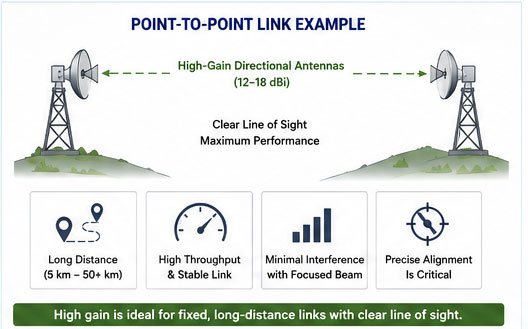
Performance improvement depends on matching the antenna's characteristics to your specific needs. If your application requires long-range communication to a single fixed point, a high-gain directional antenna will improve performance significantly. The focused beam delivers more energy to the target and improves signal quality.
I worked with a customer who needed to connect two buildings 5 kilometers apart. They had no budget for fiber optic cable. We installed 18 dBi parabolic dish antennas on both ends. The link worked perfectly with high throughput and low latency. The high gain antennas made this connection possible. No lower gain antenna could have achieved the same result.
However, high-gain antennas can also reduce performance. If your base station serves multiple users in different locations, a high-gain antenna limits coverage. You might reach users at the edge of your range, but you lose users in other directions. A medium-gain sector antenna or omnidirectional antenna serves more users simultaneously, which improves overall network performance.
Environmental factors also matter. In dense urban environments, buildings block and reflect signals. A high-gain antenna with a narrow beam may not capture reflected signals that provide alternative paths. A wider beam antenna captures more multipath components, which diversity receivers can combine to improve signal quality.
Another consideration is device mobility. If your devices move, a high-gain antenna cannot track them. The connection drops as the device moves out of the narrow beam. A lower-gain omnidirectional antenna maintains connection regardless of device movement.
Here is a summary table:
| Use Case | High Gain Improves Performance? | Reason |
|---|---|---|
| Rural fixed wireless | Yes | Clear line of sight, long range needed |
| Urban mobile hotspot | No | Movement and obstacles require wide coverage |
| Indoor office WiFi | No | Walls and floors need omnidirectional coverage |
| Wireless backhaul link | Yes | Fixed point-to-point, line of sight |
| Vehicle-mounted LTE | No | Constant movement requires omnidirectional pattern |
| LoRa gateway (rural) | Yes | Long range to many fixed sensors |
Is a High-Gain Antenna Best for Every Application?
No, a high-gain antenna is not best for every application. Different applications need different antenna characteristics. Gain is just one parameter, and it must match your specific requirements.
A high-gain antenna is best for long-distance point-to-point communication with fixed endpoints and clear line of sight. It is not suitable for indoor coverage, mobile devices, multi-user access points, or environments with obstacles. The best antenna balances gain, beamwidth, size, and cost for your specific application.
Each application has unique requirements. Indoor WiFi needs wide coverage in all directions, including vertically through floors. A low-gain omnidirectional antenna works best. A high-gain antenna would create dead zones and require multiple units to cover the same space, increasing cost and complexity.
Mobile applications require antennas that work regardless of device orientation. A high-gain directional antenna fails this requirement. Even a vehicle-mounted directional antenna loses connection when the vehicle turns. We use low to medium gain omnidirectional antennas for vehicles, handhelds, and portable equipment.
Base stations and access points serving multiple users need sector antennas with moderate gain. These antennas provide a balance between range and coverage angle. A typical cellular sector antenna has 15-17 dBi gain with a 65-degree horizontal beamwidth. This covers a sector of the cell while providing good range. Using a higher gain antenna would narrow the beamwidth too much, requiring more sectors and more equipment.
I once had a customer who wanted to use high-gain antennas for a LoRa sensor network covering a farm. The farm had sensors scattered across fields at various distances and directions. A single high-gain directional antenna could not cover all sensors. We installed a medium-gain omnidirectional antenna at the gateway instead. This provided 360-degree coverage and reached all sensors reliably. The lower gain was enough because LoRa's long range capability compensated for the reduced antenna gain.
Physical constraints also affect antenna choice. High-gain antennas are usually larger. A 15 dBi WiFi antenna might be 50 cm long. A 3 dBi antenna might be 10 cm long. For compact devices like routers, laptops, or IoT sensors, physical size limits antenna gain. We cannot simply install the highest gain antenna without considering size and weight.
Cost is another factor. High-gain antennas cost more to manufacture. They require precision construction and materials. For consumer products, a medium or low-gain antenna that meets performance requirements while keeping costs low is better than an expensive high-gain antenna that provides no practical advantage.
Here is an application guide:
| Application | Typical Gain | Antenna Type | Key Requirements |
|---|---|---|---|
| WiFi router (home) | 2-5 dBi | Omnidirectional | Wide coverage, low cost |
| 4G LTE base station | 15-17 dBi | Sector | Balance range and coverage width |
| Satellite communication | 20-30 dBi | Parabolic dish | Maximum gain, narrow beam |
| GPS receiver | 3-5 dBi | Patch or helix | Overhead coverage, circular polarization |
| Walkie-talkie | 2-3 dBi | Whip | Compact, omnidirectional |
Does More Gain Always Lead to Longer Range?
No, more gain does not always lead to longer range. Range depends on many factors, and gain alone cannot guarantee increased range.
More gain increases range only when the antenna's beam points directly at the target and line of sight exists. If the antenna is misaligned, blocked by obstacles, or used in a multipath environment, higher gain may actually reduce effective range. Additionally, legal power limits, cable losses, and receiver sensitivity also determine range.
Range calculations include transmitter power, antenna gain, cable losses, receiver sensitivity, and path loss. Path loss increases with distance and frequency. It also increases dramatically when obstacles block the signal. A high-gain antenna cannot overcome severe obstruction losses.
The link budget equation shows this clearly:
Received Power (dBm) = Transmitted Power (dBm) + Transmitter Antenna Gain (dBi) - Cable Loss (dB) - Path Loss (dB) + Receiver Antenna Gain (dBi)
If path loss is very high due to obstacles, even a high-gain antenna may not close the link. Sometimes, moving the antenna to a better location provides more range improvement than adding gain.
Alignment errors reduce the benefit of high gain antennas. A 15 dBi antenna might have a 3 dB beamwidth of only 30 degrees. If you misalign the antenna by 15 degrees, you lose several dB of effective gain. This can reduce range below what a properly aligned 9 dBi antenna would achieve.
I have seen this problem many times. A customer installs a high-gain Yagi antenna for a 4G router but does not aim it carefully. The antenna points 20 degrees away from the cell tower. The signal is weaker than with the original omnidirectional antenna that came with the router. After I helped them aim the antenna correctly, the signal improved significantly and range increased.
Multipath interference also affects range. In urban areas, signals bounce off buildings and arrive at the receiver from multiple directions at different times. This causes signal cancellation and fading. A high-gain narrow beam antenna may capture only the direct path while rejecting reflected paths. A medium-gain antenna with a wider beam captures multiple paths. The receiver can combine these paths using diversity or MIMO techniques, improving signal quality and effective range.
Environmental noise and interference limit range as well. A high-gain antenna increases signal level, but it also picks up more noise and interference from the direction it points. If the signal-to-noise ratio does not improve, range does not improve. Sometimes, a lower gain antenna with better noise rejection characteristics performs better.
Legal limits on radiated power also restrict range gains. In most countries, you cannot simply increase transmitter power to compensate for losses. EIRP limits restrict the product of transmitter power and antenna gain. If you double antenna gain, you may need to halve transmitter power, resulting in no range improvement.
Here is a comparison table:
| Factor | Low Gain Omni | High Gain Directional |
|---|