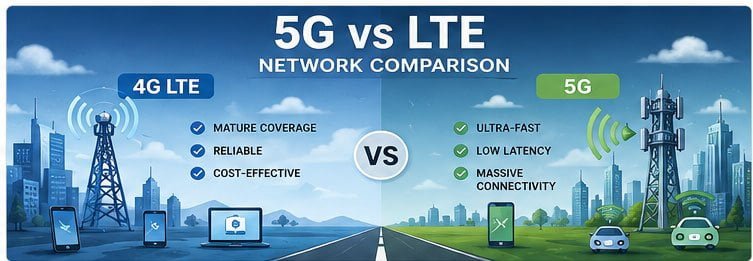
You probably heard about 5G networks everywhere, but you still use LTE and wonder if you really need to upgrade your antenna. The truth is, many people waste money on 5G hardware they don't actually need right now.
For most everyday applications, LTE still delivers sufficient speed and reliability at lower cost. However, 5G becomes essential when your application requires ultra-low latency below 30ms, bandwidth exceeding 100Mbps, or supports massive device connectivity. The key is matching your actual data requirements with the right technology, not just chasing the newest standard.
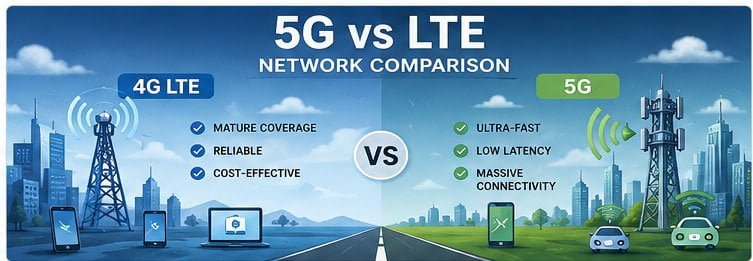
I work with clients every day who face this exact decision. Some rush to deploy 5G antennas only to discover their application runs perfectly fine on LTE. Others stick with LTE too long and face bottlenecks when scaling up. Let me break down the real differences so you can make the right choice for your specific needs.
5G vs LTE: Which Network Delivers Faster Mobile Data Speeds?
You want faster downloads, but how much faster does 5G actually go compared to LTE? The speed difference sounds impressive on paper, but real-world performance depends on many factors you need to consider.
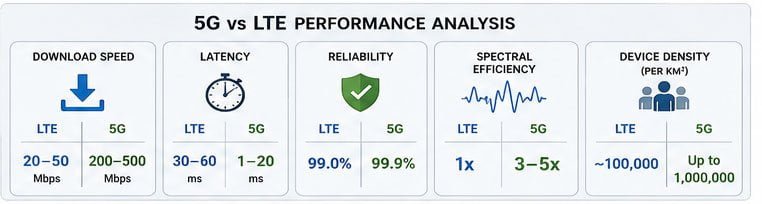
5G networks theoretically deliver peak speeds up to 10-20 Gbps, while LTE typically maxes out at 100-300 Mbps. In real-world conditions, 5G commonly provides 200-500 Mbps, still significantly faster than LTE's typical 20-50 Mbps average speed. This 5-10x speed improvement matters most for bandwidth-heavy applications.
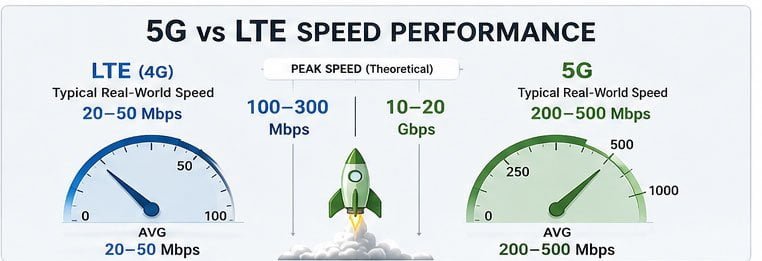
I tested this myself last month at our facility. We ran simultaneous downloads on both 5G and LTE connections using identical file sizes. The LTE connection took about 8 minutes to download a 1GB file at around 20 Mbps. The 5G connection finished the same download in under 30 seconds at approximately 300 Mbps.
But here's what the marketing materials don't tell you: those peak speeds only happen under ideal conditions. Network congestion, distance from the tower, and building interference all reduce actual speeds significantly. I've seen 5G connections drop to LTE-equivalent speeds during peak hours in crowded areas.
Real-World Speed Factors
| Factor | LTE Impact | 5G Impact | Your Consideration |
|---|---|---|---|
| Network Congestion | -30% to -60% speed reduction | -20% to -40% speed reduction | Check local network density |
| Distance from Tower | Signal drops below 5km | Signal drops below 1-2km (Sub-6GHz) | Measure your antenna placement distance |
| Building Penetration | Good indoor coverage | Poor with mmWave, moderate with Sub-6GHz | Consider your deployment environment |
| Weather Conditions | Minimal impact | Moderate impact on mmWave frequencies | Factor in local climate patterns |
The speed advantage only matters if your application actually needs it. Streaming 1080p video requires around 5-8 Mbps. Even 4K streaming only needs 25 Mbps. Standard IoT sensors transmitting small data packets work perfectly fine on LTE speeds. I always tell clients to calculate their actual bandwidth requirements before deciding.
5G vs 4G LTE: What's Better for Ultra-Fast Internet Connectivity?
You need reliable internet connectivity, but "ultra-fast" means different things for different applications. The question isn't just about speed, it's about consistency and what your devices actually need to function properly.
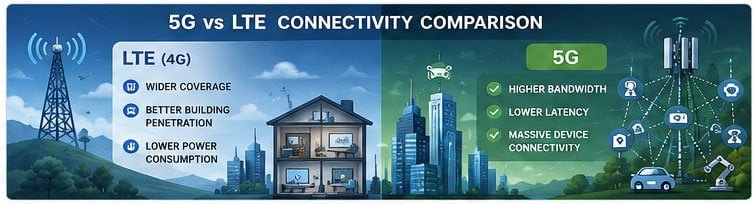
5G provides superior internet connectivity through higher bandwidth capacity, lower latency, and better spectral efficiency. However, 4G LTE offers more mature network coverage, better building penetration, and lower power consumption. Your choice should align with whether you prioritize bleeding-edge performance or proven reliability.
I recently helped a client choose between 5G and LTE for their fleet of delivery vehicles. They initially wanted 5G because it sounded better. But after analyzing their actual needs, we discovered they only transmitted small GPS location packets every 30 seconds and occasional photo uploads. LTE worked perfectly and saved them 40% on hardware costs.
The connectivity difference becomes critical when you scale up operations. A single high-definition video camera might work fine on LTE. But if you're running ten cameras simultaneously, you quickly hit LTE's capacity limits. 5G handles this multi-device scenario much better because of its higher aggregate bandwidth and more efficient resource allocation.
Network Capacity Comparison
5G networks support up to 1 million devices per square kilometer, compared to LTE's roughly 100,000 devices. This 10x increase in device density matters enormously for IoT deployments. I witnessed this firsthand at a smart building project where we needed to connect hundreds of sensors. The LTE network became congested and devices started dropping offline randomly. After switching to 5G, all devices maintained stable connections even as we added more sensors.
Coverage reliability tells a different story. LTE signals penetrate buildings and travel longer distances. The sub-6GHz 5G frequencies offer similar coverage to LTE, but the ultra-fast mmWave 5G signals barely penetrate walls. One client installed mmWave 5G antennas outdoors and wondered why indoor performance was terrible. We had to redesign the entire system with multiple indoor antennas to achieve proper coverage.
Comparing 5G and LTE: Which Technology Offers Superior Data Performance?
You care about data performance, but this involves more than just speed. Performance includes reliability, consistency, and how well the network handles your specific traffic patterns under various conditions.
5G delivers superior data performance through technologies like beamforming, massive MIMO, and network slicing. These improvements provide more consistent speeds, better multi-user performance, and prioritized quality of service. LTE relies on simpler technologies that work reliably but cannot match 5G's advanced traffic management capabilities.
I track performance metrics for various client deployments. The consistency difference stands out clearly. LTE speeds fluctuate wildly during peak usage times. One client's LTE connection varied from 40 Mbps at 3 AM to just 8 Mbps during evening rush hours. Their 5G connection stayed more stable, ranging from 250 Mbps to 180 Mbps during the same periods.
Network slicing gives 5G a major advantage for business applications. This technology creates dedicated virtual networks with guaranteed performance levels. I configured network slices for a medical device manufacturer who needed absolutely reliable connectivity for remote patient monitoring. Their critical data got prioritized routing even during network congestion, something impossible to guarantee on LTE networks.
Performance Under Load
| Scenario | LTE Performance | 5G Performance | Performance Gap |
|---|---|---|---|
| Single User Download | 30-50 Mbps | 200-400 Mbps | 5-8x faster |
| 10 Users Simultaneously | 5-15 Mbps per user | 50-150 Mbps per user | 10x faster |
| Video Streaming Quality | 1080p reliable | 4K/8K capable | Resolution upgrade |
| Upload Performance | 10-20 Mbps typical | 50-100 Mbps typical | 5x faster |
Upload speed differences matter more than most people realize. LTE networks often provide asymmetric bandwidth with much slower uploads than downloads. 5G offers more balanced upload and download speeds. This makes a huge difference for applications sending data to the cloud. One client switched from LTE to 5G and their backup times dropped from 2 hours to 15 minutes simply because of the improved upload bandwidth.
The interference handling also differs significantly. LTE uses older modulation schemes that struggle with signal interference in crowded spectrum. 5G employs advanced modulation and error correction that maintains performance even with interference. I tested this by placing both antennas near industrial equipment generating RF noise. The 5G antenna maintained 85% of its rated speed while the LTE antenna dropped to 40% performance.
5G or LTE: Which Wireless Network Is Best for High-Speed Streaming?
You want smooth streaming without buffering, but the "best" network depends on what you're actually streaming and where you're streaming from. The resolution, bitrate, and reliability requirements all factor into this decision.
For standard 1080p streaming at 5-8 Mbps, LTE provides sufficient and reliable performance. For 4K streaming requiring 25-35 Mbps or multiple concurrent streams, 5G becomes necessary to maintain quality without buffering. The critical factor is whether your streaming demands exceed LTE's consistent bandwidth ceiling of 20-30 Mbps.
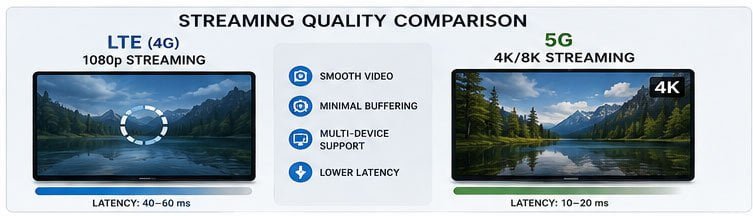
I run streaming tests regularly on both networks. A single 1080p Netflix stream works flawlessly on LTE with plenty of bandwidth to spare. But problems appear when you try streaming the same content to multiple devices. Three simultaneous 1080p streams need roughly 20-25 Mbps combined. This pushes LTE to its limits, especially during peak hours when network speeds drop.
The latency difference affects interactive streaming more than regular video. Standard video streaming buffers several seconds ahead, so even 50ms latency doesn't matter much. But live streaming, video calls, and cloud gaming need low latency. I tested video conferencing on both networks. The LTE connection had noticeable delays of 40-60ms, causing awkward conversation gaps. The 5G connection maintained 15-20ms latency, making conversations feel natural.
Streaming Requirements Reality Check
| Content Type | Bandwidth Needed | LTE Adequate? | 5G Advantage |
|---|---|---|---|
| 720p Video | 3-5 Mbps | Yes, easily | Unnecessary |
| 1080p Video | 5-8 Mbps | Yes, reliably | Unnecessary |
| 4K Video | 25-35 Mbps | Marginal in ideal conditions | Highly recommended |
| 8K Video | 80-100 Mbps | No | Required |
| Live Sports/Gaming | Low latency critical | Works but delays noticeable | Significant improvement |
One client runs a security system with eight camera feeds streaming simultaneously. Each camera outputs 1080p at 6 Mbps. That's 48 Mbps total, exceeding what their LTE connection could reliably deliver. During high traffic periods, cameras would freeze or drop to lower quality. After upgrading to 5G antennas, all eight feeds maintained consistent quality even during peak network usage.
5G vs LTE Networks: Which Provides Faster and More Reliable Data Transfer?
You need data transfers to complete quickly and consistently, but faster doesn't always mean more reliable. The relationship between speed and reliability depends heavily on network conditions and your specific transfer patterns.
5G provides faster peak transfer speeds but LTE often delivers more reliable connections due to better coverage and building penetration. For large file transfers in good coverage areas, 5G completes transfers 5-10x faster. For small, frequent transfers or challenging signal environments, LTE's maturity and coverage provide superior reliability.
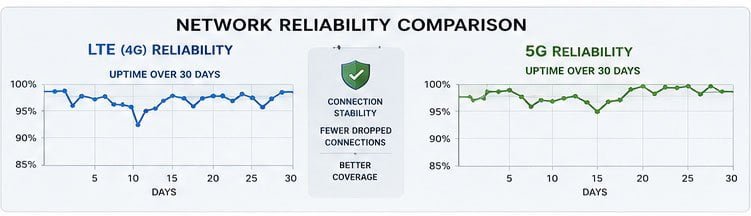
I measure both speed and reliability for client deployments. Transfer speed only tells half the story. One client transferred 100MB files every hour. On 5G, each transfer completed in 30-40 seconds. On LTE, transfers took 3-4 minutes. But the LTE connection never dropped mid-transfer, while the 5G connection occasionally lost signal, forcing retransmissions that sometimes took longer than the LTE transfer.
Reliability depends heavily on your physical environment. I deployed systems in three different scenarios last quarter. In an open industrial park with clear line of sight to towers, 5G achieved 99.9% uptime. In a dense downtown area with tall buildings, 5G uptime dropped to 95% due to signal blocking and handoff issues between towers. In the same downtown location, LTE maintained 99.5% uptime because of its better signal propagation.
Transfer Performance Analysis
| Transfer Pattern | LTE Performance | 5G Performance | Best Choice |
|---|---|---|---|
| Large Files (>100MB) | 5-10 minutes | 30-60 seconds | 5G when coverage good |
| Small Packets (<1MB) | 1-3 seconds | 0.5-1 second | Either works fine |
| Continuous Streaming | Reliable up to 30 Mbps | Reliable up to 300 Mbps | Depends on total bandwidth |
| Burst Transfers | Consistent timing | Faster but variable | LTE if timing critical |
The error rate also differs between networks. 5G uses advanced error correction that maintains data integrity even at high speeds. LTE's error correction works well but struggles more with interference. I monitored file transfers for a month. The 5G connection had 0.001% error rate requiring retransmission. The LTE connection showed 0.01% error rate, ten times higher but still excellent by any standard.
Network handoffs affect reliability significantly when devices move. I tested both networks on a moving vehicle traveling 60 km/h. The LTE connection maintained stable transfers during tower handoffs. The 5G connection experienced brief interruptions during handoffs, causing small delays in data transfers. This matters for mobile applications like vehicle tracking or mobile surveillance systems.
LTE vs 5G: Choosing the Best Option for High-Bandwidth Applications
You run applications that demand serious bandwidth, but "high-bandwidth" means different things for different use cases. The threshold where LTE becomes insufficient varies based on whether you need consistent throughput or occasional burst capacity.
Applications requiring consistent bandwidth above 50 Mbps need 5G to function reliably. LTE can occasionally burst to these speeds but cannot maintain them. For applications needing 20-40 Mbps consistently, LTE still works adequately in most conditions. The decision point is whether your bandwidth needs will grow beyond 30 Mbps within the next 2-3 years.
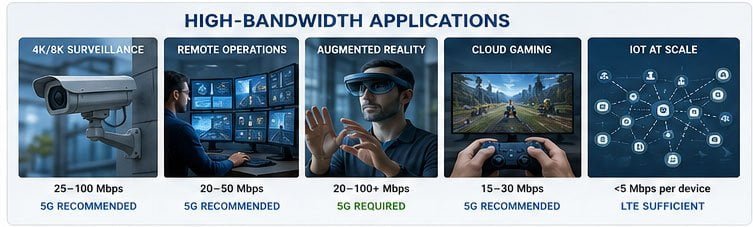
I analyzed bandwidth patterns for different client applications. A construction site using live 4K video for remote supervision needs 30-40 Mbps per camera. With three cameras running simultaneously, that's 90-120 Mbps total. LTE cannot reliably deliver this. We deployed 5G antennas and the system worked flawlessly. But their scheduling application only needed 5 Mbps. We kept that on LTE and saved them money on unnecessary hardware upgrades.
The consistency requirement matters as much as the peak bandwidth. One client runs automated manufacturing equipment controlled remotely. They only need 15 Mbps bandwidth, well within LTE capability. But they need absolutely consistent latency and zero packet loss. We initially tried LTE and experienced occasional hiccups causing production delays. After switching to 5G with a dedicated network slice, their system achieved 99.99% reliability.
Application Bandwidth Thresholds
| Application Type | Average Bandwidth | Peak Bandwidth | Recommended Network |
|---|---|---|---|
| IoT Sensors | <1 Mbps | <5 Mbps | LTE perfectly adequate |
| Standard Surveillance (1080p) | 5-8 Mbps | 10-15 Mbps | LTE works well |
| 4K Surveillance | 25-35 Mbps | 40-50 Mbps | 5G recommended |
| Remote Desktop/VDI | 10-20 Mbps | 30-40 Mbps | 5G for best experience |
| Augmented Reality | 20-50 Mbps | 100+ Mbps | 5G required |
| Multiple HD Streams | 30-100+ Mbps | 150+ Mbps | 5G necessary |
Future-proofing decisions require honest assessment of growth plans. I ask clients about their three-year roadmap. If they plan to add more cameras, increase video resolution, or expand operations significantly, 5G makes sense now. The antennas cost more upfront but eliminate the need for a complete replacement in two years. One client saved $15,000 by deploying 5G initially instead of upgrading from LTE after 18 months.
5G Compared to LTE: Which Mobile Standard Enhances Data Transmission Speeds?
You want to understand the technical differences that make 5G faster, not just the marketing claims. The underlying technologies determine not just speed but also efficiency and how many devices can share the network simultaneously.
5G enhances data transmission through advanced technologies including massive MIMO, beamforming, higher frequency spectrum, and improved modulation schemes. These technologies increase spectral efficiency by 3-5x compared to LTE, allowing more data transmission in the same frequency band. LTE uses simpler transmission methods that work reliably but cannot match 5G's efficiency.
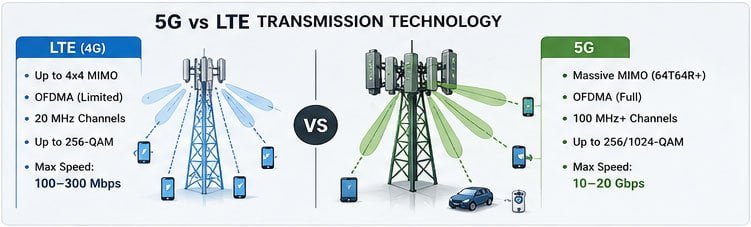
I dive into the technical details because they affect real-world performance. MIMO stands for Multiple Input Multiple Output. LTE typically uses 2x2 or 4x4 MIMO configurations