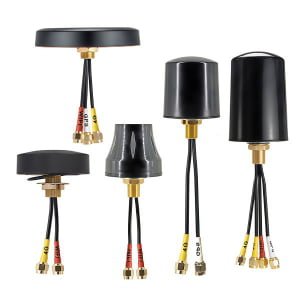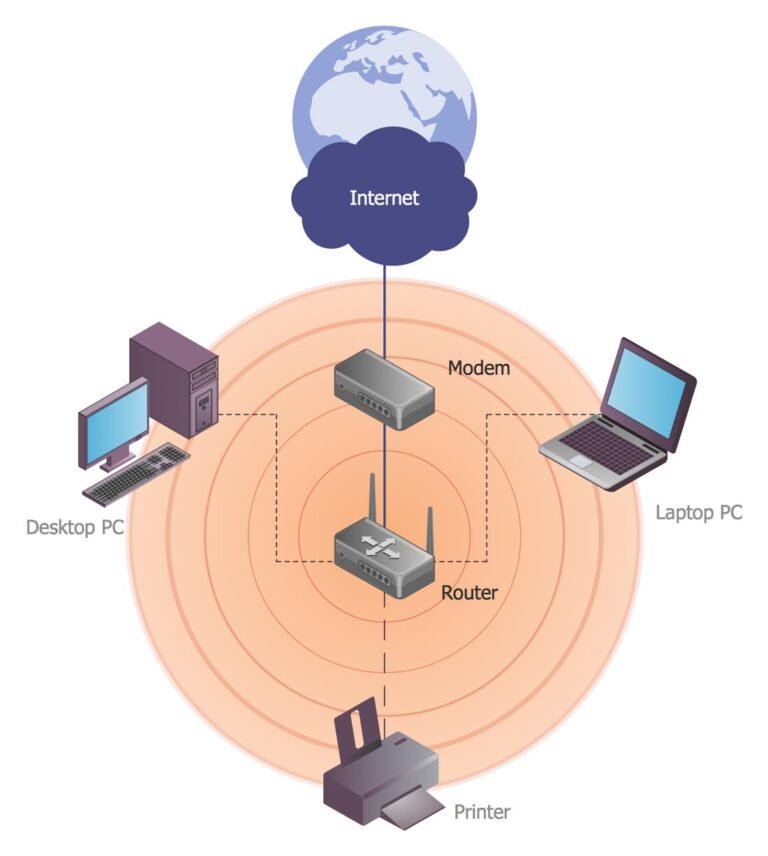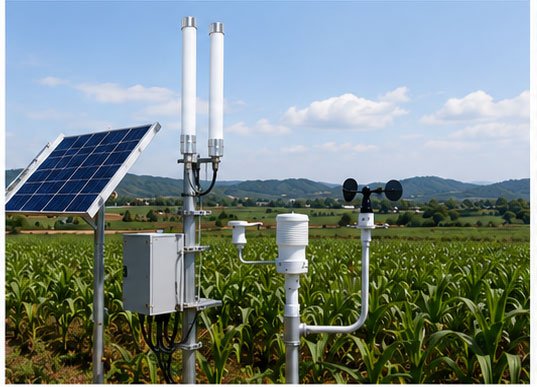
You need a GPS antenna for your device, but you are confused about which type to pick. Active and passive GPS antennas look similar, but they perform very differently in real situations.
Active GPS antennas have a built-in amplifier that boosts weak signals, making them ideal for areas with obstructions or long cable runs. Passive GPS antennas have no amplifier and work best in open areas with strong signals and short cable connections.
I have worked with hundreds of customers over the past 17 years. Many of them struggled with GPS signal issues until they understood these two types. Let me walk you through everything you need to know.
Active vs Passive GPS Antenna: What's the Difference?
The main difference lies in one critical component. Active antennas have something that passive antennas do not.
Active GPS antennas contain a Low Noise Amplifier (LNA) that amplifies the received GPS signal by several times. Passive GPS antennas have no amplifier and rely only on the antenna element itself to capture signals.
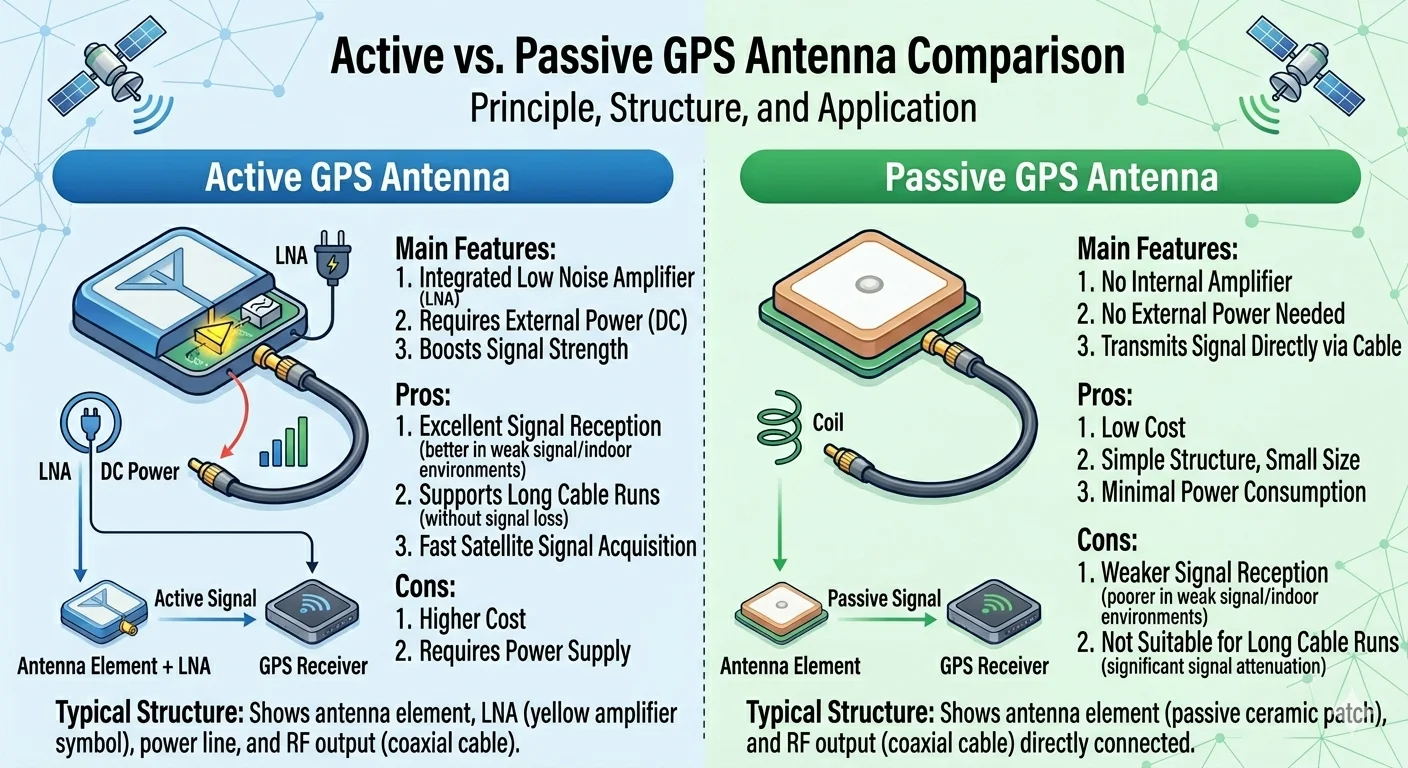
The LNA makes a huge difference in real-world performance. When GPS satellites send signals to earth, these signals become very weak by the time they reach your antenna. An active antenna takes this weak signal and makes it stronger before sending it through the cable to your GPS receiver.
I remember a customer who ran a logistics company with hundreds of heavy trucks. His fleet often drove through mountainous areas where signals got blocked by terrain. He used regular suction cup antennas at first. These antennas had poor vibration resistance and broke easily on bumpy roads. His trucks experienced position drift and incorrect mileage calculations. This affected his billing and fuel monitoring systems.
After he found us online, our technical team analyzed his situation. We recommended strong magnetic GPS antennas with shock-absorbing rubber bases and built-in low noise amplifiers. We also used IP67 waterproof connectors. He installed them on the truck roofs. After three months of testing on rough roads, not a single antenna had internal damage or connection problems. His positioning error dropped from ±15 meters to ±2.5 meters. The system now accurately recorded every kilometer. False fuel reports decreased by 12%, saving him about 300,000 yuan per year in fuel costs.
This example shows how active antennas perform in challenging conditions. But passive antennas also have their place.
How Active GPS Antennas Work
Active antennas need power to operate. The LNA inside requires a DC voltage, usually 3V to 5V. This power comes through the same coaxial cable that carries the GPS signal. We call this "bias voltage" or "antenna power."
The antenna element captures the GPS signal from satellites. The LNA immediately amplifies this signal. The amplified signal then travels through the cable to your GPS receiver. Because the signal is stronger, it can travel through longer cables without losing quality.
The LNA also filters out noise. GPS signals are very weak compared to other radio frequencies around us. The amplifier helps separate the GPS signal from interference.
How Passive GPS Antennas Work
Passive antennas have a simpler design. They contain only the antenna element and the connector. When GPS signals hit the antenna element, they create a small electrical current. This current travels directly through the cable to your receiver.
Because there is no amplification, the signal stays weak. Long cables cause signal loss. If your cable is too long, the receiver may not detect the signal at all.
Passive antennas do not need power. They work as soon as you connect them. This makes them easier to install in some situations.
Active vs Passive GPS Antennas: Performance and Design Comparison
Performance differences become clear when you compare specific parameters. I have tested both types in many situations.
Active antennas typically provide 25-30dB of gain, while passive antennas offer only 2-5dB. Active antennas work effectively with cable lengths up to 10 meters, whereas passive antennas perform best with cables under 3 meters.
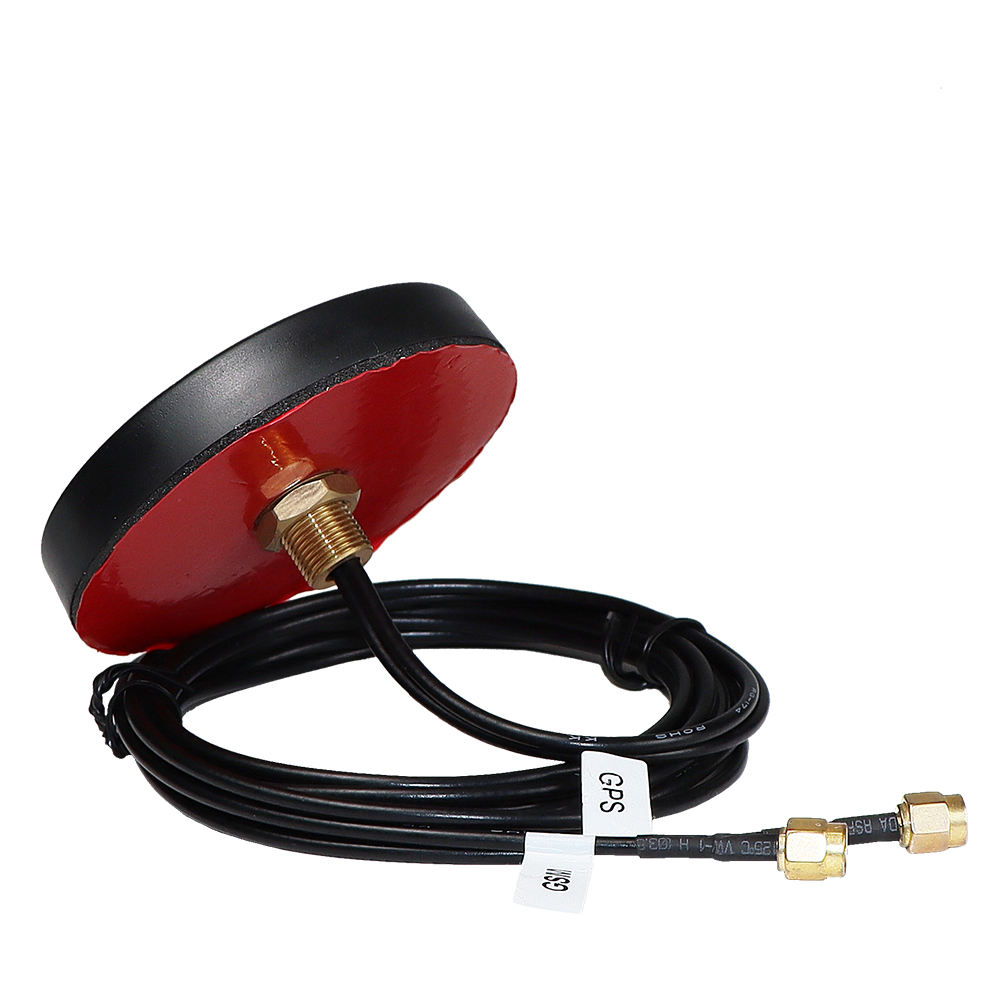
Let me break down the key performance factors:
| Parameter | Active GPS Antenna | Passive GPS Antenna |
|---|---|---|
| Signal Gain | 25-30dB | 2-5dB |
| Noise Figure | 1.5dB typical | N/A |
| Maximum Cable Length | Up to 10m or more | Under 3m recommended |
| Power Requirement | 3-5V DC | None |
| Signal Strength | Strong, amplified | Weak, unamplified |
| Indoor Performance | Good | Poor |
| Obstructed Area Performance | Good | Poor |
| Open Sky Performance | Excellent | Good |
| Price Range | Higher | Lower |
Signal Strength Analysis
Active antennas deliver stronger signals in all conditions. I tested this with a customer who installed GPS trackers in shipping containers. Metal containers block GPS signals heavily. Passive antennas failed to get any position fix inside the containers. Active antennas with external mounting provided stable positioning data.
The amplification does not create signal where none exists. It makes weak signals usable. If you are in a basement with zero GPS signal, even an active antenna cannot help. But if you have a weak signal that a passive antenna cannot use, an active antenna can make it work.
Cable Length Impact
Cable length affects both types differently. Every meter of cable causes signal loss. We measure this loss in decibels per meter.
For passive antennas, a 5-meter cable might lose 3-4dB of signal. If your passive antenna only captures 3dB of signal to start with, you will have almost nothing left at the receiver end.
Active antennas amplify the signal before it enters the cable. A 5-meter cable still causes loss, but you start with 28dB instead of 3dB. You still have plenty of signal at the receiver end.
I always tell customers to keep passive antenna cables as short as possible. If you need a long cable run, you must use an active antenna.
Power Consumption Considerations
Active antennas draw power constantly. The LNA typically uses 10-20mA at 3-5V. This equals about 50-100mW of power.
For battery-powered devices, this matters. If you run a GPS tracker on a small battery, the active antenna will drain it faster. Some customers use sleep modes to reduce power consumption. The GPS system wakes up periodically to get a position fix, then goes back to sleep.
Passive antennas draw zero power. For solar-powered or battery-powered applications in remote areas, this advantage becomes significant.
Active vs Passive GPS Antennas: Which One Should You Choose?
The right choice depends on your specific situation. I help customers make this decision every week.
Choose an active GPS antenna if you have long cable runs, signal obstructions, indoor installations, or need maximum reliability. Choose a passive GPS antenna if you have short cables, clear sky view, outdoor mounting, or need to minimize power consumption.
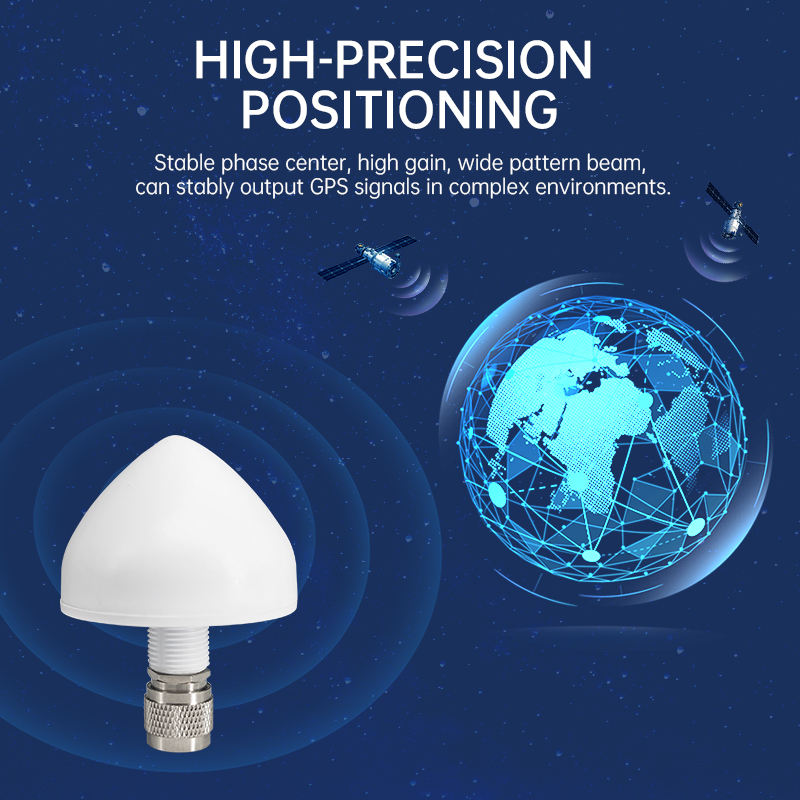
Let me explain the decision factors in detail:
When to Choose Active GPS Antennas
Active antennas solve problems that passive antennas cannot handle. Use them in these situations:
Cable Length Requirements: If your GPS receiver sits more than 3 meters from the antenna mounting location, you need an active antenna. I have customers running 8-meter cables in buses and RVs. Passive antennas would fail completely in these installations.
Signal Obstruction: Buildings, metal structures, trees, and mountains block GPS signals. Active antennas can pick up weaker signals that bounce off nearby surfaces. One customer installed GPS systems in underground parking garages. Only active antennas could maintain a position fix near the entrance ramps.
Indoor Applications: GPS signals lose 20-30dB when passing through building materials. Active antennas compensate for this loss. If you must install a GPS receiver indoors with an external antenna, choose an active type.
Vehicle Integration: Modern vehicles have metal bodies that block signals. When you install a GPS receiver inside the dashboard, you need an external active antenna on the roof. The amplification overcomes the signal loss through the vehicle body and cable routing.
Reliability Requirements: If GPS positioning is critical for your application, active antennas provide a safety margin. They maintain signal lock in conditions where passive antennas would lose connection.
When to Choose Passive GPS Antennas
Passive antennas work well in the right conditions. They offer advantages that active antennas cannot match:
Power-Sensitive Applications: Battery-powered GPS trackers in remote areas benefit from passive antennas. Every milliwatt of power saved extends battery life. If you deploy sensors in wildlife tracking or environmental monitoring, passive antennas make sense.
Short Cable Installations: If your GPS receiver sits right next to the antenna, a passive antenna works perfectly. Handheld GPS devices and compact IoT sensors often use passive antennas.
Open Sky Mounting: Rooftop installations with clear views of the sky receive strong GPS signals. Passive antennas handle these conditions easily. Marine applications on boat tops often use passive antennas successfully.
Cost-Sensitive Projects: Passive antennas cost less than active ones. For large deployments where conditions favor passive antennas, the cost savings add up quickly.
Simplified Installation: Passive antennas need no power supply. You just connect the cable and start using them. This reduces installation complexity and potential failure points.
Active vs Passive GPS Antennas: Pros, Cons, and Use Cases
Every antenna type has strengths and weaknesses. Understanding these helps you make better decisions.
Active GPS antennas excel in challenging signal environments but require power and cost more. Passive GPS antennas work well in ideal conditions, need no power, and cost less but struggle with obstructions and long cables.
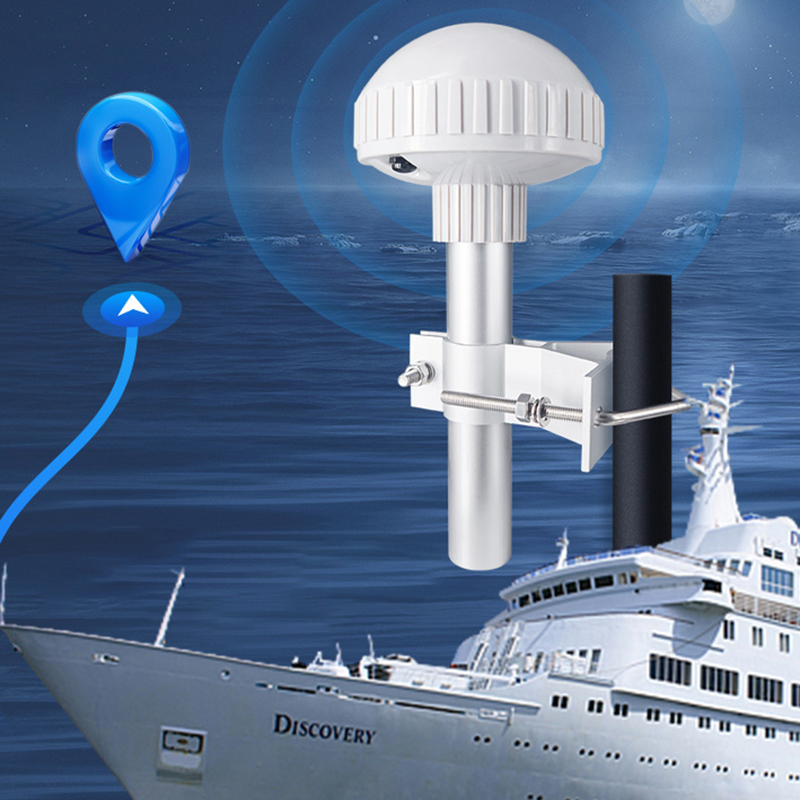
Active GPS Antenna Advantages
The built-in amplifier creates several benefits:
Superior Signal Reception: Active antennas lock onto satellites faster. When you start your GPS device, it needs to find and track multiple satellites. Strong signals make this process quicker. I have seen active antennas achieve position fixes in 30 seconds while passive antennas took 2-3 minutes in the same location.
Better Accuracy: Stronger signals mean better position calculations. Your GPS receiver can track more satellites simultaneously. More satellites improve position accuracy. The difference can be several meters in challenging conditions.
Longer Cable Flexibility: You can route cables through walls, under floors, or around obstacles. This gives you more mounting options. I often design installations where the antenna must be 5-8 meters from the receiver. Active antennas make this possible.
Reduced Interference Sensitivity: The LNA amplifies the GPS signal above the noise floor. Other radio frequencies have less relative impact. This matters in industrial environments with lots of electrical equipment.
Active GPS Antenna Disadvantages
The amplifier also creates some challenges:
Power Requirement: You must supply voltage to the antenna. If your GPS receiver does not provide antenna power, you need an external bias tee. This adds cost and complexity.
Higher Cost: Active antennas cost 2-3 times more than similar passive antennas. The LNA, additional components, and more complex manufacturing drive up the price.
Potential Overload: In areas with very strong GPS signals, the amplifier might overload. This rarely happens, but I have seen it on mountain tops with clear sky views. The receiver gets too much signal and performs worse.
Failure Points: The LNA can fail. Lightning strikes, voltage spikes, or component aging can damage the amplifier. When this happens, you must replace the entire antenna.
Passive GPS Antenna Advantages
Simplicity brings its own benefits:
No Power Needed: Passive antennas work immediately when connected. This makes them perfect for portable devices and battery-powered applications.
Lower Cost: Simpler design means lower manufacturing cost. For budget-conscious projects, this matters.
Higher Reliability: Fewer components mean fewer things can break. A passive antenna is just a piece of metal shaped correctly. It will work for decades.
No Overload Issues: Passive antennas cannot overload. Strong signals remain strong, weak signals remain weak. The receiver handles whatever signal arrives.
Passive GPS Antenna Disadvantages
The lack of amplification creates limitations:
Poor Indoor Performance: Without amplification, weak indoor signals become unusable. Passive antennas rarely work inside buildings.
Cable Length Restrictions: Long cables kill the signal. You must keep cables under 3 meters for reliable performance.
Weak Signal Sensitivity: In urban canyons, under tree cover, or near buildings, passive antennas struggle. They need strong, direct signals from satellites.
Slower Acquisition: Finding satellites takes longer with weaker signals. Users notice the delay when starting up their GPS devices.
Active vs Passive GPS Antennas: Real-World Use Cases
Let me share specific applications where each type works best. These examples come from actual customer projects.
Active GPS antennas dominate in vehicle tracking, fleet management, marine navigation, aviation systems, and any installation with signal challenges. Passive GPS antennas work well in handheld devices, outdoor sensors, rooftop installations, and applications where power consumption matters most.

Fleet Management and Vehicle Tracking
Every fleet tracking system I have installed uses active GPS antennas. Vehicles create challenging signal environments. The metal body acts as a shield. The GPS receiver usually sits inside the dashboard or under a seat.
Active antennas mount on the roof with magnetic bases or adhesive pads. The cable runs down the windshield pillar or through a grommet. Cable lengths range from 3 to 8 meters. Passive antennas would fail completely in this setup.
I worked with a delivery company that tried passive antennas to save money. Their drivers reported constant position errors. Packages went to wrong addresses. The company switched to active antennas and the problems disappeared.
Marine and Aviation Applications
Boats and aircraft need reliable GPS for navigation. These applications use active antennas almost exclusively.
On boats, the antenna mounts on the highest point for best sky view. The GPS display sits in the cabin. Cable runs can be 10 meters or more. Active antennas maintain signal quality over these distances.
Aircraft face even more demanding conditions. They fly at high speeds, experience vibration, and need position data for safety systems. Active antennas with rugged construction handle these requirements.
IoT and Sensor Networks
Internet of Things devices have different requirements. Many IoT sensors run on batteries and must operate for months or years without maintenance.
For outdoor sensors with solar panels and clear sky views, passive antennas make sense. I designed a system for agricultural monitoring where sensors measured soil conditions across large fields. Each sensor had a passive GPS antenna for position data. The sensors sat on poles 2 meters above ground with 50cm cables. Passive antennas worked perfectly and saved battery power.
However, IoT devices in urban areas need active antennas. Building shadows, signal reflections, and variable conditions require the extra gain.
Handheld GPS Devices
Hiking GPS units, smartphones, and portable navigation devices typically use passive antennas. The antenna sits right next to the GPS chip. Cable length is just a few centimeters.
These devices work outdoors where signals are strong. The passive antenna provides enough signal for the receiver. Adding an active antenna would drain the battery faster without improving performance.
Base Station and Reference Systems
GPS base stations for surveying and scientific applications use active antennas. These systems need the best possible accuracy. They track all visible satellites continuously.
Base station antennas mount on rooftops or poles with clear 360-degree sky views. Cable runs to equipment rooms can be 15-20 meters. Only active antennas can handle these cable lengths while maintaining signal quality.
Emergency and Rescue Equipment
Search and rescue teams carry GPS devices in challenging conditions. They work in forests, mountains, and urban disaster zones. These environments block and reflect GPS signals.
Active antennas help maintain position fixes in these difficult conditions. The extra gain means the difference between having location data and having none. When lives depend on knowing your position, active antennas are worth the extra cost and power consumption.
Active vs Passive GPS Antenna: Installation and Maintenance Tips
Proper installation makes a huge difference in performance. I have seen good antennas perform poorly due to installation mistakes.
Mount active GPS antennas with clear sky view, use proper cable routing, ensure good ground plane, check antenna power supply, and protect connections from moisture. For passive antennas, minimize cable length, avoid signal obstructions, use high-quality cables, and ensure tight connections.
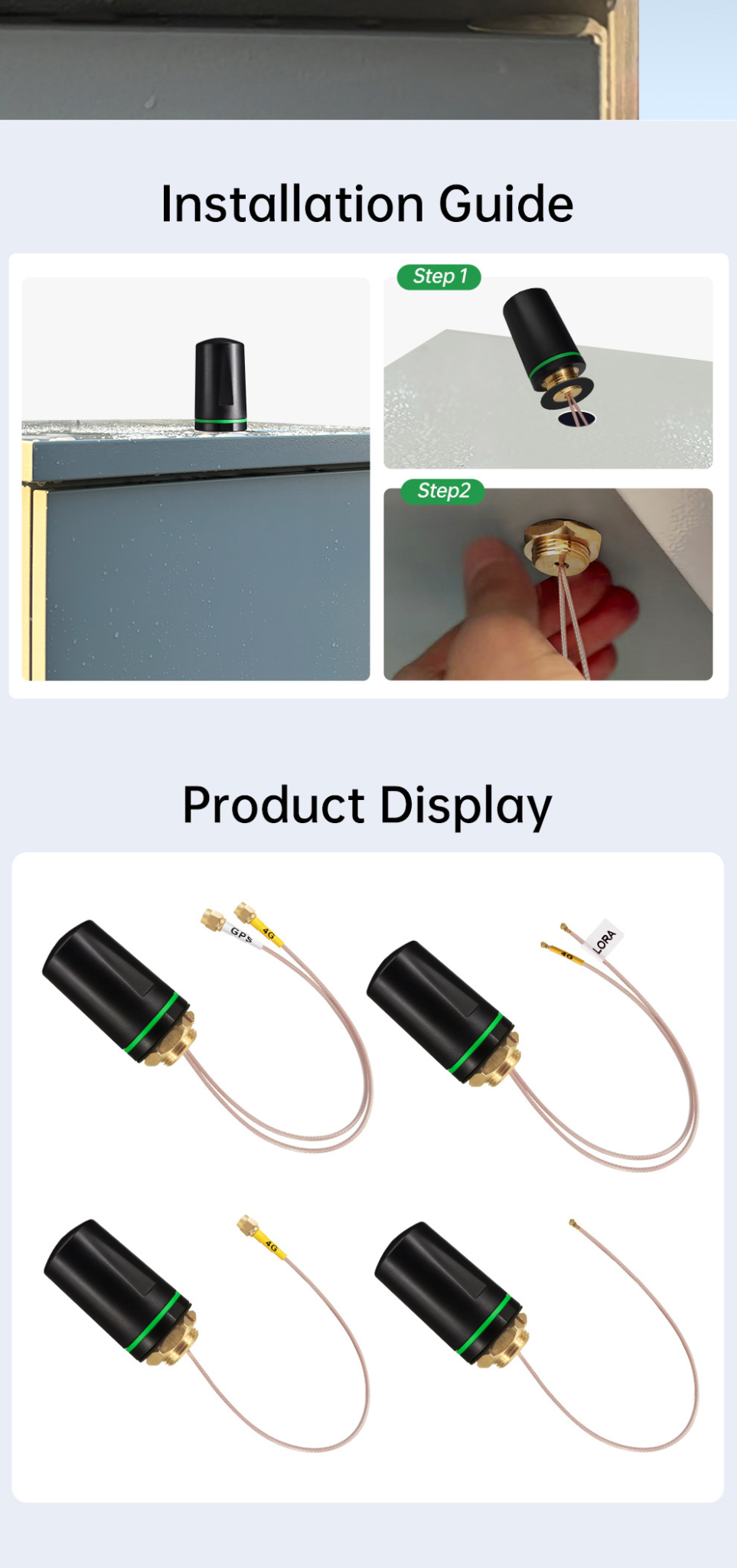
Active GPS Antenna Installation
Follow these steps for best results:
Location Selection: Choose a mounting spot with maximum sky visibility. Avoid mounting under metal overhangs, near large metal structures, or where buildings block significant portions of the sky. The antenna should see at least 120 degrees of open sky.
Ground Plane: GPS antennas work best with a ground plane. This is a