Every day I receive emails from clients who struggle to choose the right 5G antenna. They face connection drops, weak signals, and wasted money on wrong products. This guide will solve your antenna selection problem once and for all.
Choosing a 5G antenna in 2026 requires understanding your specific use case: indoor antennas work best for homes and offices with stable signals, outdoor antennas handle harsh weather and long distances, and MIMO antennas with multiple input/output channels deliver faster speeds and better reliability for demanding applications.
The 5G antenna market has evolved dramatically. In my 17 years working with communication antennas, I have seen technology shift from simple passive antennas to advanced active integrated solutions. This guide will walk you through every critical decision point to help you choose the perfect 5G antenna for your needs.
What Are the Key Differences Between Indoor and Outdoor 5G Antennas in 2026?
Your environment determines whether you need an indoor or outdoor antenna. Many buyers make expensive mistakes by choosing the wrong type. Understanding these differences saves you time and money.
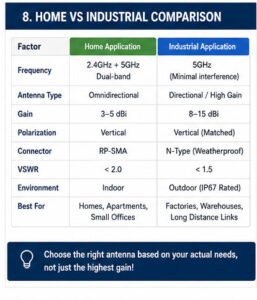
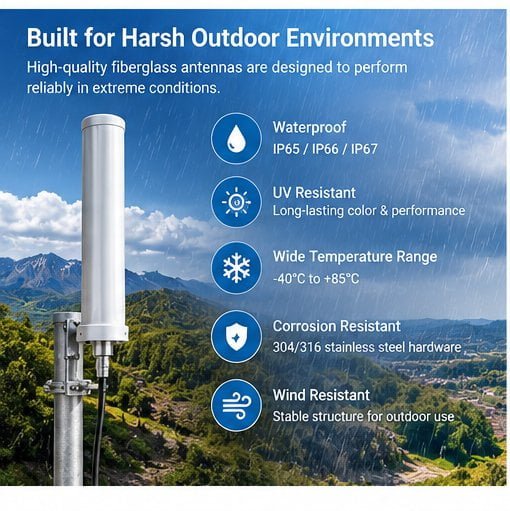
Indoor 5G antennas are compact, easy to install, and designed for controlled environments with temperatures between -10°C to +60°C, while outdoor antennas feature weatherproof IP65-IP67 ratings, UV-resistant materials, and operate in extreme conditions from -40°C to +85°C with higher gain to overcome signal obstacles.
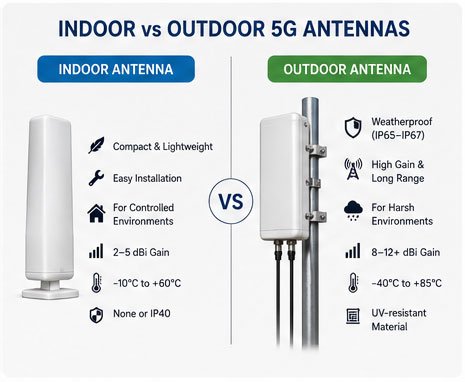
Indoor antennas typically use smaller form factors. We manufacture models that measure just 150mm x 30mm for wall mounting or ceiling installation. These antennas work perfectly in homes, offices, retail stores, and warehouses where the signal already exists but needs improvement. The installation requires no special tools. You can mount them with adhesive backing or simple brackets.
Outdoor antennas must survive harsh conditions. Last month I visited a client's rooftop installation in Dubai where summer temperatures exceed 50°C. Their outdoor antenna still performed perfectly after 18 months of continuous operation. We design these antennas with fiberglass radomes, stainless steel brackets, and sealed connectors. The weatherproof housing prevents water ingress during heavy rain. UV-stabilized materials prevent degradation from constant sun exposure.
The gain difference matters significantly. Indoor antennas usually provide 2-5 dBi gain because walls already provide some protection from interference. Outdoor antennas offer 8-12 dBi or higher gain to compensate for longer distances and obstacles like trees, buildings, and terrain features.
Power handling also differs. Indoor antennas typically handle 10-50 watts because indoor systems use lower power. Outdoor antennas must handle 100-200 watts or more for base stations and high-power applications. We test every outdoor antenna for lightning protection and surge resistance up to 3kA.
Consider your mounting options carefully. Indoor antennas offer magnetic mounts, adhesive backing, or lightweight brackets. Outdoor antennas require heavy-duty pole mounts, wall brackets, or specialized mounting kits that resist wind loads up to 150 km/h. I have seen cheap outdoor mounts fail during storms, causing expensive antenna damage.
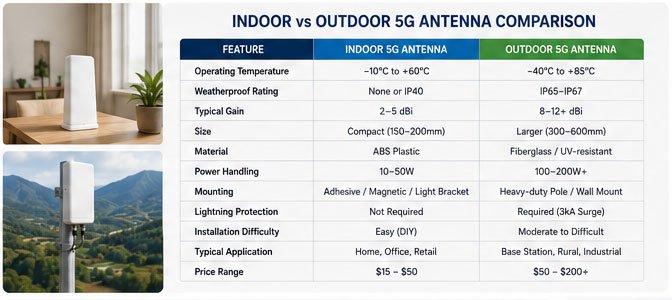
Here is a detailed comparison table:
| Feature | Indoor 5G Antenna | Outdoor 5G Antenna |
|---|---|---|
| Operating Temperature | -10°C to +60°C | -40°C to +85°C |
| Weatherproof Rating | None or IP40 | IP65-IP67 |
| Typical Gain | 2-5 dBi | 8-12+ dBi |
| Size | Compact (150-200mm) | Larger (300-600mm) |
| Material | ABS plastic | Fiberglass/UV-resistant plastic |
| Power Handling | 10-50W | 100-200W+ |
| Mounting | Adhesive/magnetic/light bracket | Heavy-duty pole/wall mount |
| Lightning Protection | Not required | Required (3kA surge) |
| Installation Difficulty | Easy (DIY) | Moderate to difficult |
| Typical Application | Home, office, retail | Base station, rural, industrial |
| Price Range | $15-$50 | $50-$200+ |
Why Do 5G MIMO Antennas Deliver Better Performance Than Single-Port Antennas?
MIMO technology has revolutionized 5G connectivity. Many clients ask me why they should pay more for MIMO antennas. The performance difference becomes clear once you understand how MIMO works.
MIMO (Multiple Input Multiple Output) antennas use multiple signal paths simultaneously to increase data throughput by 2-4 times, reduce interference through spatial diversity, and maintain stable connections even when one signal path degrades, making them essential for high-speed applications like video streaming and industrial IoT.
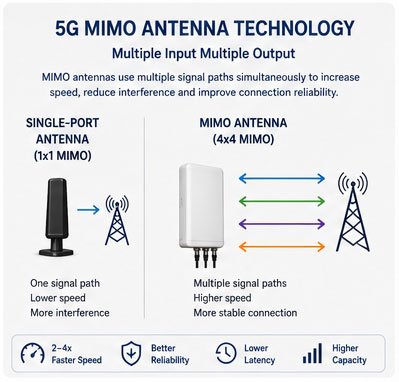
Single-port antennas transmit and receive on one channel. This limits your maximum speed to the bandwidth of that single channel. MIMO antennas use 2x2, 4x4, or even 8x8 configurations. Each number pair represents separate transmit and receive paths. A 4x4 MIMO antenna has four separate antennas working together in one housing.
The speed improvement is dramatic. In my testing facility, a single-port 5G antenna achieves around 800 Mbps download speed in ideal conditions. A 2x2 MIMO antenna in the same location reaches 1.5 Gbps. A 4x4 MIMO system can exceed 3 Gbps. Your actual speed depends on your carrier network and local signal conditions, but the relative improvement remains consistent.
MIMO also improves reliability through diversity. When one signal path faces interference or obstruction, the other paths maintain your connection. Last week a customer told me their single-port antenna lost connection every time a large truck parked nearby. We replaced it with a 2x2 MIMO antenna. The problem disappeared because the second antenna maintained signal even when the truck blocked the first antenna's line of sight.
Spatial multiplexing is the secret behind MIMO performance. The antenna system sends different data streams on each path simultaneously. Your 5G modem or router then combines these streams. This parallel transmission multiplies your effective bandwidth without requiring more spectrum from the carrier.
MIMO antennas do have drawbacks. They cost more because they contain multiple antenna elements, separate RF paths, and more complex internal networks. A single-port antenna might cost $20, while a 4x4 MIMO antenna costs $80-150. The installation also requires more careful consideration of antenna spacing and polarization angles.
You also need a MIMO-capable device. Your 5G router or modem must support MIMO to benefit from a MIMO antenna. Check your device specifications before purchasing. We manufacture antennas with 2x2 MIMO for consumer devices and 4x4 MIMO for industrial applications and high-speed fixed wireless access.
Consider beam forming capabilities. Advanced MIMO antennas support beam forming where the antenna system electronically steers the signal pattern toward your device. This increases signal strength and reduces interference. We integrate beam forming in our premium outdoor MIMO antennas for base station applications.
Here is when you need MIMO:
| Application | Recommended Configuration | Reason |
|---|---|---|
| Home internet (basic) | 2x2 MIMO | Balanced cost and performance |
| Video streaming (4K) | 2x2 or 4x4 MIMO | High bandwidth requirement |
| Industrial IoT | 2x2 MIMO minimum | Reliability critical |
| Fixed wireless access | 4x4 MIMO | Maximum speed needed |
| Vehicle connectivity | 2x2 MIMO | Mobility and reliability |
| Smart city infrastructure | 4x4 MIMO | Multiple device connections |
| Emergency services | 4x4 MIMO | Reliability in all conditions |
What Does High-Gain Mean and How Much Gain Do You Actually Need?
Gain specifications confuse many buyers. Sales people often claim higher gain is always better. This is not true. Understanding gain helps you choose the right antenna without overpaying.
Antenna gain measured in dBi indicates how focused the antenna's radiation pattern is compared to a perfect isotropic radiator, with each 3 dB increase doubling the effective signal strength in the desired direction, but higher gain also narrows the beam width which can cause coverage blind spots if improperly installed.
Think of antenna gain like a flashlight. A bare light bulb spreads light in all directions but appears dim at any specific point. A focused flashlight beam appears much brighter in one direction but leaves other areas dark. Antenna gain works the same way. It focuses radio energy in specific directions rather than radiating equally in all directions.
The dBi scale is logarithmic. A 3 dB increase doubles your effective power. A 10 dBi antenna produces twice the signal strength of a 7 dBi antenna in its main direction. A 13 dBi antenna produces four times the strength of a 7 dBi antenna. This matters when you need to reach distant cell towers or penetrate through obstacles.
I see clients make a common mistake. They buy the highest gain antenna available without considering beam width. A 15 dBi antenna might have a beam width of only 30 degrees. If your cell tower is not exactly in that 30-degree cone, you get worse performance than a lower gain antenna with wider coverage. We once had a customer return a 12 dBi antenna because it performed worse than their old 5 dBi antenna. The problem was incorrect aiming, not the antenna itself.
Indoor applications rarely need high gain. Your cell tower is usually close and signals penetrate buildings well enough. A 2-5 dBi omni-directional antenna works perfectly. The wide pattern ensures good coverage throughout your space. You do not need to worry about precise aiming.
Outdoor applications benefit from higher gain when distance is a factor. If your nearest cell tower is 2-3 km away with clear line of sight, a 9-12 dBi antenna significantly improves your signal. For rural installations 5-10 km from the tower, you might need 15-18 dBi directional antennas. We manufacture specialized long-range antennas for clients in remote mining operations and agricultural areas.
Directionality ties directly to gain. Omni-directional antennas radiate in a 360-degree horizontal pattern. They typically max out around 5-8 dBi. Directional antennas like Yagi or panel types focus energy in one direction. They achieve 9-18 dBi or higher. I recommend omni-directional for mobile applications or when you have multiple cell towers in different directions. Choose directional when you have one strong tower in a known location.
VSWR (Voltage Standing Wave Ratio) matters as much as gain. A high-gain antenna with poor VSWR wastes power through reflection. Look for VSWR below 2.0:1 across all 5G frequency bands. Our antennas achieve VSWR below 1.5:1 in production testing. This ensures the gain specifications translate to actual performance.
Consider polarization when evaluating gain. 5G signals use vertical, horizontal, or dual polarization. Your antenna must match. A vertically polarized antenna loses 20 dB or more if the cell tower uses horizontal polarization. Most cell towers use dual polarization. MIMO antennas typically provide both polarizations automatically.
Here is a practical gain selection guide:
| Distance to Tower | Environment | Recommended Gain | Antenna Type |
|---|---|---|---|
| Under 1 km | Urban/indoor | 2-5 dBi | Omni-directional |
| 1-3 km | Suburban | 6-9 dBi | Omni or low-gain directional |
| 3-5 km | Rural/clear | 9-12 dBi | Directional panel |
| 5-10 km | Rural/obstacles | 12-15 dBi | High-gain panel or Yagi |
| Over 10 km | Remote | 15-18+ dBi | Parabolic or specialized |
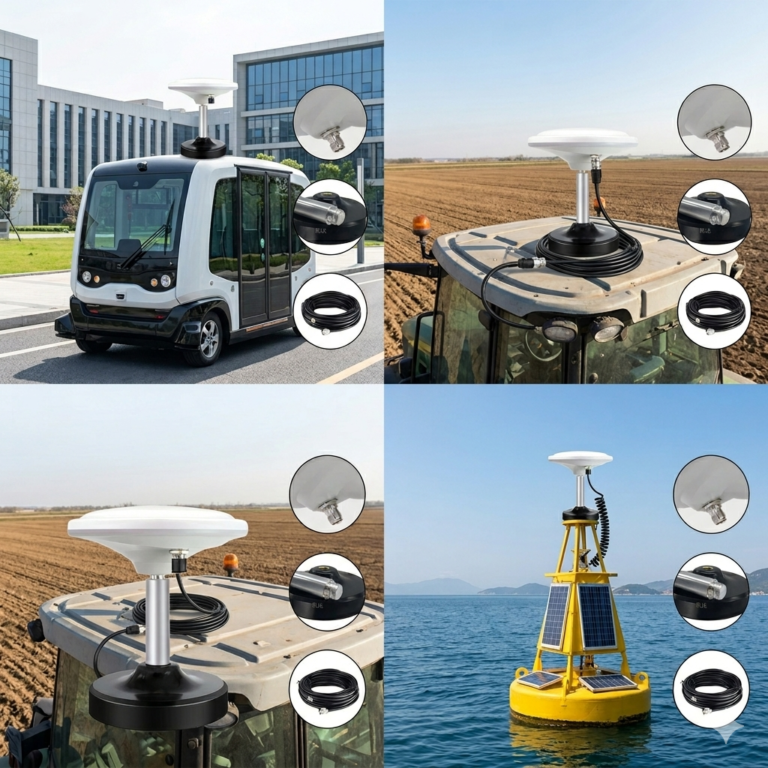
| Mobile/vehicle | Variable | 3-5 dBi | Omni-directional |
How Do Active and Passive Antennas Differ and Which Should You Choose?
The antenna market has changed significantly in recent years. Active antennas represent a major technological shift. Understanding this difference helps you make better purchasing decisions.
Passive antennas simply transmit and receive radio signals without signal processing, while active antennas integrate RF amplifiers, filters, and sometimes beam forming circuits directly into the antenna unit to boost weak signals, reduce noise, and improve overall system performance especially in challenging environments.
Traditional passive antennas contain only the radiating elements and matching network. They connect to your modem or router through a coaxial cable. All signal processing happens in your device. This simple design keeps costs low and reliability high. Most antennas we have manufactured over the past 17 years are passive designs.
Active antennas include built-in electronics. The most common type integrates a low noise amplifier (LNA) in the receive path. This LNA boosts weak signals from distant cell towers before cable losses occur. Some advanced active antennas also include power amplifiers for the transmit path. The electronics require power, usually supplied through the RF cable using a bias tee or through a separate power wire.
I started seeing active antenna demand increase about three years ago. Clients in underground parking facilities, basement factories, and remote areas needed better solutions than passive antennas could provide. Active antennas solve specific problems that passive antennas cannot address adequately.
The main advantage is improved signal quality. Cable losses eat into your signal strength. A 10-meter cable might lose 3-5 dB of signal. An active antenna with built-in LNA compensates for this loss and adds extra gain. This matters most when the original signal is weak. If you have strong signal already, active amplification provides little benefit and might even cause problems from overload.
Active antennas shine in weak signal environments. Last month we deployed active magnetic mount antennas for a logistics company whose vehicles enter underground loading docks. The passive antennas lost connection completely underground. The active antennas with 15 dB amplification maintained reliable 5G connectivity even three levels below ground. This cost more but paid for itself through improved operational efficiency.
Base station applications have embraced active antenna systems. Major carriers use active antenna units (AAU) that integrate the entire radio and antenna into one weatherproof unit. These systems enable advanced features like massive MIMO, beam forming, and beam tracking. The integration reduces installation complexity and improves performance. We manufacture smaller-scale active antennas for private networks and fixed wireless access that use similar principles.
The disadvantages of active antennas include higher cost, power requirements, and potential failure points. A passive antenna never needs power and has almost no failure modes beyond physical damage. An active antenna needs DC power (usually 12V or via USB) and the electronics can fail. The amplifiers also generate noise that can interfere with nearby devices if poorly designed.
Power consumption matters for mobile applications. A passive antenna draws zero power. An active antenna might consume 100-300 mA, which drains batteries faster in vehicle or portable applications. Consider your power budget carefully before choosing active antennas.
Active antennas can cause problems if misapplied. In areas with already strong signals, the amplifier might overload your modem's receiver causing worse performance than a passive antenna. The amplifier gain is not adjustable in most consumer models. We recommend passive antennas unless you specifically face weak signal issues.
Here is our decision framework:
| Scenario | Recommended Type | Reason |
|---|---|---|
| Good signal strength | Passive | No benefit from amplification |
| Weak signal (under -100 dBm) | Active | Amplification improves usability |
| Long cable runs (over 5m) | Active | Compensates for cable loss |
| Underground/indoor deep | Active | Overcomes penetration loss |
| Budget constrained | Passive | Lower cost, simpler |
| Mobile/battery powered | Passive | No power consumption |
| Base station/fixed installation | Active (AAU) | Best performance for infrastructure |
| IoT with edge power | Active | Improves reliability in weak areas |
What Frequency Bands Must Your 5G Antenna Support in 2026?
Frequency band compatibility creates confusion for many buyers. Different countries and carriers use different 5G bands. Choosing an antenna that does not cover your required bands wastes your investment completely.
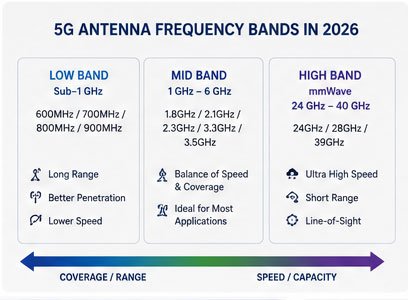
5G networks in 2026 operate across three main spectrum ranges: low-band (600-900 MHz) for wide coverage, mid-band (1-6 GHz including n77, n78, n79 bands) for balanced speed and coverage, and high-band millimeter wave (24-40 GHz) for ultra-high speeds in dense urban areas, requiring antennas specifically designed for your carrier's deployed bands.