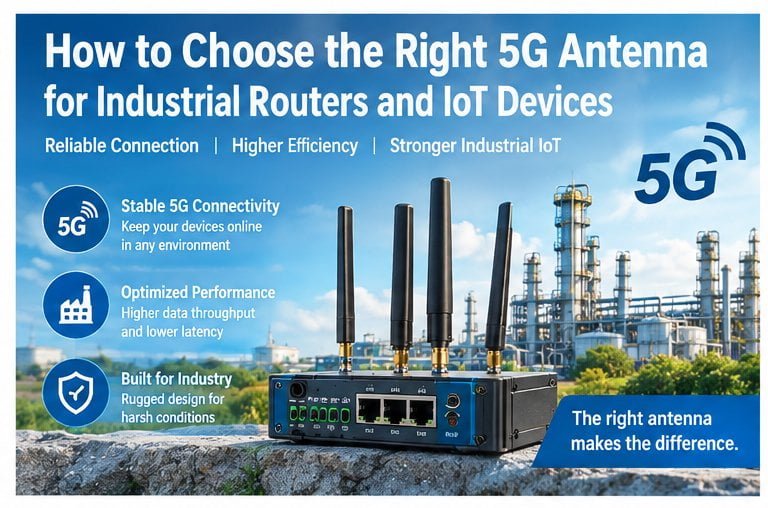
Unreliable connectivity can severely disrupt operations for industrial routers and IoT devices, leading to costly downtime and inefficient data transmission. Many businesses grapple with intermittent signals or poor performance from their wireless setups, which can undermine the very purpose of deploying advanced industrial IoT solutions. Choosing the right 5G antenna for industrial routers and IoT devices is paramount to ensuring robust and continuous communication in demanding environments.
Choosing the right 5G antenna for industrial routers and IoT devices is a critical decision that hinges on several key factors, including the operating frequency bands, the required gain, the Voltage Standing Wave Ratio (VSWR), and the specific environmental conditions of deployment. It involves a careful evaluation of electrical performance, mechanical robustness, and compatibility with the connected equipment to ensure reliable, continuous 5G wireless communication in challenging industrial settings.
I often see companies struggle with optimizing their wireless networks, only to realize the weakest link is an improperly selected antenna. Selecting the right one transforms your industrial connectivity from a point of frustration to a core strength. Let’s delve into how you can make an informed choice for your specific needs.
What Factors Influence 5G Antenna Selection for Industrial IoT Devices?
The sheer variety of industrial IoT applications means there's no one-size-fits-all solution for 5G antennas. Companies often face the challenge of matching an antenna's technical specifications with their unique operational demands, risking suboptimal performance if key factors are overlooked. This challenge can lead to frustration and costly reworks if not addressed proactively.
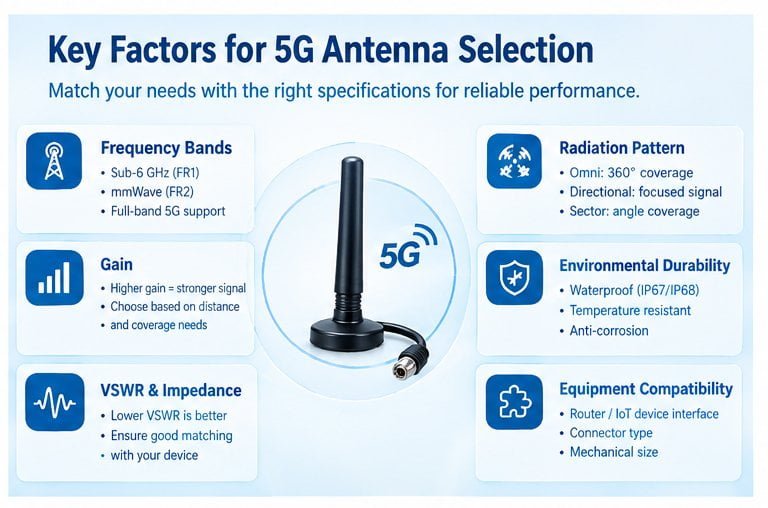
When selecting a 5G antenna for industrial IoT devices, the primary factors influencing the decision include the operational frequency bands, the required signal gain, the antenna's impedance matching (VSWR), its radiation pattern, and its physical durability in harsh environments. Each element plays a crucial role in ensuring optimal connectivity and data throughput for your specific industrial application.
Dive Deeper: Critical Considerations for Performance and Reliability
From my perspective, after years in this field, the foundation of successful 5G industrial deployment begins with a meticulous assessment of the antenna's core specifications and how they align with your system's requirements. We know that industrial environments are diverse, from manufacturing floors with heavy machinery to outdoor installations exposed to the elements. This diversity necessitates a thoughtful approach to antenna selection.
H3: Understanding Frequency Bands and Bandwidth
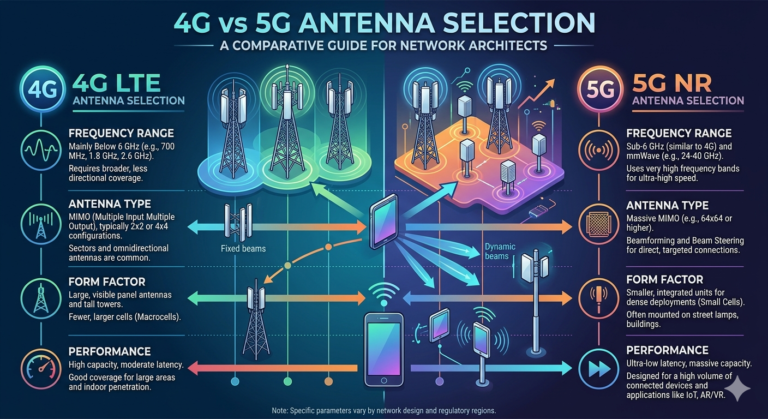
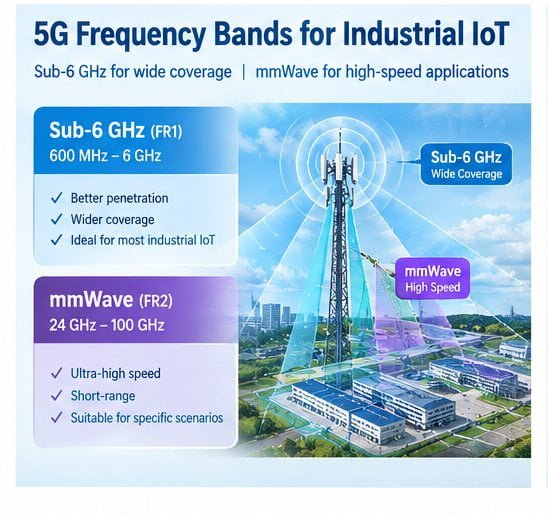
Modern 5G technology operates across a wide spectrum of frequencies, broadly categorized into sub-6 GHz (FR1) and millimeter-wave (mmWave, FR2). Industrial routers and IoT devices need antennas specifically designed to cover the frequency bands they will utilize. For instance, most current industrial IoT applications leverage sub-6 GHz frequencies (e.g., 600 MHz to 6 GHz) for their better penetration and coverage, while mmWave is gaining traction for ultra-high-speed, short-range applications. An antenna must be truly "full-band 5G" compatible to support all relevant bands, ensuring future-proofing and adaptability. I always advise my clients to verify the specific bands supported, not just a generic "5G compatible" claim. A narrow bandwidth antenna might restrict your device's ability to connect to certain network operators or limit its future expandability.
H3: Gain and Radiation Patterns
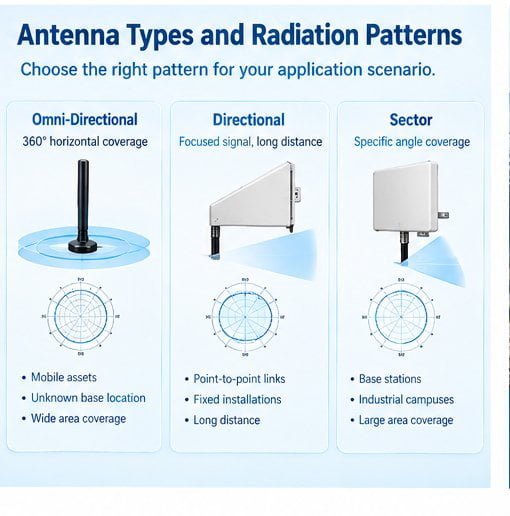
Antenna gain refers to its ability to direct radio frequency energy in a specific direction, effectively boosting signal strength. High-gain antennas are beneficial for long-distance communication or penetrating obstacles, but they often have narrower beamwidths, meaning precise alignment is crucial. Conversely, omni-directional antennas offer broader coverage but with lower gain, making them suitable for mobile assets or situations where the exact location of the base station is unknown or constantly changing.
- Omni-directional antennas: Ideal for scenarios where devices move or base stations are scattered. They provide 360-degree horizontal coverage.
- Directional antennas: Best for fixed installations requiring a strong, focused signal over a long distance, such as point-to-point links between two industrial sites. Examples include Yagi or panel antennas.
- Sector antennas: A hybrid, often used in base stations to cover a specific angular sector, useful for large industrial campuses.
Understanding the radiation pattern is crucial for optimizing signal strength and minimizing interference. My experience shows that a mismatch here often leads to frustrating connectivity issues that are difficult to diagnose.
H3: VSWR and Impedance Matching
Voltage Standing Wave Ratio (VSWR) is a measure of how efficiently radio frequency power is transmitted from a power source, through a transmission line, into a load. For antennas, it indicates how well the antenna is matched to the transmission line and the transceiver. A low VSWR (ideally close to 1:1) signifies that most of the power is being radiated by the antenna, while a high VSWR means a significant portion of the power is reflected back, leading to signal loss and potentially damaging the radio. In industrial settings, where continuous operation is paramount, a low VSWR is non-negotiable for stable gain and efficient power transfer. We often see issues arise when a poorly matched antenna introduces unnecessary losses, reducing the effective range and reliability of the 5G connection.
H3: Power Handling and Polarization
The antenna must be able to handle the output power of your industrial router or IoT device without degrading performance or suffering damage. This is especially important for high-power industrial applications. Polarization, whether linear (vertical or horizontal) or circular, should also match the polarization of the incoming signal for optimal reception. Many general-purpose antennas are linearly polarized, but in complex industrial environments with multiple reflections, circularly polarized antennas can offer more robust performance by mitigating multipath fading.
My insights from supporting global clients emphasize that a truly robust 5G antenna for industrial applications must support full 5G frequency bands, maintain low VSWR for stable gain, and possess anti-interference capabilities. These electrical parameters are the backbone of reliable industrial wireless communication.
How Do Environmental Conditions Affect 5G Antenna Performance?
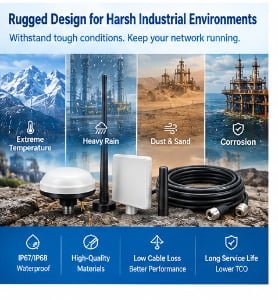
Industrial environments are notoriously harsh, posing significant challenges to the durability and performance of electronic components. Many organizations underestimate the impact of these conditions, leading to premature antenna failure, signal degradation, and operational disruptions. This oversight often results from a lack of awareness regarding the specific stressors present in their deployment sites.
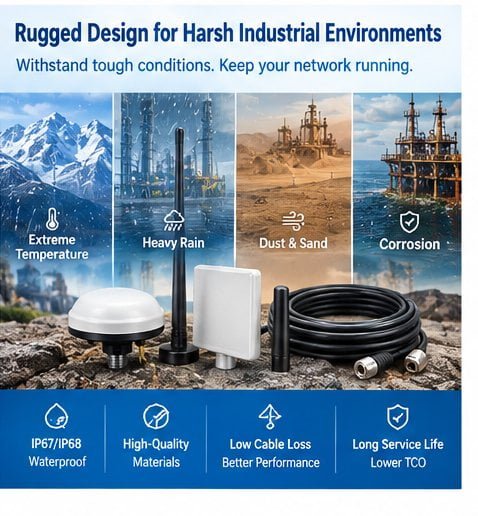
Environmental conditions significantly affect 5G antenna performance by exposing them to extreme temperatures, moisture, dust, vibration, corrosive chemicals, and electromagnetic interference. These factors can degrade materials, alter electrical properties, and physically damage the antenna, leading to reduced signal strength, increased VSWR, and ultimately, connectivity failures for industrial routers and IoT devices.
Dive Deeper: Ensuring Robustness in Challenging Environments
When I consult with clients, a significant portion of our discussion revolves around the operational environment. It's not enough to have a technically proficient antenna; it must also survive and thrive where it's deployed. From my perspective, neglecting environmental considerations is one of the most common pitfalls in industrial wireless deployments.
H3: Temperature Extremes
Industrial sites can experience vast temperature fluctuations, from scorching summers in unventilated enclosures to freezing winters in outdoor installations. An antenna's materials must withstand these extremes without physical deformation or changes in electrical properties. For instance, plastics can become brittle in cold or warp in heat, affecting the internal geometry and thus the electrical performance. We ensure our materials are rated for wide operating temperature ranges, typically from -40°C to +85°C or even higher, to guarantee consistent performance across all seasons and operational scenarios.
H3: Ingress Protection (IP) Ratings
Dust, dirt, and moisture are pervasive in many industrial settings. A high Ingress Protection (IP) rating is crucial for antennas deployed outdoors or in dusty/wet indoor environments.
- IP67: Fully dust-tight and protected against immersion in water up to 1 meter for 30 minutes. This is often a minimum for outdoor industrial use.
- IP68: Offers even greater protection against continuous immersion in water under specified conditions. Understanding the difference between IP ratings helps ensure that the antenna can withstand wash-downs, rain, or even temporary submersion without internal damage. We always recommend confirming the specific IP rating required for your environment.
H3: Mechanical Durability and Vibration Resistance
Industrial machinery often generates significant vibrations. An antenna designed for a desktop application will likely fail quickly when mounted on a vibrating piece of equipment. Industrial-grade antennas feature robust housings, secure mounting mechanisms, and internal components designed to resist shock and vibration. This includes using specialized adhesives, potting compounds, and robust soldering techniques. I have personally seen antennas literally shake themselves apart in high-vibration environments, leading to complete communication loss. It's important to consider material choices like fiberglass for its excellent durability and weather resistance in specific antenna types like omni-directional sticks.
H3: Chemical Exposure and UV Resistance
In chemical plants or processing facilities, antennas may be exposed to corrosive gases, acids, or solvents. Materials like certain plastics or metals can degrade rapidly under such conditions. Similarly, outdoor antennas need UV-resistant materials to prevent degradation from prolonged sun exposure, which can cause cracking and material breakdown. We prioritize materials that are proven to resist common industrial chemicals and have strong UV stability to ensure long-term integrity.
H3: Electromagnetic Interference (EMI)
Industrial environments are often rife with electromagnetic interference from motors, welding equipment, and high-voltage lines. While an antenna itself doesn't generate EMI, its design can influence its susceptibility to external interference. Proper shielding, grounding, and robust circuit design within the antenna assembly or related components can help minimize the impact of EMI on signal quality, ensuring clear and consistent communication for your 5G antenna for industrial routers and IoT devices.
My experience tells me that while electrical specifications are paramount, neglecting the mechanical and environmental resilience of an antenna is a recipe for costly system failures in industrial scenarios. Integrating considerations like feeder cable loss and ensuring waterproof and shockproof structures are vital for guaranteeing continuous, reliable 5G wireless communication.
Why is 5G Antenna Customization Important for Industrial Use Cases?
Off-the-shelf 5G antennas, while convenient, often present compatibility issues or suboptimal performance in highly specialized industrial environments. Many businesses face the dilemma of trying to force a generic solution into a unique setup, leading to compromised efficiency, signal dead zones, or even non-compliance with specific industrial standards. This "close enough" approach can hinder the full potential of their industrial IoT deployments.
5G antenna customization is important for industrial use cases because it allows for precise optimization of performance parameters like frequency range, gain, cable length, and connector type to match specific device requirements, installation constraints, and environmental challenges. Tailored solutions ensure maximum efficiency, robust connectivity, and seamless integration for industrial routers and IoT devices, overcoming the limitations of generic products.
Dive Deeper: Tailoring Solutions for Peak Performance
From my perspective, customization is not just a value-added service; it's often a necessity for achieving true reliability and peak performance in demanding industrial applications. Our 17+ years in the industry have shown us that every industrial deployment has its nuances, and a one-size-fits-all approach rarely delivers optimal results.
H3: Adapting to Unique Device Requirements
Industrial routers and IoT devices come in myriad forms and sizes, with varying power outputs, internal architectures, and spatial constraints. A customized 5G antenna can be designed to match the specific impedance of the device, optimize for its transmit power, and fit perfectly within or on its enclosure. This includes tailoring:
- Frequency tuning: Ensuring the antenna is precisely tuned to the specific 5G bands used by the industrial device or network operator.
- Gain optimization: Adjusting the antenna's gain to provide the required signal strength without excessive power consumption or interference.
- Polarization: Matching the antenna's polarization to that of the expected incoming signal for the best reception.
- Connector types: Ensuring seamless compatibility with the router or device's RF port (e.g., SMA, N-type, U.FL, MHF4), preventing the need for problematic adapters that introduce signal loss.
H3: Overcoming Installation Constraints
Physical space limitations, mounting options, and cable routing challenges are common in industrial settings. A standard antenna might be too large, too small, or lack the appropriate mounting hardware for a specific location. Customization allows for:
- Custom cable lengths and types: Minimizing cable loss by providing the exact length needed, and selecting cable types (e.g., low-loss LMR series) that suit the environment and frequency. I always advise against using excessively long cables, as every foot adds signal degradation.
- Flexible mounting options: Designing antennas with specific brackets, screw holes, or adhesive pads to integrate seamlessly into existing structures or equipment.
- Form factor adaptation: Creating antennas with unique shapes or profiles (e.g., embedded, patch, puck, blade) to fit within tight enclosures or discreetly mount on machinery.
H3: Addressing Specific Environmental Challenges
Beyond standard IP ratings and temperature resistance, some industrial environments present unique challenges that can benefit from specialized materials or design modifications. For instance, in environments with extreme vibrations, a custom-designed robust internal structure might be necessary. In chemically aggressive areas, specific polymers or coatings can be selected to enhance longevity. This proactive approach prevents costly failures down the line.
H3: OEM/ODM Capabilities and Brand Support
For communication equipment manufacturers and system integrators, OEM/ODM (Original Equipment Manufacturer/Original Design Manufacturer) capabilities are crucial. This means we can produce antennas designed specifically for their products, including private labeling and custom packaging. This not only ensures performance but also supports their brand identity and supply chain efficiency. Our ability to offer flexible MOQs (Minimum Order Quantities) further supports their prototyping and production needs, allowing them to test and deploy custom solutions without massive upfront commitments. This direct integration is a significant advantage, especially for companies looking to quickly develop and market their products.
My firm belief is that partnering with a manufacturer who offers strong R&D and customization capabilities, alongside a stable production system, provides a distinct competitive edge. It's about providing high-performance, cost-effective, and reliable 5G antenna solutions that truly fit the bill.
What Are the Key Electrical Specifications for 5G Antennas?
When evaluating 5G antennas for industrial applications, navigating the array of electrical specifications can be daunting. Many procurement teams or engineers struggle to prioritize these parameters, leading to decisions based on incomplete understanding rather than comprehensive technical alignment. This can result in antennas that theoretically work but practically underperform in a demanding industrial setting.
The key electrical specifications for 5G antennas include operating frequency range, peak gain (dBi), Voltage Standing Wave Ratio (VSWR), impedance (ohms), power handling capacity (watts), and polarization. These parameters collectively define an antenna's ability to efficiently transmit and receive 5G signals, ensuring stable and robust connectivity for industrial routers and IoT devices.
Dive Deeper: Deconstructing Antenna Performance Metrics
In my experience, understanding the electrical heart of an antenna is paramount. It’s what truly dictates performance. While physical ruggedness is vital, if the electrical characteristics aren't precisely aligned with your system and the 5G network, you simply won't get the desired throughput or reliability.
H3: Frequency Range
As discussed, 5G operates across a broad spectrum. An antenna's specified frequency range (e.g., 600-6000 MHz for sub-6 GHz 5G) indicates the bands over which it is designed to operate efficiently. A wider, continuous frequency range is desirable for universal 5G compatibility and future-proofing, especially as new bands are deployed. It's not enough for an antenna to simply "cover" a range; its performance (gain, VSWR) should be stable and acceptable across that entire range.
H3: Peak Gain (dBi)
Gain is a measure of an antenna's ability to focus RF energy in a particular direction. It's measured in decibels isotropic (dBi). Higher gain generally means a stronger signal in the desired direction, which is critical for long-range communication or penetrating obstacles. However, higher gain usually comes with a narrower beamwidth. For industrial IoT, the optimal gain depends on the application:
- Lower gain (0-5 dBi): Often omni-directional, suitable for local area coverage, mobile assets, or situations where signal direction is variable.
- Medium gain (5-9 dBi): A good balance for many fixed industrial applications, offering decent range without overly narrow beamwidth.
- High gain (9+ dBi): Typically directional, used for point-to-point links or reaching distant base stations.
My advice: don't simply chase the highest dBi number. Consider the trade-off between gain, beamwidth, and your specific coverage requirements. Stable gain across the operating frequency is far more important than a high peak gain at a single frequency.
H3: Voltage Standing Wave Ratio (VSWR)
I cannot overstate the importance of VSWR. It quantifies how much power is reflected back from the antenna rather than being radiated. A VSWR of 1:1 is perfect, meaning no power is reflected. In practice, a VSWR of 1.5:1 or lower is generally considered excellent for most industrial applications, meaning only 4% of power is reflected. A VSWR of 2:1 (11% reflected) is often an acceptable maximum. Higher values indicate poor impedance matching, leading to:
- Reduced signal strength: Less power radiates from the antenna.
- Increased heat: Reflected power returns to the radio, potentially causing overheating or damage.
- Unreliable connection: Intermittent or slow data transfer.
We meticulously design our antennas to achieve low VSWR across the entire operating frequency range, ensuring consistent and reliable signal transmission. This commitment is reflected in our robust QC processes.
H3: Impedance
The characteristic impedance of most RF systems, including 5G antennas and transmission lines, is 50 ohms. It's crucial that the antenna's impedance matches the system's impedance to minimize reflections and ensure maximum power transfer. Mismatched impedance is the primary cause of high VSWR.
H3: Power Handling Capacity
This specification indicates the maximum RF power (in watts) an antenna can safely handle without sustaining damage or degrading performance. For industrial routers and IoT devices, ensuring the antenna's power handling capacity exceeds the maximum output power of your connected radio is a fundamental safety and reliability consideration. Overpowering an antenna can lead to internal arcing, material breakdown, and catastrophic failure.
H3: Polarization
The orientation of the electric field of the radio wave is its polarization. Most common antennas are linearly polarized (vertical or horizontal). Matching the antenna's polarization to that of the signal you intend to receive is crucial for optimal reception. In some complex industrial environments with significant multipath propagation, circularly polarized antennas might be considered for their ability to mitigate fading.
As a manufacturer, we recognize that accurate and truthful performance parameters are vital for our clients. We always advise buyers to verify specifications through testing and consider our ISO9001 quality management system as proof of our commitment to consistent product quality.
Frequently Asked Questions
What is the typical lifespan of an industrial 5G antenna?
The lifespan of an industrial 5G antenna largely depends on its build quality, material durability, and the environmental conditions it endures. A well-designed, industrial-grade antenna with appropriate IP ratings and robust construction can typically last 5-10 years or even longer in demanding industrial environments, provided it's installed correctly and not subjected to extreme, unforeseen stresses.
Can 5G antennas be used for outdoor industrial applications?
Yes, many 5G antennas are specifically designed for outdoor industrial applications. These antennas feature robust, weather-resistant housings with high IP ratings (e.g., IP67 or IP68), UV stability, and resistance to extreme temperatures, dust, and moisture. They are built to withstand the rigors of outdoor deployments on factory rooftops, remote sites, or exposed infrastructure, ensuring continuous connectivity.
What's the difference between omni-directional and directional 5G antennas for industrial use?
Omni-directional 5G antennas provide 360-degree horizontal coverage, making them suitable for mobile industrial assets or when connecting to multiple base stations from a central point. Directional 5G antennas focus signal strength in a specific direction, offering higher gain and longer range, ideal for fixed point-to-point links or penetrating obstacles in a defined path.
How important is VSWR in a 5G antenna for industrial routers?
VSWR (Voltage Standing Wave Ratio) is extremely important for 5G antennas in industrial routers. A low VSWR (ideally under 1.5:1) ensures maximum power transfer from the router to the antenna, meaning more signal is radiated. High VSWR indicates significant power reflection, leading to reduced signal strength, potential overheating of the router, and unreliable, intermittent connectivity crucial for industrial operations.
Conclusion
Choosing the right 5G antenna for industrial routers and IoT devices is a critical decision that directly impacts the reliability and efficiency of your industrial operations. We've explored the key considerations, from crucial electrical specifications like frequency, gain, and VSWR, to the vital importance of environmental durability, including factors like temperature resistance, IP ratings, and mechanical robustness. Moreover, we've highlighted how customization ensures perfect alignment with your unique device requirements and challenging installation scenarios.
Making an informed choice means evaluating an antenna's ability to provide stable gain, low VSWR, and robust performance across full 5G frequency bands, while also being physically resilient against industrial stressors. My experience over 17 years has taught me that the longevity and performance of your industrial IoT deployment depend on this foundational component. By prioritizing stable quality, OEM/ODM capabilities, and reliable delivery, you can secure continuous and high-performance 5G wireless communication. Explore our range of high-quality, customizable 5G antennas designed for industrial use. Contact us today to discuss your specific requirements and ensure your industrial connectivity is truly robust and future-proof.