I see many LoRa projects fail because the signal is weak. The device works on the desk, then drops outdoors. A better antenna often fixes this.
I increase LoRa range by choosing the right frequency, gain, antenna type, cable, connector, and mounting position. I also test the antenna in the real use environment, because a good antenna only works well when it matches the device, the network, and the installation site.
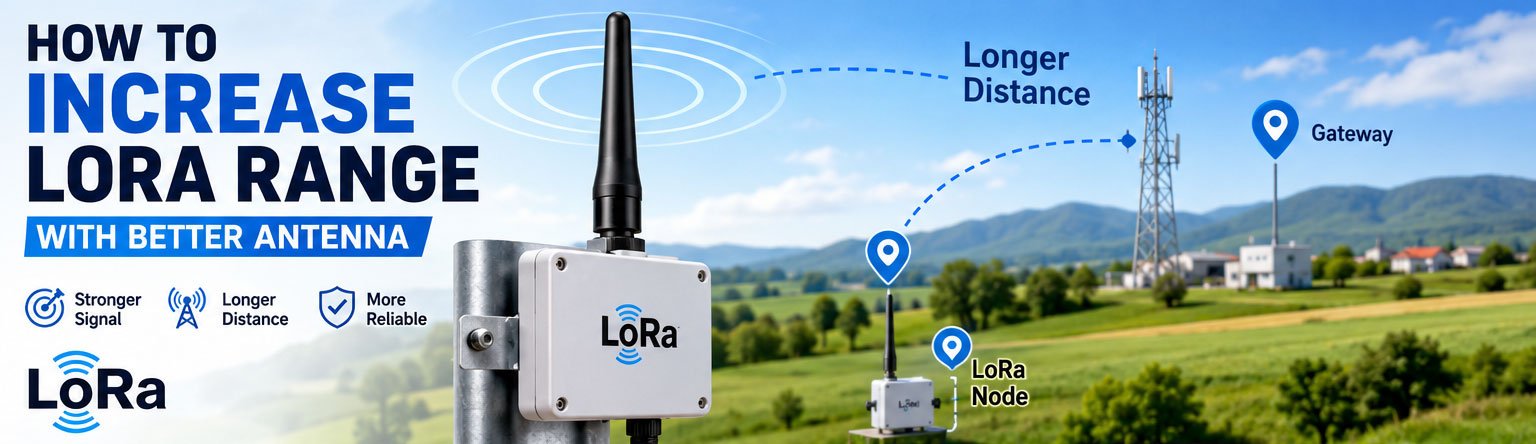
I have worked with many LoRa devices for gateways, sensors, smart meters, farms, and industrial sites. I learned one clear point from these projects. The antenna is not just an accessory. It is part of the whole radio system. If I choose it only by gain number, I may miss the real reason for poor range. If I match the antenna to the frequency, device, cable, enclosure, and site, I can often get a much stronger and more stable link. That is where the real range starts.
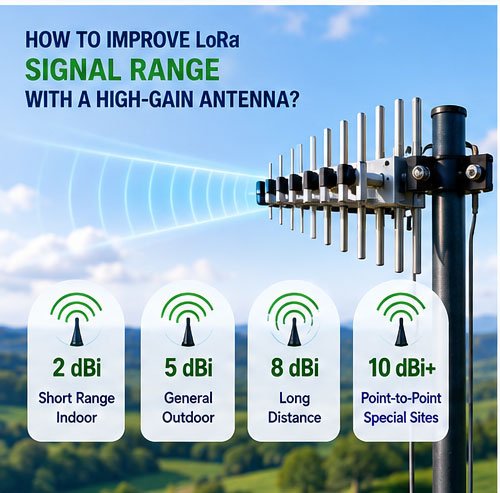
How to Improve LoRa Signal Range with a High-Gain Antenna?
I often see weak LoRa links caused by small low-gain antennas. The signal fades fast. A high-gain antenna can focus energy better.
I improve LoRa signal range with a high-gain antenna by matching the gain, frequency, radiation pattern, and mounting height to the real LoRa application. I do not pick the highest gain blindly. I choose the gain that fits the coverage shape.
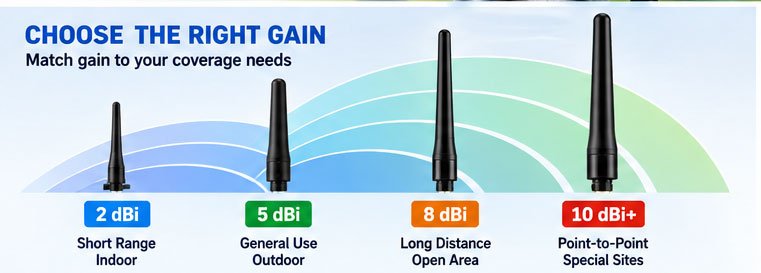
I choose gain based on coverage shape
I treat antenna gain as a tool, not as a magic number. A high-gain antenna can help LoRa reach farther, but it also changes the signal shape. I often explain it like a flashlight. A low-gain antenna spreads light in many directions. A high-gain antenna sends light farther in a narrower shape. This is useful for long outdoor links. It may be less useful when sensors sit above, below, and around the gateway.
| Antenna Choice | Best Use | My Main Check |
|---|---|---|
| 2 dBi antenna | Short range, indoor, mixed directions | I check stable nearby coverage |
| 5 dBi antenna | General outdoor IoT use | I check balance between range and coverage |
| 8 dBi antenna | Long distance, open area | I check mounting height and direction |
| 10 dBi+ antenna | Point-to-point or special sites | I check beam angle and legal limits |
I also check frequency. LoRa may use 433 MHz, 868 MHz, 915 MHz, or other bands. A 915 MHz antenna cannot work at best on 868 MHz. The difference may look small, but it can reduce real field performance. I always match the antenna band before I talk about gain.
Boost Your LoRa Coverage with the Right Antenna Setup?
I have seen good antennas perform badly because the setup was wrong. A poor mount, bad cable, or metal box can waste signal fast.
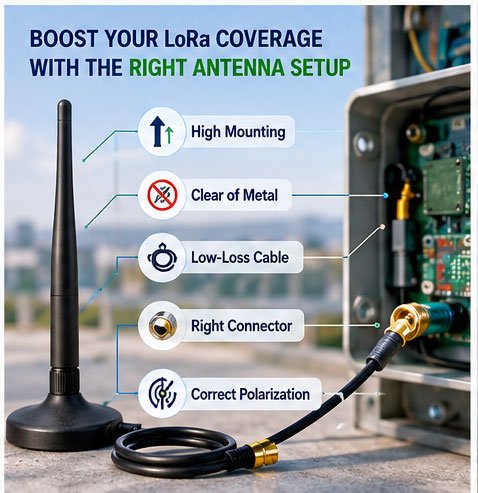
I boost LoRa coverage with the right antenna setup by placing the antenna high, keeping it clear of metal, using low-loss cable, and matching the connector and frequency. The setup can matter as much as the antenna itself.
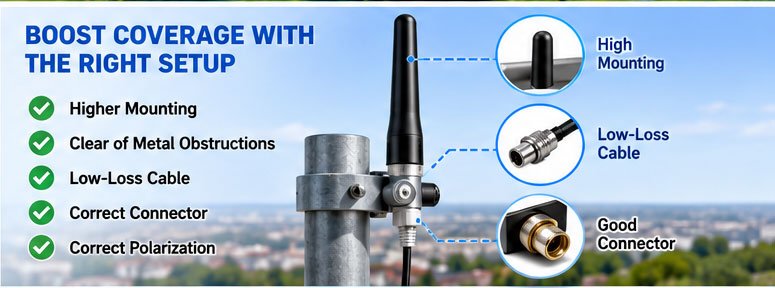
I fix the setup before I blame the antenna
I do not judge a LoRa antenna only on a bench test. I ask where the device will be used. I ask if the device is inside a plastic box, a metal cabinet, a vehicle, a pole, or a wall. The same antenna can give very different results in these places. A metal enclosure can block or detune the antenna. A long poor cable can lose signal before it reaches the antenna. A connector mismatch can also add loss.
| Setup Factor | Bad Result | My Better Choice |
|---|---|---|
| Antenna near metal | Signal pattern changes | I move it away or use an external antenna |
| Long thin cable | RF loss increases | I use shorter or lower-loss coaxial cable |
| Wrong connector | Weak or unstable contact | I match SMA, RP-SMA, N-type, IPEX, or other types |
| Low mounting height | More obstacles block signal | I mount higher when the site allows it |
I also keep the antenna vertical when the system expects vertical polarization. If one antenna is vertical and the other is horizontal, I may lose a lot of signal. This detail looks simple, but I have seen it cause many range complaints.
10 Ways to Extend LoRa Communication Range Using Better Antennas?
I know LoRa can reach far, but small antenna mistakes reduce distance. Many failures come from simple parts that people ignore.
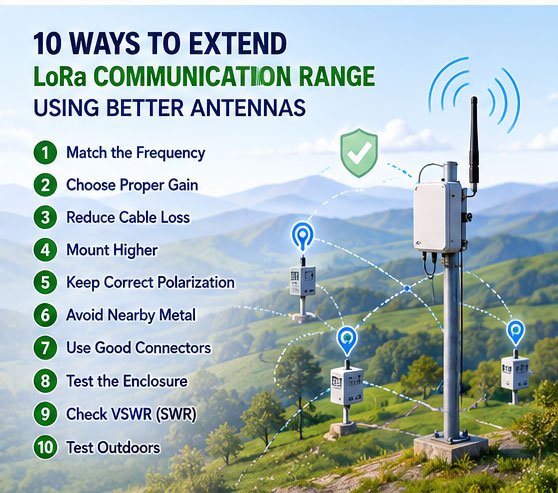
I extend LoRa communication range by improving antenna gain, frequency match, cable quality, mounting height, polarization, ground plane, connector quality, enclosure design, site clearance, and field testing. These ten points help me find real problems fast.
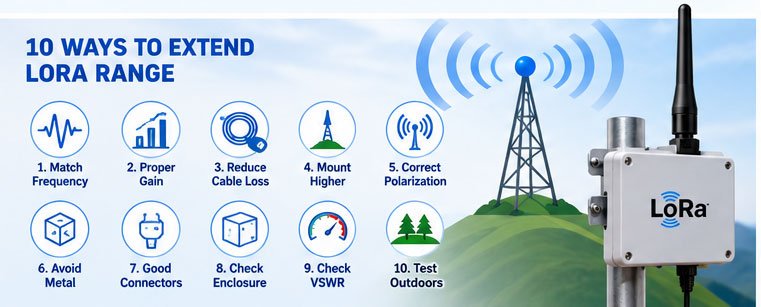
I use a simple checklist in real projects
I like checklists because they stop me from guessing. When a customer tells me that a LoRa node has poor range, I do not start by replacing everything. I check the antenna system step by step. Many times, the antenna itself is not bad. It is just not suitable for the device or site. A small terminal antenna may work in a test room, but it may fail in a farm field when the enclosure, battery, and mounting position change the signal.
| Way | What I Do | Why It Helps |
|---|---|---|
| 1 | I match the frequency | The antenna works near its tuned band |
| 2 | I choose proper gain | The signal fits the coverage need |
| 3 | I reduce cable loss | More power reaches the antenna |
| 4 | I mount higher | Fewer obstacles block the path |
| 5 | I keep correct polarization | Both antennas receive better |
| 6 | I avoid nearby metal | The pattern stays more stable |
| 7 | I use good connectors | Contact loss stays low |
| 8 | I test the enclosure | Plastic and metal affect tuning |
| 9 | I check VSWR | The antenna match is clear |
| 10 | I test outdoors | The real site gives real answers |
I also remind myself that LoRa range is a system result. The antenna is very important, but the radio power, receiver sensitivity, spreading factor, local noise, and terrain also matter.
Maximize LoRa Performance with an Optimized Antenna?
I sometimes see buyers ask for a “strong antenna” only. That is risky. Strong does not always mean optimized.
I maximize LoRa performance with an optimized antenna by tuning the antenna for the exact frequency, device space, installation method, and target range. I also check VSWR, gain, efficiency, and real field results.
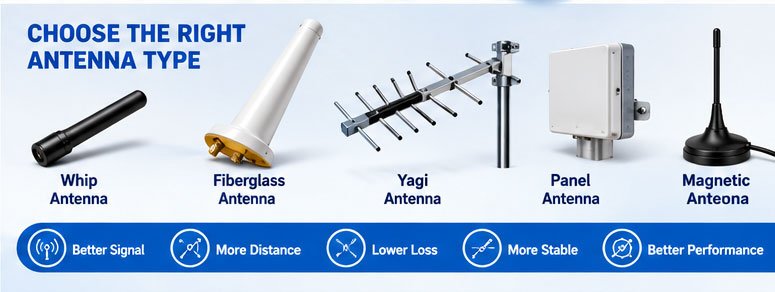
I define performance before I design or choose
I start with the use case. A LoRa water meter, a smart parking sensor, and an outdoor gateway do not need the same antenna. The water meter may need a compact internal antenna. The gateway may need a fiberglass outdoor antenna. The parking sensor may sit close to the ground, so the antenna must handle a hard environment. If I use one standard antenna for all three, I may get poor results in at least one project.
| Performance Item | What I Check | My Reason |
|---|---|---|
| Frequency | 433, 868, 915 MHz, or custom band | The antenna must be tuned correctly |
| VSWR | Low reflection in working band | The radio sends power more efficiently |
| Gain | Useful dBi for coverage | The signal shape must fit the site |
| Efficiency | Real radiated energy | Small antennas may have hidden loss |
| Mechanical design | Size, cable, connector, housing | The antenna must fit the product |
I also test the antenna near the real PCB and battery. Internal antennas are very sensitive to the product layout. A ground plane change can shift frequency. That is why I prefer sample testing before mass production.
How a Better Antenna Can Double Your LoRa Range?
I cannot promise double range in every case. I can say that a poor antenna often wastes enough signal to make a big difference.
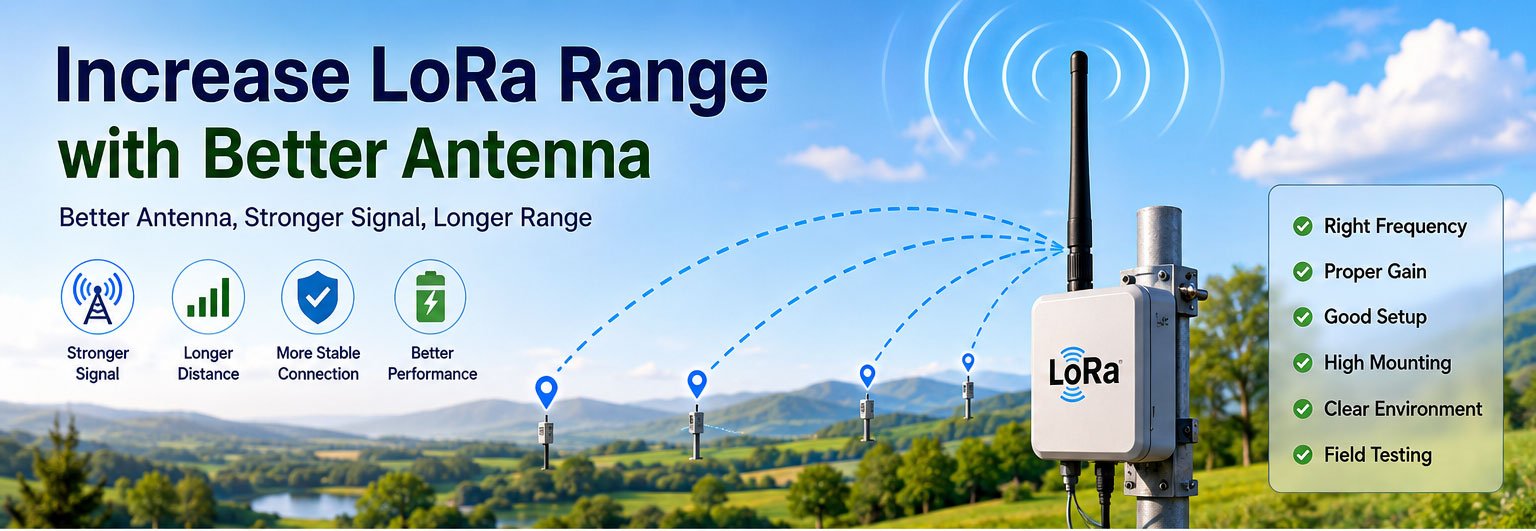
A better antenna can double LoRa range when the old antenna has poor tuning, low efficiency, high cable loss, or a bad mounting position. The improvement comes from reducing loss and sending the signal in a more useful direction.
I look for hidden loss first
When I hear that a better antenna doubled the range, I usually suspect the old system had hidden loss. The old antenna may have been tuned for the wrong band. The cable may have been too long or too thin. The antenna may have been blocked by metal. The antenna may also have been installed inside an enclosure that changed its frequency. In those cases, a better antenna is not just adding gain. It is removing waste.
| Hidden Problem | What It Does | How I Improve It |
|---|---|---|
| Wrong frequency antenna | It reflects or loses power | I use the correct LoRa band antenna |
| Poor efficiency | It turns RF energy into heat | I choose a tested antenna design |
| Bad cable | It reduces transmit and receive signal | I use shorter low-loss cable |
| Metal blocking | It changes radiation direction | I move antenna outside or away |
| Bad ground plane | It shifts tuning | I adjust PCB or use external antenna |
I also manage expectations. If the original antenna was already good, the range may not double. It may improve by a smaller but still useful amount. Real range depends on the link budget and the field environment.
Increase LoRa Transmission Distance with Simple Antenna Upgrades?
I like simple upgrades because they save time. Many LoRa range issues do not need a full product redesign.
I increase LoRa transmission distance with simple upgrades like using a higher-quality antenna, changing to an external antenna, shortening the cable, choosing low-loss coax, and mounting the antenna higher and clearer.
I start with changes that are easy to test
I often begin with the easiest upgrade. If a device uses a small internal antenna, I test an external whip antenna or a fiberglass antenna with the same frequency. If the gateway antenna is mounted low, I lift it higher and compare RSSI and packet loss. If the coaxial cable is long, I try a shorter cable. These tests are simple, but they can show the main problem quickly.
| Simple Upgrade | Test Method | My Expected Result |
|---|---|---|
| Change internal to external antenna | I compare signal outside the box | The signal often becomes stronger |
| Use correct band antenna | I test 868 MHz or 915 MHz as needed | VSWR and link quality improve |
| Shorten coaxial cable | I compare RSSI before and after | Cable loss goes down |
| Use fiberglass antenna | I test outdoors on a pole | Coverage becomes wider and more stable |
| Raise mounting height | I test line-of-sight paths | Obstacles affect the link less |
I also pay attention to waterproofing. Outdoor LoRa antennas need stable housings, sealed connectors, and proper mounting parts. A good upgrade should last in rain, sun, and wind. Range is not useful if the antenna fails after a few months.
The Best Antenna Tips for Longer LoRa Range?
I have learned that small antenna tips can prevent large field problems. The best range often comes from careful basic work.
My best antenna tips for longer LoRa range are to match the frequency, use proper gain, mount the antenna high, avoid metal, reduce cable loss, keep polarization aligned, and test in the real site.
I keep the basics clear and repeatable
I do not treat LoRa antenna selection as a one-time purchase. I treat it as part of product design. I first confirm the region and frequency. Europe often uses 868 MHz. North America often uses 915 MHz. Some projects use 433 MHz. Then I check the device size, connector, cable length, installation place, and target distance. These details help me avoid the wrong antenna at the start.
| Tip | My Action | Common Mistake I Avoid |
|---|---|---|
| Match frequency | I choose the right LoRa band | I do not mix 868 and 915 MHz casually |
| Check gain | I select gain for coverage shape | I do not choose highest gain by default |
| Control cable loss | I use suitable coaxial cable | I do not use long poor cable |
| Watch the enclosure | I test inside final housing | I do not trust open-air tests only |
| Test in the field | I measure real packet success | I do not rely only on data sheets |
I also ask for real product conditions when I support customers. A data sheet helps, but it cannot show every installation issue. A clear photo of the device and site often tells me more than a long message.
Enhance LoRa Connectivity with High-Performance Antennas?
I see LoRa connectivity problems when the signal is near the limit. Packets drop. Devices reconnect. The network looks unstable.
I enhance LoRa connectivity with high-performance antennas by improving antenna efficiency, stable matching, weather resistance, and installation quality. A good antenna helps both transmission and reception, so the link becomes more reliable.
I focus on stability, not only long distance
Connectivity is more than maximum range. A LoRa node may connect at five kilometers one day and fail the next day because of rain, noise, battery level, or movement. I want stable margin. A high-performance antenna gives the link more margin when the environment changes. This is important for IoT projects because many sensors work without human attention.
| Antenna Feature | Why I Care | What I Check |
|---|---|---|
| Stable VSWR | The radio works with less reflection | I test across the LoRa band |
| Good efficiency | More signal is radiated | I compare real performance |
| Strong housing | Outdoor use needs durability | I check UV, water, and material |
| Solid connector | Contact must stay stable | I inspect SMA, N-type, or IPEX quality |
| Repeatable production | Each batch should perform the same | I check quality control records |
I also care about manufacturing consistency. One good sample is not enough for a real product launch. I need antennas that perform the same in batch production. This is why ISO-style process control and stable test methods matter in antenna supply.
How to Get More Range from Your LoRa Network with Better Antennas?
I often find that network range problems come from both node antennas and gateway antennas. Improving only one side may not be enough.
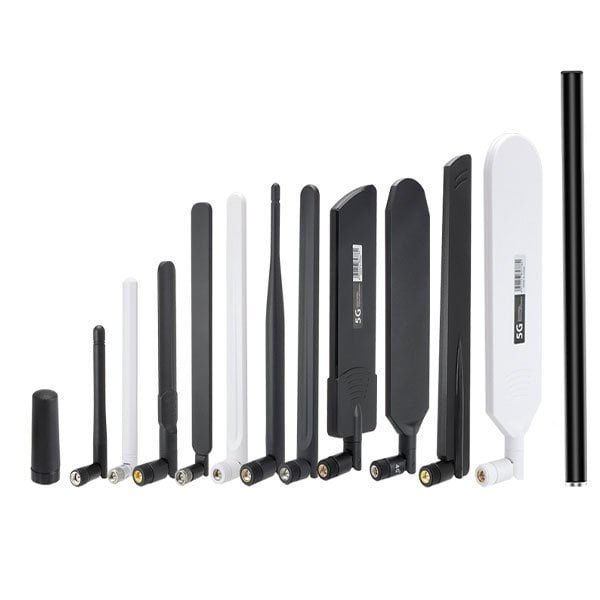
I get more range from a LoRa network by improving antennas on both the gateway and end devices. I also place the gateway antenna higher, use low-loss cable, and make sure each node antenna fits its enclosure and location.
I treat the network as two sides of one link
A LoRa link has two ends. The gateway sends and receives. The node also sends and receives. If the gateway has a great antenna but the node has a weak internal antenna inside a metal box, the link may still fail. If the node antenna is good but the gateway antenna is mounted behind a wall, the network also suffers. I need to improve both sides when I want real coverage.
| Network Side | My Antenna Focus | My Usual Upgrade |
|---|---|---|
| Gateway | Height, gain, outdoor durability | Fiberglass antenna on a clear pole |
| Outdoor node | Waterproofing and stable pattern | External antenna with sealed cable |
| Indoor node | Small size and enclosure tuning | PCB or flexible antenna tuned in housing |
| Mobile node | Vibration and connector strength | Rugged whip antenna or cabled antenna |
| Dense sensor area | Coverage balance | Medium gain antenna with wide pattern |
I also check gateway cable length. A gateway may use a high-gain antenna, but a long cheap cable can remove much of the benefit. I prefer placing the radio closer to the antenna when possible, or using a better coaxial cable.
Unlock Greater LoRa Coverage Through Antenna Optimization?
I believe many LoRa systems already have more possible range inside them. The antenna system just needs better tuning and placement.
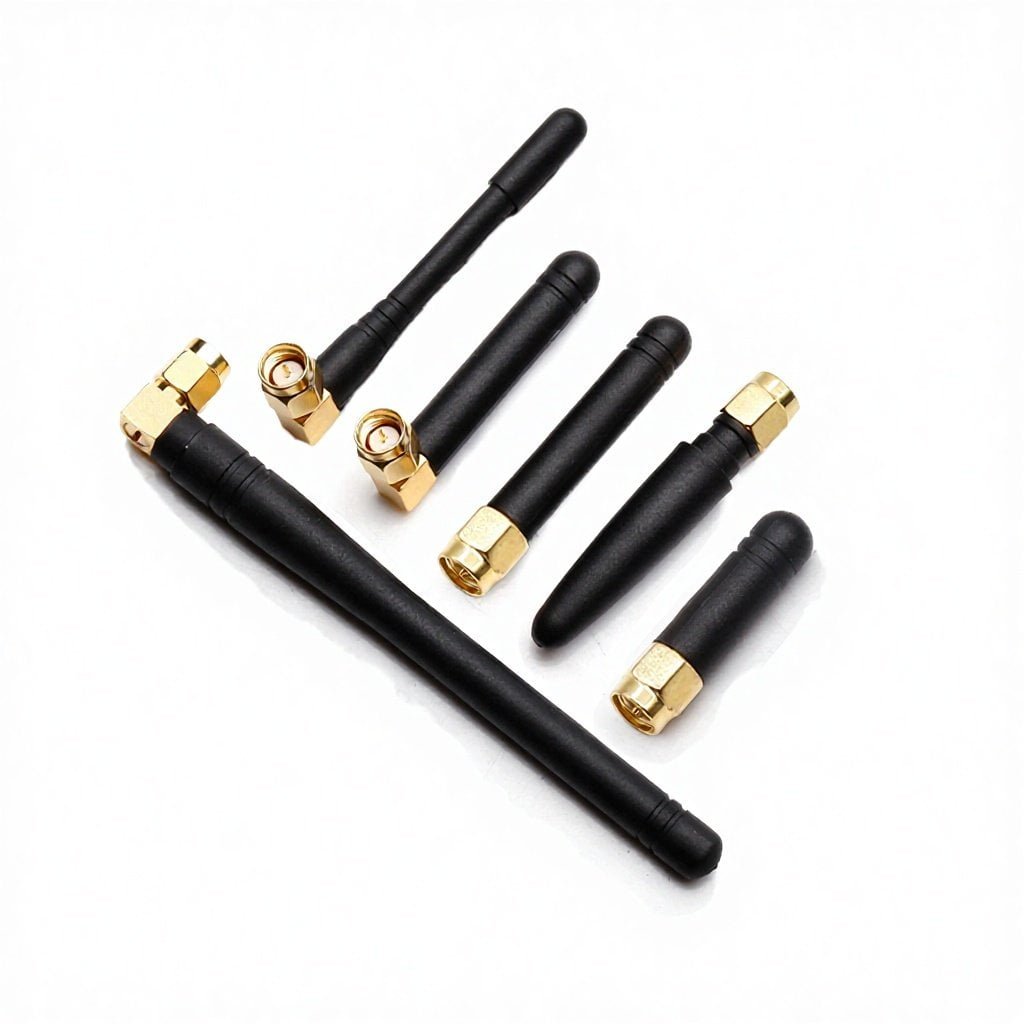
I unlock greater LoRa coverage through antenna optimization by testing frequency match, radiation pattern, gain, cable loss, enclosure effect, and real field performance. I make changes based on data, not guesswork.
I use testing to turn guesses into choices
Antenna optimization is not only theory. I need measurement and field feedback. I use tools like a network analyzer when I need to check VSWR and frequency tuning. I also use RSSI, SNR, and packet success rate in real LoRa tests. These values help me understand if the antenna change really helps. A beautiful antenna does not matter if the data does not improve.
| Test Item | What It Shows | How I Use It |
|---|---|---|
| VSWR | Antenna match at frequency | I confirm the antenna is tuned |
| RSSI | Received signal strength | I compare antenna positions |
| SNR | Signal quality against noise | I judge link margin |
| Packet success rate | Real communication result | I check practical reliability |
| Field distance test | Real coverage | I confirm final choice |
I also optimize for the final product, not only for the sample table. If the antenna will be used with a certain cable length, connector, plastic shell, or mounting bracket, I test that full setup. The best antenna is the one that works well in the final real condition.
Conclusion
I increase LoRa range by choosing the right antenna, installing it correctly, and testing it in the real environment where the device must work.