Designing a custom antenna for your product can bring significant performance advantages, but the thought of unexpected costs, like mold charges, often raises concerns for procurement managers. It’s a common problem: you need a unique solution, but you worry about the initial investment. Understanding in what scenarios mold charges apply to custom antennas is crucial for accurate budgeting and effective supplier negotiations.
Mold charges typically apply to custom antennas when the unique design requires new tooling for components like the radome, housing, or specific mounting brackets that cannot be produced using existing molds or standard fabrication methods. This investment covers the creation of specialized dies, injection molds, or casting tools necessary to achieve the antenna's specific physical dimensions, material properties, and aesthetic requirements.
Navigating the landscape of custom antenna manufacturing costs can feel complex, especially when discussing tooling. Let's delve deeper into the specific situations and factors that determine when these mold fees are necessary and how they impact your overall project budget.
When Are Mold Fees Required for Custom Antenna Manufacturing?
The prospect of custom antenna manufacturing often raises questions about initial costs, and mold fees are a primary concern for many buyers. It's a challenging situation when you need a perfectly integrated antenna, but are unsure if your unique design will trigger significant upfront tooling expenses. Understanding the conditions that necessitate these fees is key to planning your project accurately.
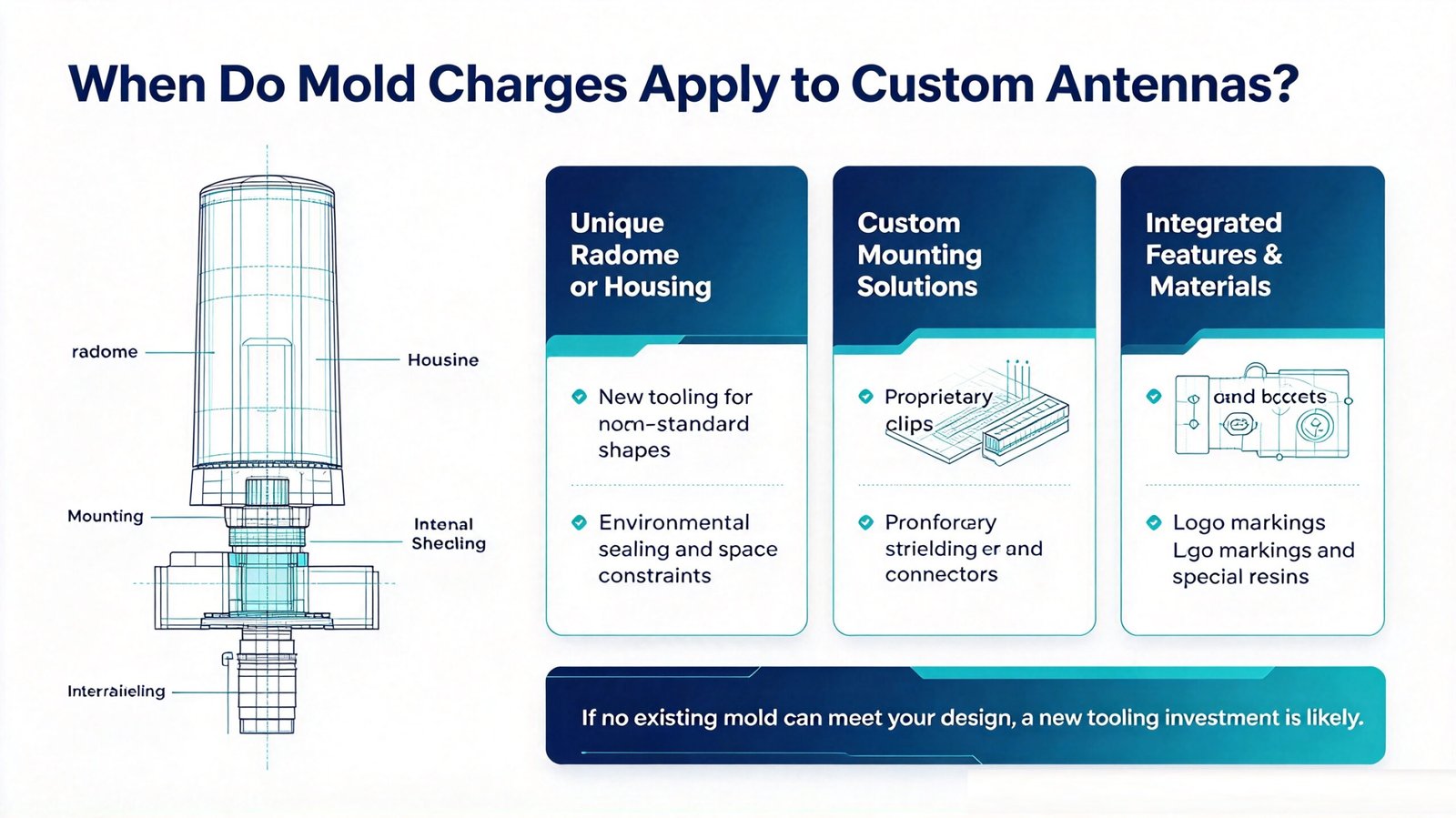
Mold fees are typically required for custom antenna manufacturing when your design deviates significantly from standard product offerings, necessitating the creation of new physical forms or specialized components. This includes custom radomes, unique mounting solutions, specific housing designs, or proprietary connectors that cannot be produced with existing factory molds or readily available off-the-shelf parts.
Dive Deeper: Specific Triggers for New Mold Development
When we talk about mold charges applying to custom antennas, it's usually because the physical attributes of the antenna are unique to your application. As a manufacturer with over 17 years of experience, we've seen countless custom antenna projects, and I can tell you that the need for a new mold almost always stems from a functional or aesthetic requirement that existing tools simply cannot meet.
Here are the primary scenarios that trigger the need for new mold development:
-
Unique Radome or Housing Design: The most common reason for new mold charges is a custom radome or housing. This could be due to:
- Specific Aesthetic Requirements: Your product might demand a particular shape, size, or color that integrates seamlessly into its industrial design. For example, a sleek IoT device might require a flush-mounted antenna with a unique curvature that isn't standard.
- Environmental Protection: If the antenna needs to withstand extreme conditions (e.g., high temperatures, corrosive chemicals, specific waterproofing standards like IP67), it might require a custom-designed housing from specialized materials or with unique sealing mechanisms that necessitate a new mold.
- Space Constraints: Often, devices have very limited internal space. A custom antenna might need to conform to an irregular cavity, requiring a highly specific, non-standard housing. My colleagues often work with clients who need an antenna to fit into a very specific and unconventional space within their product.
- Antenna Array Integration: For advanced antenna arrays or MIMO configurations, the individual antenna elements and their housing might need to be precisely spaced and shielded within a custom-molded enclosure for optimal performance.
-
Custom Mounting Solutions: While some custom antennas can utilize standard mounting hardware, many applications demand integrated or unique mounting brackets.
- Proprietary Mounting Systems: If your device uses a non-standard clip, screw pattern, or adhesive mounting surface, a mold might be needed to create a bracket that perfectly aligns with your product's design.
- Enhanced Durability: For antennas in harsh environments (e.g., automotive, heavy machinery), a custom-molded, reinforced mounting solution might be necessary to ensure long-term stability and vibration resistance.
-
Integrated Components or Unique Features: Beyond just the outer shell, mold charges can arise from custom internal structures or integrated features.
- Internal Shielding: Specific internal structures for RF shielding or impedance matching might require custom molding within the antenna's housing.
- Embedded Connectors/Cables: While standard connectors are common, a highly integrated design might require a custom-molded base that encapsulates a specialized connector or a unique cable exit point, reducing strain or enhancing sealing.
- Branding/Logos: For brand recognition, a client might request their logo or specific markings be molded directly into the antenna's housing, which requires a custom mold cavity. This is a common request for brand-conscious customers, particularly those selling in competitive markets.
-
Material Selection: While materials themselves don't always require a new mold, specific material choices might necessitate custom tooling. For instance, if a standard mold was designed for ABS but you require a high-performance LCP (Liquid Crystal Polymer) for dielectric properties, the shrinkage rates and processing temperatures might be so different that a new mold optimized for LCP is required.
-
Small Production Volumes with High Customization: For very small batch production, if the degree of customization is high, the per-unit cost of tooling can be substantial. However, the need for the mold is driven by the design, regardless of volume. Our flexible MOQ policy means we can sometimes work with clients to spread these costs or explore alternative, less tooling-intensive manufacturing methods if feasible.
In essence, if your custom antenna needs to look, fit, or perform in a way that no existing mold can accommodate, then a new mold investment will likely be part of the project. It's about achieving that perfect blend of form, fit, and function for your specific application.
What Factors Determine Mold Costs for Custom antennas?
Understanding that mold fees can apply is one thing, but knowing what drives the actual cost of these molds is another crucial piece of the puzzle for buyers. It can be frustrating to receive quotes where mold costs vary significantly, leaving you unsure of what factors are truly influencing the price. We often get asked, "Why does this mold cost so much?" or "Can we reduce this tooling expense?"
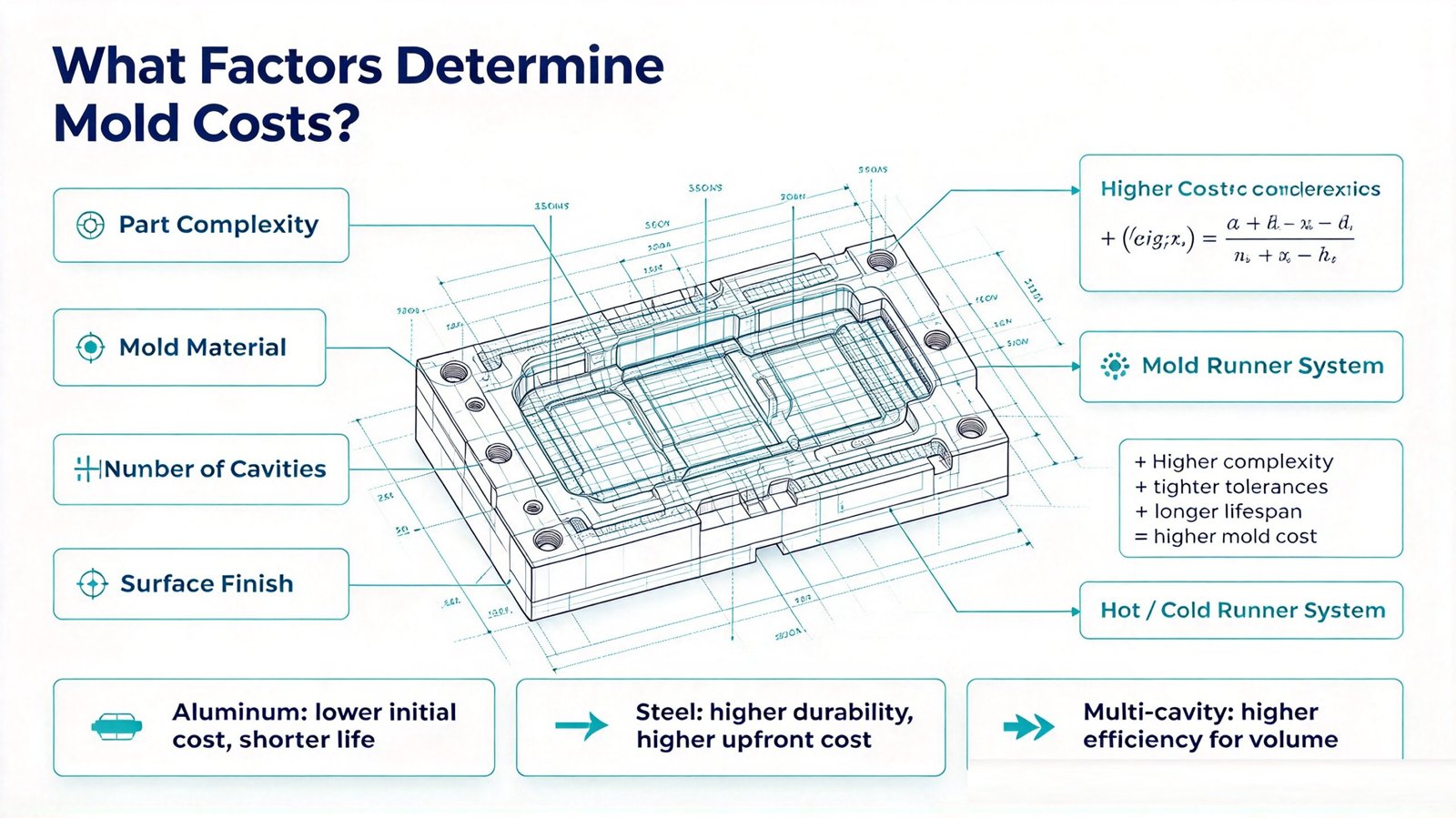
Mold costs for custom antennas are primarily determined by the complexity of the part design, the type of material used for the mold (e.g., steel, aluminum), the required lifespan of the mold (influenced by production volume), the precision and surface finish specifications, and the number of cavities. More intricate designs, higher durability requirements, and stricter tolerances all contribute to higher mold fabrication expenses.
Dive Deeper: Deconstructing the Cost of Custom Antenna Tooling
When we provide a quote for mold charges for custom antennas, several critical elements are factored in. These aren't arbitrary numbers; they reflect the engineering expertise, material expense, and manufacturing effort required to create a precision tool that will consistently produce high-quality antenna components.
Here's a breakdown of the key factors influencing mold costs:
-
Design Complexity and Geometry:
- Intricacy of Shape: Highly complex shapes with undercuts, internal features, thin walls, or intricate textures require more advanced mold design and machining. This means more CNC machine time, specialized tooling for the mold itself, and often necessitates multi-part molds with slides, lifters, or core pulls, all of which add to the cost. My team often spends considerable time optimizing complex geometries to ensure manufacturability while minimizing mold costs.
- Part Size: Larger antenna housings or radomes naturally require larger molds, consuming more material and requiring larger machining equipment, which increases costs.
- Dimensional Tolerances: If your custom antenna component requires extremely tight dimensional tolerances (e.g., for precision fitment or critical RF performance), the mold must be built to higher precision, leading to increased machining time, more sophisticated measurement equipment, and potentially more rework during mold trials.
-
Mold Material:
- Steel vs. Aluminum: Steel molds (e.g., P20, H13, S7, D2 tool steel) are more durable, offer a longer lifespan, and are suitable for high-volume production and tougher plastics. They are, however, more expensive and slower to machine. Aluminum molds are quicker and cheaper to produce but have a shorter lifespan, making them ideal for prototyping or low-volume runs. The choice depends on your projected annual volume.
- Specialty Steels: For abrasive materials, high-temperature plastics, or highly corrosive environments, specialty hardened steels might be required, further increasing the material and machining costs.
-
Number of Cavities:
- A single-cavity mold produces one part per cycle. A multi-cavity mold (e.g., 2-cavity, 4-cavity, 8-cavity) produces multiple parts per cycle, drastically increasing production efficiency and lowering the per-part cost in the long run. However, multi-cavity molds are significantly more expensive to build due to increased material, machining time, and complexity in ensuring all cavities produce identical parts. We often recommend multi-cavity molds for clients with high volume forecasts to optimize their total cost of ownership.
-
Surface Finish Requirements:
- Aesthetic Finish: If your custom antenna's exterior needs a highly polished (SPI A-1 finish) or textured (e.g., matte, sandblasted) surface, this requires additional labor-intensive polishing or etching processes on the mold cavity. This significantly impacts cost compared to a basic, utilitarian finish.
- Functional Finish: Sometimes a specific surface roughness is needed for adhesion, paint, or other functional purposes.
-
Mold Lifespan and Production Volume:
- The expected total number of parts to be produced over the mold's lifetime (e.g., 10,000, 100,000, 1,000,000+ shots) directly influences the choice of mold material and construction robustness. A mold for a million parts will be significantly more expensive than one for 10,000 parts because it requires higher-grade materials, more robust mechanisms, and potentially more durable coatings. This is a key discussion point during initial quotations.
-
Hot Runner vs. Cold Runner Systems:
- Cold Runner: Simpler and cheaper to build, but generates plastic waste (sprue) that needs to be removed and possibly recycled.
- Hot Runner: More expensive to build, but eliminates waste and often improves cycle times and part quality by keeping the plastic molten up to the gate. This is often preferred for high-volume, high-precision custom antennas where material waste is costly.
-
Engineering and Design Expertise:
- The initial mold design, DFM (Design for Manufacturability) analysis, and simulation (e.g., mold flow analysis) are crucial for preventing costly errors during production. Highly skilled mold designers and engineers contribute to the overall mold cost but save money in the long run by ensuring a robust, efficient mold. Our experienced engineering team in Shenzhen is a major advantage here.
-
Testing and Validation:
- Initial mold trials (T0, T1 samples), adjustments, and retesting are part of the mold development process. More complex designs or tighter tolerances may require more iterations, adding to the overall cost.
By understanding these interwoven factors, you can better appreciate why a specific mold quote is structured as it is and engage more effectively in discussions with your antenna manufacturer.
How Do Mold Charges Affect the Cost of Custom Antenna Development?
When embarking on a custom antenna project, buyers are naturally focused on the overall budget, and mold charges can introduce a significant upfront investment that impacts the entire development timeline and cost structure. It can be daunting to consider a potential five-figure or even six-figure tooling fee before a single antenna is produced. My clients often ask, "How will this mold cost truly impact my project's bottom line?"
Mold charges significantly affect the overall cost of custom antenna development by introducing a substantial upfront capital expenditure. This initial investment in tooling, which can range from hundreds to tens of thousands of dollars or more, directly impacts the project's break-even point, minimum order quantities (MOQ), and ultimately, the per-unit cost of the antenna, especially for lower production volumes.
Dive Deeper: Financial Implications and Strategic Considerations
The impact of mold charges applying to custom antennas extends far beyond just the initial invoice. It's a strategic investment that influences procurement decisions, product pricing, and long-term financial planning. From our perspective as an OEM/ODM manufacturer, guiding clients through these implications is essential for a successful partnership.
Here’s how mold charges fundamentally affect your custom antenna development costs:
-
Upfront Capital Expenditure:
- Initial Investment: Mold charges represent a non-recurring engineering (NRE) cost. Unlike unit prices, this is a one-time fee paid before mass production begins. For many businesses, especially startups or those with tight R&D budgets, this can be a significant hurdle. It shifts a portion of the project's financial burden to the early stages.
- Budget Allocation: Companies must allocate a substantial part of their development budget specifically for tooling. This might mean fewer funds available for other aspects of product development, marketing, or inventory.
-
Impact on Unit Cost and Break-Even Point:
- Amortization: The mold cost is typically amortized (spread out) over the total number of parts expected to be produced using that mold.
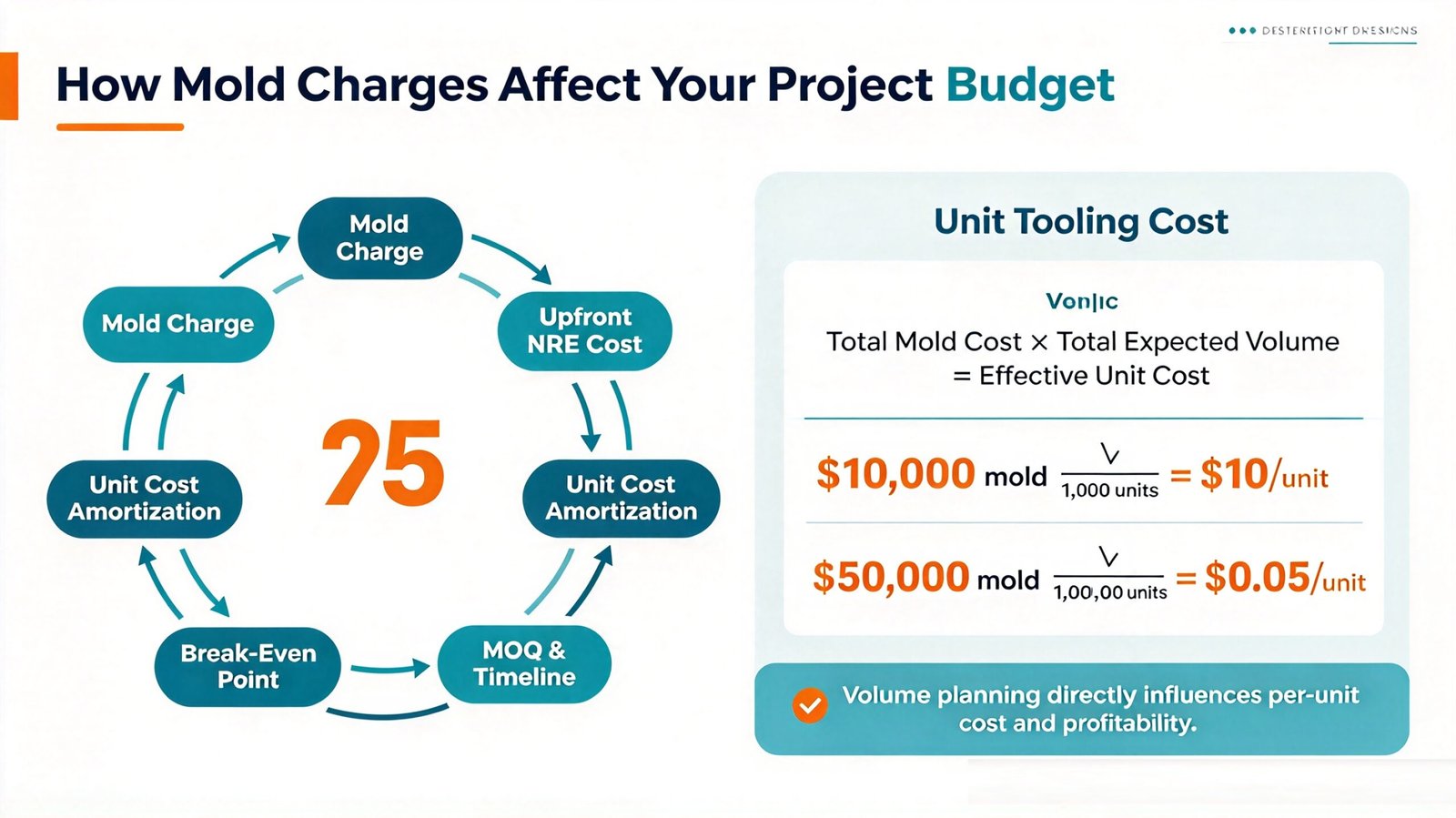
- Formula: Effective Unit Tooling Cost = Total Mold Cost / Total Expected Production Volume
- High vs. Low Volume:
- For low-volume custom antenna projects, the mold cost per unit can be very high. For example, a $10,000 mold for 1,000 units adds $10 per unit.
- For high-volume projects, the mold cost per unit becomes negligible. A $50,000 mold for 1,000,000 units adds only $0.05 per unit.
- This direct correlation means that evaluating the mold cost in relation to your projected sales volume is critical for accurate per-unit cost calculation and setting competitive market prices. It directly affects when your product will become profitable.
- Amortization: The mold cost is typically amortized (spread out) over the total number of parts expected to be produced using that mold.
-
Minimum Order Quantity (MOQ) and Flexibility:
- Manufacturer Incentive: Manufacturers invest significant time and resources in building a custom mold. To recoup this investment (or at least justify the effort), they often require a higher MOQ for custom-molded parts compared to standard, off-the-shelf items or custom antennas that use existing tooling.
- Buyer Impact: This higher MOQ can tie up more capital in inventory for the buyer, especially if market demand is uncertain. We try to offer flexible MOQs where possible, but for complex custom molds, there's often a baseline for viability.
-
Development Timeline Extension:
- Mold Design and Fabrication Time: Creating a new custom mold is a process that typically takes several weeks to months, depending on complexity. This period includes design, material sourcing, CNC machining, polishing, assembly, and initial testing (T0/T1 samples).
- Iterative Adjustments: Rarely is a mold perfect on the first shot. Adjustments (e.g., to address shrinkage, warpage, or dimensional inaccuracies) often require further machining and re-testing, extending the timeline further. This directly impacts your product's time-to-market.
-
Risk and Quality Control:
- Initial Quality: The quality of the mold directly impacts the quality and consistency of every part it produces. Investing in a high-quality mold from a reputable manufacturer like us minimizes risks of defective parts, costly rework, and production delays down the line. We emphasize rigorous quality control throughout the mold-making process, including ISO9001 standards.
- Maintenance and Longevity: While not an upfront cost, the mold's quality also determines its lifespan and maintenance requirements. A cheaper, lower-quality mold might require more frequent repairs or premature replacement, leading to unexpected costs later.
-
Strategic Sourcing Decisions:
- Manufacturer Selection: The ability of a manufacturer to manage mold design, fabrication, and subsequent production is a key differentiator. A supplier like us, offering end-to-end solutions from design to mass production with in-house engineering capabilities, can often streamline this process and offer more integrated cost management.
- Tooling Ownership: It's important to clarify who owns the mold once paid for. Typically, the customer owns the mold, giving them flexibility for future production or potential transfer to another supplier (though transferring molds can be complex).
In summary, while mold charges are a considerable initial expense for custom antennas, they are an investment in the unique form, fit, and function of your product. Carefully considering these financial and timeline implications is vital for making informed procurement decisions and ensuring the long-term success of your custom antenna project.
How to Reduce Mold Costs When Ordering Custom antennas
The idea of custom antenna solutions is exciting for product innovation, but the associated mold charges can sometimes seem prohibitive, especially for businesses managing tight budgets. Many of my clients approach us seeking to optimize their custom antenna projects, asking directly, "What steps can I take to reduce the mold costs without compromising too much on design or performance?" It's a critical question that speaks to cost-efficiency and smart procurement.
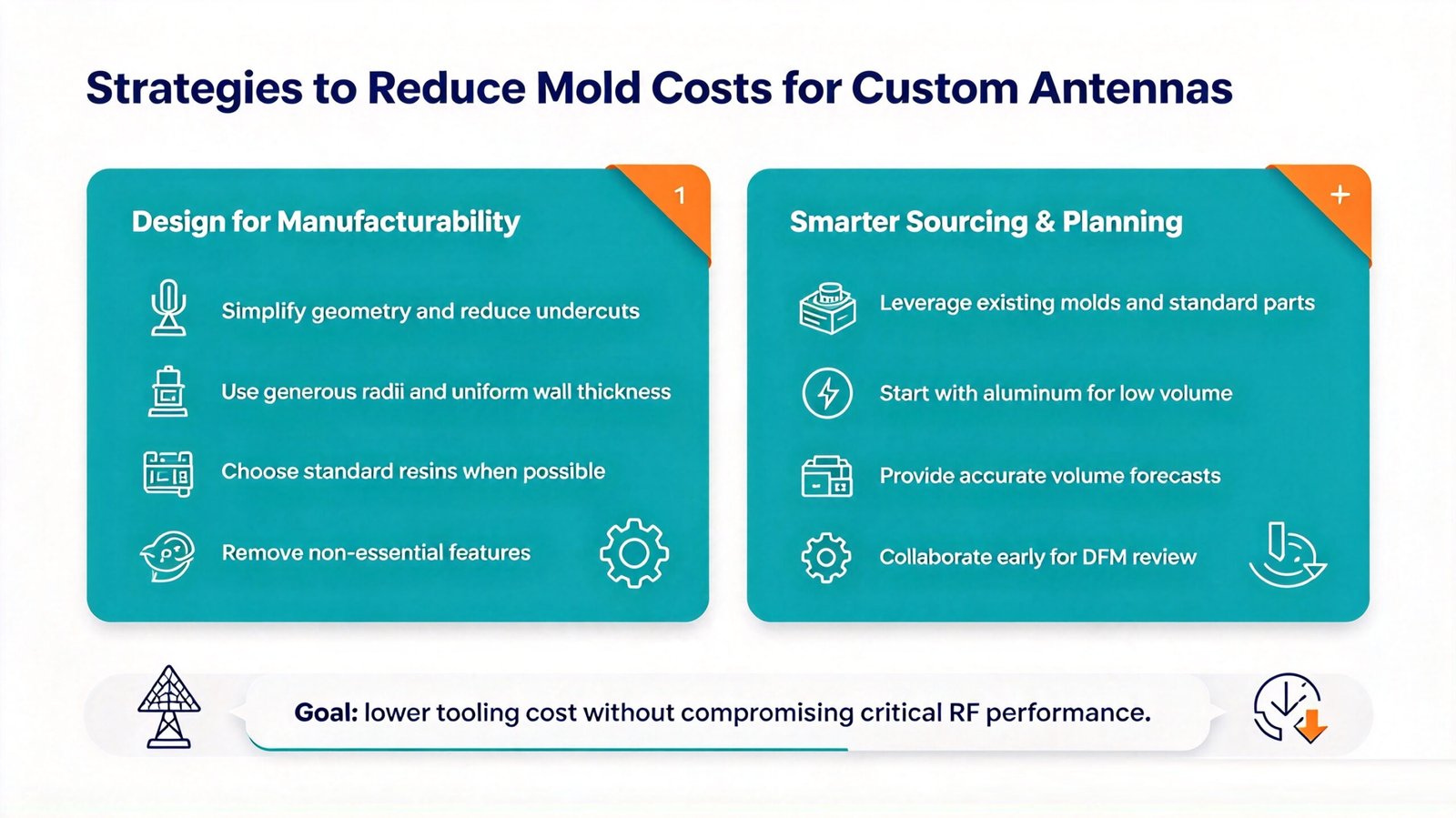
To effectively reduce mold costs when ordering custom antennas, focus on simplifying the part geometry, optimizing material choices, strategically planning production volumes, and leveraging existing tooling or standard components where possible. Early collaboration with a experienced manufacturer is paramount to identify cost-saving opportunities in design for manufacturability (DFM) and tooling selection.
Dive Deeper: Practical Strategies for Mold Cost Optimization
Reducing mold charges for custom antennas doesn't mean sacrificing quality or functionality entirely. Instead, it involves smart design choices and strategic planning in close collaboration with your manufacturing partner. As a manufacturer specializing in OEM/ODM capabilities, we regularly work with clients to find the most cost-effective solutions.
Here are actionable strategies to help you minimize mold costs:
-
Simplify Design for Manufacturability (DFM):
- Avoid Unnecessary Complexity: Every curve, undercut, thin wall, or intricate feature adds to the mold's complexity and cost. Can a sharp corner be rounded? Can an internal feature be simplified or removed? My engineers are experts at reviewing designs for opportunities to simplify without impacting critical performance.
- Minimize Undercuts and Side Actions: Undercuts require complex mold mechanisms like slides or lifters, which significantly increase mold cost and maintenance. Redesigning parts to eliminate or minimize undercuts can lead to substantial savings.
- Uniform Wall Thickness: Maintaining relatively uniform wall thickness throughout the part helps prevent warping and reduces the need for complex cooling channels, simplifying the mold.
- Generous Radii: Sharp internal and external corners require more delicate machining and can stress the mold. Adding radii reduces cost and improves part strength.
-
Optimize Material Selection:
- Standard vs. Specialty Materials: The choice of plastic (e.g., ABS, PC, Nylon, LCP) impacts the mold material and design. Using common, easy-to-mold plastics (like ABS) can reduce mold costs compared to high-performance, abrasive, or high-temperature resins that require hardened steel molds.
- Consider Mold Material: For lower production volumes, discussing the possibility of an aluminum mold instead of a steel mold can significantly cut initial tooling costs, acknowledging its shorter lifespan.
-
Leverage Existing Tooling and Standard Components:
- Utilize Existing Molds: This is the most direct way to avoid new mold charges. While you need a "custom antenna," can its housing or certain components be adapted from existing molds already owned by the manufacturer? We maintain a library of common antenna housings and radomes that might fit your needs with minor modifications.
- Standard Parts: Can standard screws, clips, or brackets be used instead of custom-molded mounting features? Using off-the-shelf connectors instead of custom-integrated ones can also bypass mold costs for connector housing.
- Modular Design: Design your custom antenna in modules where some parts can be standard and only truly unique components require new tooling.
-
Strategic Production Volume Planning:
- Accurate Forecasts: Providing accurate long-term production volume forecasts allows the manufacturer to recommend the most cost-effective mold solution (e.g., single-cavity vs. multi-cavity, aluminum vs. steel). Over-specifying mold durability for low volumes is a common mistake.
- Phased Investment: For new products with uncertain market demand, consider starting with a lower-cost, lower-capacity mold (e.g., aluminum, single-cavity) for initial market testing. Once demand is proven, you can invest in a higher-capacity, more durable mold.
-
Early Collaboration with Manufacturer:
- DFM Review: Engage your chosen antenna manufacturer early in the design phase. Our engineering team can conduct a Design for Manufacturability (DFM) review and suggest modifications that reduce mold complexity and cost without compromising critical performance. This proactive approach saves significant time and money compared to redesigning after the mold is quoted or even built.
- Transparent Communication: Clearly communicate your budget constraints, target unit costs, and volume expectations. This allows the manufacturer to propose alternative solutions and explore options.
-
Consider Additive Manufacturing for Prototypes/Low Volume:
- For very low volume custom antennas or initial prototypes, consider using 3D printing (additive manufacturing) for the housing or radome. While unit costs are higher than injection molding, there are no mold charges, making it a viable option for initial runs before committing to costly tooling for mass production.
By taking these steps, you can actively influence and reduce the mold charges applying to custom antennas, making your custom antenna project more financially viable and efficient from concept to market. Our goal is always to provide high-quality, cost-effective solutions that meet your specific needs.
Frequently Asked Questions
Do all custom antennas require new mold charges?
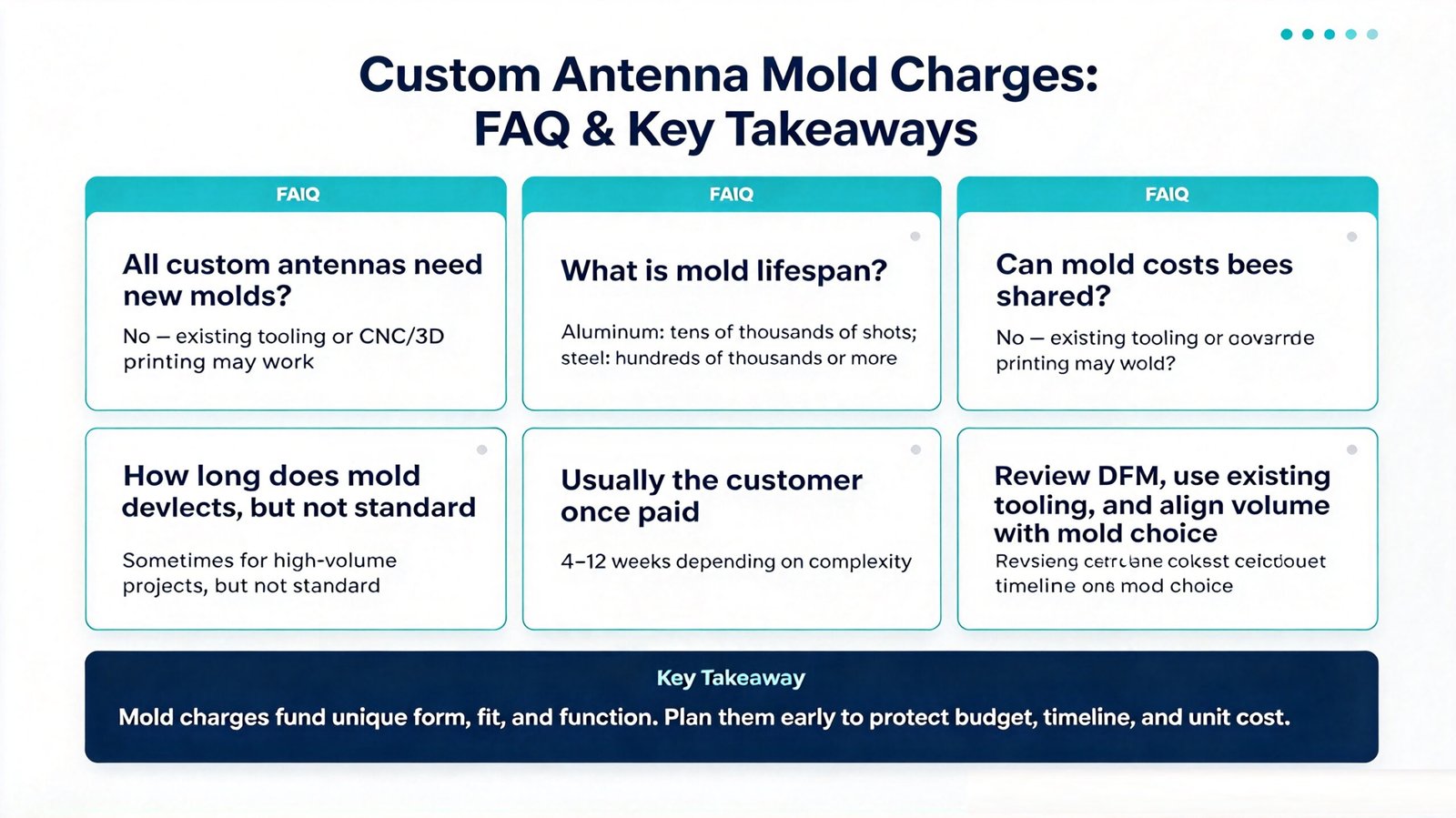
No, not all custom antennas require new mold charges. If your custom design can utilize existing molds for standard components like housings or radomes, or if the unique parts can be produced through subtractive manufacturing (CNC machining) or 3D printing without tooling, then mold charges may be avoided. The need for a new mold depends on the physical uniqueness and required production method for the specific component.
What is the typical lifespan of a custom antenna mold?
The typical lifespan of a custom antenna mold varies significantly based on the mold material and construction quality. An aluminum mold might last for tens of thousands of shots, suitable for low to medium volumes. A high-quality hardened steel mold, designed for high-volume production, can last for hundreds of thousands, or even millions, of shots with proper maintenance.
Can I share mold costs with the manufacturer?
Sharing mold costs with a manufacturer is sometimes possible through negotiation, especially for very high-volume projects where the manufacturer sees significant long-term business. However, it's not a standard practice for all custom antenna projects. Typically, the customer covers the full mold cost as it represents their specific intellectual property and tooling investment.
Who owns the custom antenna mold after it's paid for?
In most standard agreements, once the customer pays the mold charges, they own the mold. This means the customer has the right to request the mold be transferred to another manufacturer (though transfer fees and logistics apply) or to keep it in storage at the original manufacturer for future production runs. Always clarify mold ownership in your contract.
How long does it take to create a new custom antenna mold?
The time to create a new custom antenna mold varies based on complexity. Simple molds might take 4-6 weeks, while complex, multi-cavity, or high-precision molds can take 8-12 weeks or even longer. This timeline includes design, material acquisition, machining, assembly, and initial testing (T0/T1 samples).
Conclusion
Understanding in what scenarios mold charges apply to custom antennas is vital for any business looking to develop tailored communication solutions. While these charges represent an initial investment, they are directly tied to the unique form, fit, and function your product requires. Factors like design complexity, material choice, and production volume all play a role in determining the final cost, and smart procurement strategies can help mitigate these expenses.
As a manufacturer with over 17 years of experience in communication antennas and RF solutions, we emphasize transparency and collaboration. We are committed to providing high-quality, customizable, and stable antenna products for our global clientele. If your project demands a truly unique antenna solution, don't hesitate to reach out. Our engineering team in Shenzhen is ready to discuss your specific requirements, provide expert DFM analysis, and help you navigate the process of custom antenna development, ensuring a cost-effective and high-performance outcome.