Choosing the right fiberglass antenna is critical for ensuring reliable and efficient outdoor wireless communication, yet many face challenges in matching antenna specifications to specific application needs. Without the correct antenna, you risk poor signal quality, limited range, and frequent connection drops, leading to frustrating and inefficient operations. I understand this common struggle, and our goal is to help you navigate the complexities of antenna selection.
To choose a fiberglass antenna for outdoor wireless communication, prioritize its frequency band, gain, and durability to withstand environmental factors like wind, water, and corrosion. Ensure its design aligns with your required communication distance and coverage pattern, while also considering feeder cable loss and appropriate mounting solutions for stable, long-term performance in diverse outdoor settings.
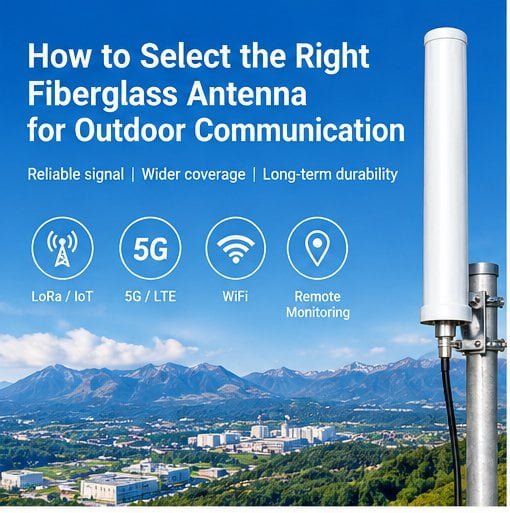
The quest for stable outdoor wireless networks often leads to questions about the optimal antenna choice. This guide will walk you through the essential considerations, helping you confidently select a fiberglass antenna that meets your project's demands, from remote IoT deployments to robust base station links.
How to Select the Right Fiberglass Antenna for Outdoor Communication?
Selecting the ideal fiberglass antenna for outdoor communication can feel overwhelming given the array of options and technical specifications. Many projects falter because the chosen antenna doesn't precisely match the network's operational requirements, leading to performance gaps and costly re-installations. We know this frustration, and it highlights the need for a systematic approach to antenna selection.
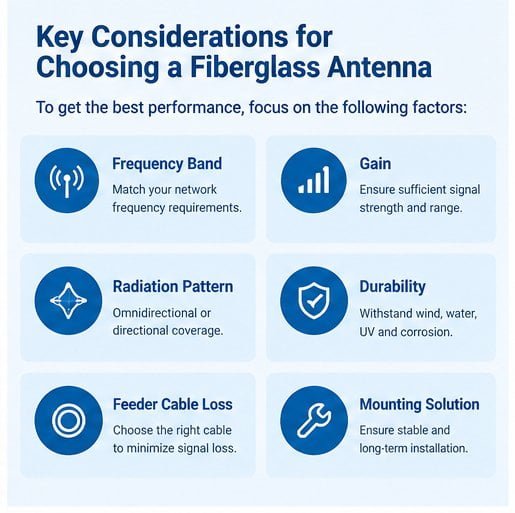
To select the right fiberglass antenna for outdoor communication, begin by identifying your target frequency band, required gain, and desired radiation pattern (omnidirectional or directional) to meet specific coverage and distance objectives. Next, assess the environmental conditions it will face, ensuring the antenna's construction offers sufficient weather resistance and durability for long-term outdoor deployment.
Dive Deeper: Matching Technical Specifications to Application Needs
When we assist our clients, the first step is always a detailed understanding of their application. A fiberglass antenna's effectiveness is profoundly tied to how well its technical characteristics align with the wireless system's demands. Here's how we break it down:
-
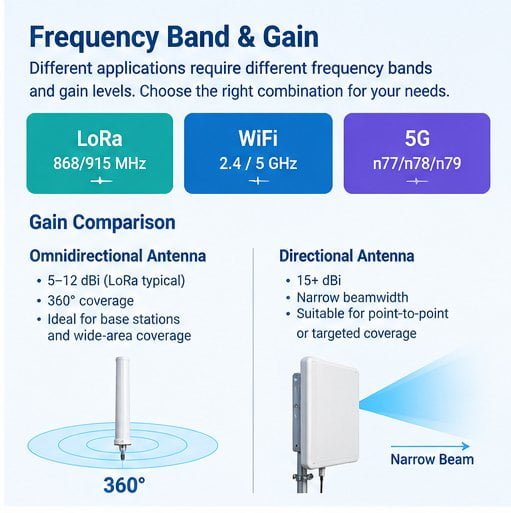
Frequency Band Compatibility: The most fundamental criterion is ensuring the antenna operates within your desired frequency range. Different applications utilize different bands—for instance, LoRaWAN typically uses sub-1 GHz frequencies (e.g., 868 MHz or 915 MHz), while 5G and Wi-Fi operate in higher bands (e.g., 2.4 GHz, 5 GHz, or even millimeter-wave bands). An antenna designed for 2.4 GHz will not perform effectively at 915 MHz. Our engineering team meticulously designs antennas to specific frequency bands, ensuring optimal impedance matching and radiation efficiency across the target spectrum. This precision is critical for minimizing signal loss and maximizing data throughput.
-
Antenna Gain (dBi): Gain is a measure of an antenna's ability to direct radio frequency (RF) energy in a specific direction, increasing signal strength and communication range. Higher gain generally means a longer reach but a narrower beamwidth.
- Omnidirectional Antennas: Ideal for broad coverage, such as a central base station needing to communicate with multiple devices in all directions. They typically have moderate gain (e.g., 5 dBi to 12 dBi for LoRa applications) and a 360-degree horizontal beamwidth. A high-gain omnidirectional fiberglass antenna for outdoor communication can extend the range significantly for IoT networks.
- Directional Antennas: Best for point-to-point links or covering a specific sector. They offer higher gain (e.g., 15 dBi or more) but a much narrower beamwidth, requiring precise aiming. For example, our panel antennas offer directional capabilities suitable for covering specific areas. The choice depends entirely on your network topology. For outdoor wireless communication, especially over long distances, selecting a fiberglass antenna with appropriate gain is paramount to overcome path loss and environmental interference.
-
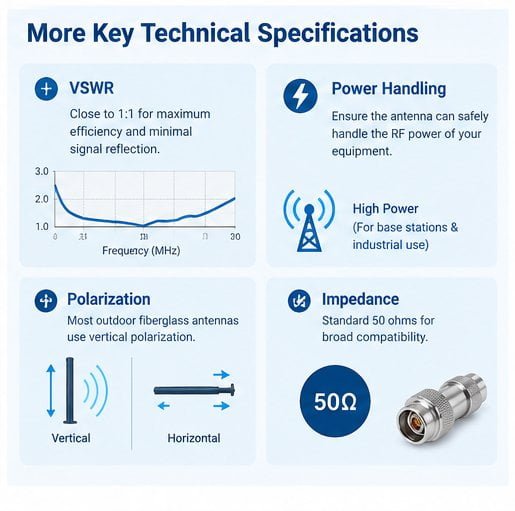
VSWR (Voltage Standing Wave Ratio): This parameter indicates how well the antenna is matched to the transmission line. A VSWR close to 1:1 signifies minimal signal reflection and maximum power transfer from the radio to the antenna. A high VSWR (e.g., 2:1 or higher) means significant power is reflected, leading to reduced efficiency and potential damage to the radio. Our manufacturing process includes rigorous testing to ensure our fiberglass antennas maintain a low VSWR across their operating band, guaranteeing efficient power transfer.
-
Power Handling: This specifies the maximum RF power an antenna can safely handle without damage. For most IoT and Wi-Fi applications, power requirements are relatively low. However, for higher-power base stations or specialized industrial applications, this becomes a more critical factor. We design our antennas to safely handle the typical power outputs of commercial and industrial communication equipment.
-
Polarization: Most fiberglass antennas for outdoor use are vertically polarized, which is common for mobile and many fixed wireless applications. However, specific applications might require horizontal or even circular polarization. It's crucial to match the antenna's polarization to that of the communicating device for optimal signal reception.
-
Impedance: Standard RF systems operate at 50 ohms impedance. An antenna must also present a 50-ohm impedance to the radio and cable to ensure efficient power transfer. Our fiberglass antennas are designed to match this standard, minimizing signal reflections and maximizing system performance.
When evaluating an antenna, I always recommend looking beyond just the headline gain figure. Understand the full data sheet, including beamwidth, front-to-back ratio (for directional antennas), and the impedance curve. Our engineering team provides comprehensive datasheets and is always ready to consult on the best antenna choice for your unique outdoor wireless communication challenges.
What Environmental Factors Influence Fiberglass Antenna Performance?
Outdoor wireless communication systems are constantly exposed to harsh environmental conditions, and failing to account for these can severely compromise antenna longevity and signal reliability. Many overlook the impact of sustained UV radiation, extreme temperatures, or corrosive elements until performance degrades, leading to unexpected maintenance and system downtime. We've seen projects suffer when a seemingly robust antenna wasn't truly built for the long haul.
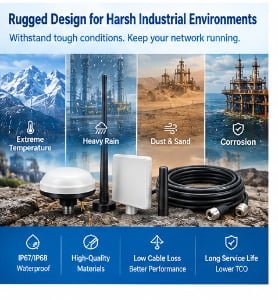
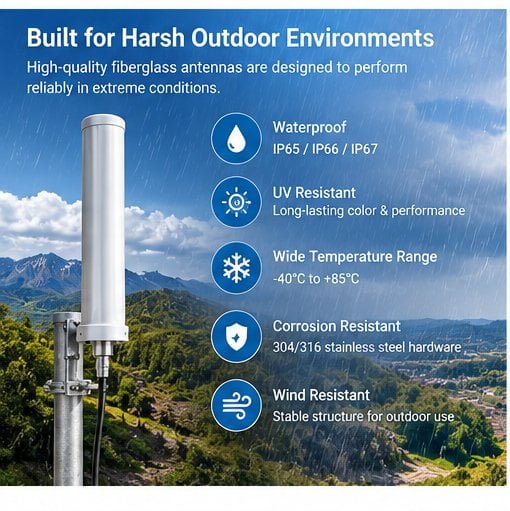
Environmental factors significantly influencing fiberglass antenna performance include wind load, UV radiation, temperature extremes, moisture (rain, snow, humidity), and corrosive agents like salt spray or industrial pollutants. A high-quality fiberglass antenna for outdoor wireless communication must be designed with robust materials and sealing to withstand these challenges, ensuring stable operation and extended lifespan.
Dive Deeper: Designing for Durability and Reliability
The very nature of outdoor deployment means your antenna must be a fortress against the elements. Our 17+ years of experience in manufacturing antennas for global markets, from scorching deserts to freezing arctic conditions, have taught us invaluable lessons about material science and structural integrity.
-
Wind Load and Structural Integrity: Strong winds are a primary concern for any outdoor structure. A fiberglass antenna's design must account for significant wind loading to prevent bending, cracking, or catastrophic failure.
- Material Strength: The fiberglass radome (outer casing) provides the necessary protection for the internal radiating elements. High-grade fiberglass offers excellent strength-to-weight ratio. We use premium fiberglass that is robust yet lightweight, minimizing stress on mounting hardware.
- Mounting Hardware: The antenna is only as strong as its weakest link. We provide industrial-grade mounting brackets and U-bolts, often made from stainless steel, designed to securely attach the antenna to poles or walls and withstand strong gusts. The entire structure, including the fiberglass antenna itself, must be engineered to resist the maximum expected wind speeds in its deployment location.
- Internal Construction: Beyond the radome, the internal elements and their support structure must be securely fixed to prevent vibration-induced damage or shifting, which can alter the antenna's radiation pattern.
-
UV Radiation and Weathering: Sunlight's ultraviolet (UV) rays can degrade plastics and composites over time, leading to discoloration, embrittlement, and cracking.
- UV-Resistant Materials: Our fiberglass radomes are treated with UV-resistant coatings or incorporate UV-stabilized resins during manufacturing. This ensures the antenna maintains its physical integrity and aesthetic appearance for years, even under intense sun exposure in regions like the Middle East or equatorial areas.
- IP Rating: An Ingress Protection (IP) rating indicates the antenna's resistance to dust and water. For outdoor applications, an IP65, IP66, or even IP67 rating is typically required.
- IP65: Dust tight, protected against water jets.
- IP66: Dust tight, protected against powerful water jets.
- IP67: Dust tight, protected against immersion in water up to 1 meter for 30 minutes. Our fiberglass antennas are designed to meet high IP ratings, ensuring internal components remain dry and free from dust, which can cause short circuits or signal degradation. This protection is vital for maintaining performance during heavy rain, snow, or high humidity.
-
Temperature Extremes: Outdoor temperatures can swing wildly, from sub-zero winters to blistering summers.
- Material Stability: The materials used in the antenna (fiberglass, metals, sealants) must retain their physical and electrical properties across a wide temperature range. Thermal expansion and contraction cycles can stress components if not properly accommodated. We select materials that exhibit high thermal stability, preventing cracks, warping, or changes in electrical characteristics.
- Operational Range: Our antennas are specified with a broad operational temperature range, often from -40°C to +85°C, making them suitable for diverse global climates.
-
Corrosion Resistance: For coastal deployments or industrial environments, salt spray and chemical pollutants can accelerate corrosion of metal components.
- Stainless Steel Hardware: We predominantly use marine-grade stainless steel (e.g., 304 or 316) for all external metal parts, including mounting brackets, connectors, and fasteners. This material offers superior resistance to rust and corrosion.
- Sealed Connectors: The RF connector (e.g., N-type female) where the coaxial cable attaches must be robust and properly sealed. We use high-quality connectors with rubber gaskets and recommend weatherproofing the connection with self-amalgamating tape and electrical tape during installation to prevent moisture ingress.
Understanding these environmental challenges is paramount. Our company's commitment to ISO9001 quality management ensures that every fiberglass antenna for outdoor wireless communication we produce undergoes rigorous material selection and testing processes to deliver superior durability and stable performance, regardless of the operating environment. This proactive approach minimizes field failures and provides our customers with peace of mind.
Why is Antenna Gain Crucial for Outdoor Wireless Communication?
In the realm of outdoor wireless communication, customers often grapple with achieving sufficient signal strength and range, leading to unreliable connections or limited network coverage. This often stems from an underestimation of the importance of antenna gain or a misunderstanding of how it impacts link budget. Without adequate gain, signals dissipate over distance, struggling to overcome obstacles and interference, ultimately compromising the entire communication system.
Antenna gain is crucial for outdoor wireless communication because it quantifies an antenna's ability to focus RF energy, effectively boosting signal strength in desired directions while reducing it elsewhere. This focused energy directly extends communication range, improves signal-to-noise ratio, and enhances link reliability, especially critical for long-distance transmissions and challenging environments where signal attenuation is high.
Dive Deeper: Maximizing Range and Reliability with Gain
Antenna gain, measured in decibels relative to an isotropic radiator (dBi), is not about "creating" power but rather "redistributing" it. An isotropic antenna radiates energy equally in all directions, having 0 dBi gain. A high-gain antenna, by contrast, concentrates that energy into a narrower beam, making the signal stronger in that specific direction.
-
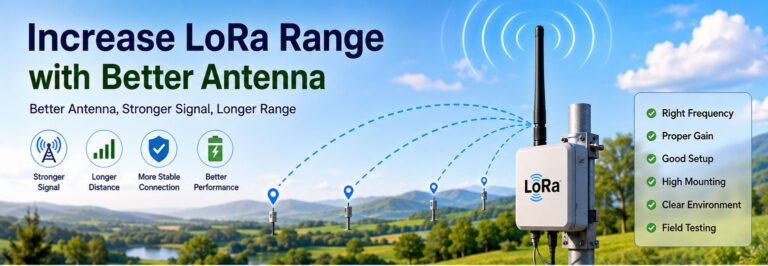
Extending Communication Range: The most direct benefit of higher gain is increased range. For every 3 dBi increase in antenna gain, you effectively double the communication distance (assuming all other factors remain constant). This is especially vital for remote IoT devices or point-to-point links spanning kilometers. If you need a fiberglass antenna for long-range outdoor communication, gain is your primary consideration. Our long-range LoRa antennas, for instance, are designed with higher gain to ensure robust connectivity across vast agricultural fields or smart city infrastructure.
-
Overcoming Path Loss and Obstacles: As RF signals travel through the air, they naturally lose strength due to free-space path loss. Obstacles like buildings, trees, and terrain further attenuate signals. A higher-gain antenna can compensate for this loss by transmitting a stronger signal and being more sensitive to weaker incoming signals. This improved signal-to-noise ratio (SNR) makes the link more robust against interference and environmental noise, leading to fewer retransmissions and higher data throughput.
-
Optimizing Coverage Patterns:
- Omnidirectional High-Gain: For a central base station needing to cover a large area uniformly, a high-gain omnidirectional fiberglass antenna for outdoor communication is often chosen. While omnidirectional, the "gain" is achieved by compressing the vertical beamwidth. This means less energy is wasted radiating directly upwards or downwards, and more is focused horizontally. This effectively creates a wider "donut" shaped coverage area on the ground.
- Directional High-Gain: For point-to-point links, high-gain directional antennas are essential. They concentrate almost all energy in a very narrow beam, allowing for extremely long-distance communication with minimal power. This requires precise alignment between the transmitting and receiving antennas. We offer a range of directional antennas, including sector and panel designs, for specific coverage needs.
-
Link Budget Considerations: In wireless system design, a "link budget" calculation is performed to ensure that sufficient signal strength (received power) will be available at the receiver for reliable communication. Antenna gain is a critical parameter in this calculation.
Received Power (dBm) = Transmit Power (dBm) + Transmit Antenna Gain (dBi) - Path Loss (dB) + Receive Antenna Gain (dBi)By increasing the gain of either the transmitting or receiving antenna (or both), you can directly improve the received power, thereby enhancing the reliability of the link or allowing for greater distances. Our engineering team often works with clients to model link budgets and recommend the appropriate gain for their specific outdoor wireless applications.
-
Balancing Gain and Beamwidth: It's important to understand the trade-off: higher gain always comes with a narrower beamwidth. For omnidirectional antennas, this means a flatter vertical beam. For directional antennas, it means a narrower horizontal and vertical beam. While higher gain is generally desirable for range, too much gain on an omnidirectional antenna in a non-flat terrain could lead to "dead zones" if the vertical beam is too narrow to cover devices at different elevations. Similarly, directional antennas with very high gain require extremely precise alignment, which can be challenging to maintain in windy conditions.
Ultimately, choosing the correct gain for a fiberglass antenna for outdoor wireless communication involves a careful balance between desired range, coverage pattern, environmental conditions, and the specific application's requirements. Our expertise in RF design allows us to help customers select the optimal gain to achieve stable and reliable long-distance outdoor wireless communication.
How Do Installation and Feeder Loss Affect Fiberglass Antenna Performance?
The performance of a high-quality fiberglass antenna for outdoor wireless communication can be significantly degraded by poor installation practices and excessive feeder cable loss, leading to frustratingly diminished signal strength and range. Many customers invest in excellent antennas but overlook the crucial role of proper cabling and mounting, only to discover their system underperforms. This often results in a significant waste of valuable RF energy before it even reaches the antenna.
Installation and feeder loss profoundly affect fiberglass antenna performance because improper mounting can misalign the antenna or weaken its structure, while signal attenuation within the feeder cable directly reduces the effective power reaching the antenna. Minimizing cable length and using low-loss coaxial cables, alongside secure, weather-resistant mounting, are essential to preserve the antenna's intended gain and ensure optimal outdoor wireless communication.
Dive Deeper: Maximizing Efficiency from Radio to Radiator
The journey of an RF signal from your radio to the antenna's radiating elements is critical. Any loss along this path directly subtracts from the antenna's effective performance. Our approach emphasizes optimizing every part of this connection.
-
Feeder Cable Loss (Coaxial Cable Attenuation): The coaxial cable connecting the radio to the antenna is often the biggest source of signal loss. This loss is dependent on several factors:
- Cable Length: The longer the cable, the greater the loss. This is why we always recommend using the shortest practical cable length. If your radio is far from the optimal antenna mounting location, consider moving the radio closer or investing in higher-quality, lower-loss cable.
- Cable Type: Different coaxial cables have different attenuation characteristics. For outdoor wireless communication, especially at higher frequencies (e.g., 2.4 GHz, 5 GHz), even small differences in cable type can lead to significant power loss.
- RG-58: High loss, suitable only for very short runs (<1 meter) at lower frequencies.
- RG-213 / LMR-400 equivalent: Moderate loss, good for medium runs. Our RF coaxial cable assemblies often utilize LMR-400 type cables for outdoor applications, offering a good balance of flexibility and low loss.
- LMR-600 / LMR-900 equivalent: Very low loss, ideal for long runs or critical applications.
- Frequency: Loss increases with frequency. A cable that performs well at 900 MHz might be completely unsuitable at 5 GHz.
- Connectors: Each connector in the cable path introduces a small amount of loss. Using high-quality, properly installed connectors is crucial. Our custom cable assemblies are built with precision-terminated connectors to minimize these losses.
Example Loss Table (approximate, per 100 feet):
| Cable Type | Loss at 900 MHz (dB) | Loss at 2.4 GHz (dB) |
|---|---|---|
| RG-58 | 15-20 | 25-35 |
| LMR-200 | 7-10 | 12-18 |
| LMR-400 | 3-5 | 6-8 |
| LMR-600 | 2-3 | 4-5 |
This table clearly shows that for outdoor wireless communication, especially at higher frequencies, choosing a low-loss cable like LMR-400 or better can be far more impactful than a few dBi gain difference in the antenna itself.-
Proper Mounting and Alignment:
- Secure Installation: A fiberglass antenna must be securely mounted to withstand wind, vibration, and environmental stress. Loose mounts can cause the antenna to shift, altering its radiation pattern and potentially damaging the cable or the antenna itself. We supply robust mounting kits designed for stability.
- Optimal Height: Generally, placing the antenna as high as possible, with a clear line of sight to the desired coverage area or other antennas, is ideal. Obstructions block or reflect signals, causing multipath interference.
- Grounding and Lightning Protection: For outdoor installations, proper grounding is essential to protect equipment from lightning strikes and static buildup. This involves grounding the mast or pole to which the antenna is attached, and often incorporating lightning arrestors in the coaxial cable path.
- Verticality: For omnidirectional antennas, maintaining true verticality is crucial for achieving the specified radiation pattern. Tilting can distort the pattern, leading to uneven coverage. We provide simple yet effective mounting solutions that allow for precise vertical adjustment.
- Directional Alignment: For directional fiberglass antennas, precise alignment towards the target receiving antenna is paramount. Even a few degrees of misalignment can significantly reduce signal strength over long distances. Tools like signal strength meters or spectrum analyzers are often used to fine-tune alignment.
-
Weatherproofing Connections: The connection point between the coaxial cable and the antenna is a vulnerable spot for moisture ingress. Even with high-quality N-type connectors, additional weatherproofing is essential. We recommend using several layers of self-amalgamating tape followed by UV-resistant electrical tape to create a watertight seal. Our antennas are often used in environments with significant rainfall, and this step is critical for long-term reliability.
By paying meticulous attention to feeder loss and installation conditions, you can ensure that the high performance our fiberglass antennas are designed to deliver is fully realized in your outdoor wireless communication system. Our team can also provide guidance on selecting appropriate cable assemblies and best practices for installation.
What Quality and Customization Should You Expect from a Fiberglass Antenna Supplier?
When procuring fiberglass antennas for outdoor wireless communication, many buyers face uncertainty regarding supplier capabilities, particularly around product quality, reliability, and the ability to meet unique project specifications. The market is saturated, making it difficult to discern truly reliable partners from those offering subpar products or limited support. This often leads to concerns about product consistency, performance guarantees, and the flexibility to adapt to evolving project needs.
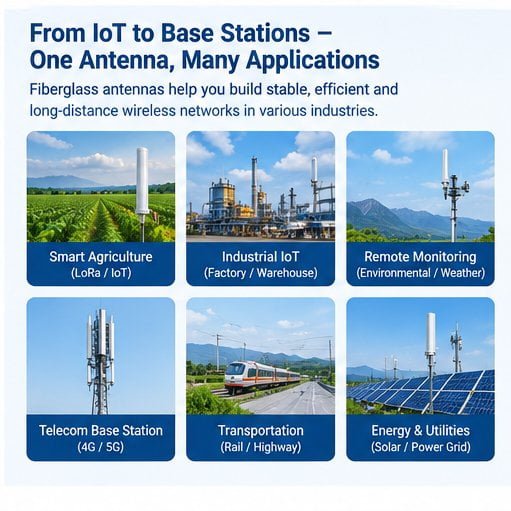
From a fiberglass antenna supplier, you should expect unwavering product quality backed by certifications like ISO9001, transparent performance data, and robust warranty support. Crucially, a top-tier supplier should offer strong OEM/ODM capabilities, providing flexible customization for frequency, gain, connector types, cable lengths, and even aesthetic design, ensuring the antenna perfectly integrates with your specific outdoor wireless communication requirements.
Dive Deeper: Partnering for Performance and Innovation
Selecting a supplier is not just about buying a product; it's about establishing a partnership that ensures the long-term success of your wireless deployments. With over 17 years in the industry, our company, based in Shenzhen, has built its reputation on delivering consistent quality and unparalleled customization.
-
Commitment to Quality and Certifications:
- ISO9001 Certification: This is a fundamental benchmark. Our ISO9001 quality management system ensures that every stage, from design and material sourcing to manufacturing and final inspection, adheres to stringent international standards. This means consistent product quality, fewer defects, and predictable performance for your fiberglass antenna for outdoor wireless communication.
- Product Certifications: Depending on the target markets, products should comply with relevant international standards such as CE (Europe) and RoHS (Restriction of Hazardous Substances). Many of our products meet these standards, facilitating smooth export to Europe, the Americas, Southeast Asia, and the Middle East, where we've shipped to over 100 countries.
- Patents and R&D: Our company holds over 40 patents (including invention and appearance patents), a testament to our commitment to innovation and engineering excellence. This proactive R&D ensures our antennas are at the forefront of technology, offering improved performance and new solutions. Our mature engineering team is constantly developing new designs, such as advanced 5G and LoRa antennas.
- Testing and Validation: A reliable supplier will perform rigorous testing on all products, including VSWR, gain, radiation patterns, and environmental stress tests (temperature, humidity, vibration). We conduct comprehensive tests on every batch to ensure parameters are true and performance is stable.
-
OEM/ODM Capabilities and Customization Flexibility:
- Design and Engineering Expertise: Our integrated R&D, production, and sales model allows for a one-stop service. We don't just sell standard products; we design and manufacture them. This gives us the agility to offer extensive OEM (Original Equipment Manufacturer) and ODM (Original Design Manufacturer) services. Whether you need modifications to an existing design or a completely new antenna developed from scratch, our engineering team can bring your vision to life.
- Customization Options: Our customers often have unique requirements. We regularly customize:
- Frequency Bands: Adjusting the antenna's operating frequency to suit specific regional regulations or niche applications.
- Gain Values: Fine-tuning gain to achieve precise coverage and range.
- Connector Types: Offering various RF connector types (e.g., N-type, SMA, RP-SMA, TNC, FME) to match your equipment.
- Cable Lengths and Types: Providing custom-length, low-loss RF coaxial cable assemblies to minimize feeder loss.
- Mounting Solutions: Adapting mounting hardware for unique installation scenarios.
- Aesthetic Design and Branding: For brand-conscious customers or e-commerce sellers, we can customize antenna colors, logos, and packaging. This includes specific labels, branding, or even modifications to the fiberglass radome's appearance.
- Flexible MOQ: We understand that not all projects require massive volumes. We offer flexible Minimum Order Quantities (MOQ), which is particularly beneficial for small to medium-sized businesses needing to test prototypes or launch new products without committing to huge initial investments. This allows our customers to procure antennas for small batch testing orders confidently.
-
Reliable Supply Chain and Fast Delivery:
- Stable Production System: Our stable production system ensures consistent output and reliable supply, which is critical for customers who depend on just-in-time inventory or need to scale their deployments quickly.
- Fast Response and Delivery: With efficient production processes and experienced logistics, we pride ourselves on rapid response times for inquiries and quick delivery, often a key differentiator for overseas clients.
Choosing a supplier that combines robust quality control, extensive customization capabilities, and a commitment to customer support ensures you get a fiberglass antenna for outdoor wireless communication that is not only high-performing but also perfectly tailored to your project's precise needs. We aim to be that long-term reliable antenna supplier for our global partners.
Frequently Asked Questions
What makes fiberglass ideal for outdoor antennas?
Fiberglass is ideal for outdoor antennas due to its excellent dielectric properties, meaning it minimally interferes with RF signals. Its high strength-to-weight ratio provides robust protection against wind and physical impact, while its resistance to UV radiation, corrosion, and extreme temperatures ensures long-term durability and stable performance in harsh outdoor environments.
Can I use a Wi-Fi fiberglass antenna for LoRa applications?
Generally, no. Wi-Fi (2.4 GHz or 5 GHz) and LoRa (sub-1 GHz, e.g., 868/915 MHz) operate on vastly different frequency bands. An antenna is tuned to a specific frequency range; using a Wi-Fi antenna for LoRa would result in severe signal loss and extremely poor performance due to impedance mismatch and inefficient radiation at the wrong frequency.
How important is the VSWR rating for an outdoor fiberglass antenna?
The VSWR (Voltage Standing Wave Ratio) rating is highly important. A low VSWR (ideally close to 1.0:1) indicates that the antenna is efficiently matched to the radio, minimizing reflected power and maximizing the signal transmitted. A high VSWR means significant power is wasted as reflection, reducing effective range and potentially damaging the radio.
What's the difference between omnidirectional and directional fiberglass antennas?
An omnidirectional fiberglass antenna radiates signal in a 360-degree pattern horizontally, providing broad coverage for a central base station, typically with moderate gain. A directional fiberglass antenna focuses its signal into a narrower beam, offering much higher gain and longer range for point-to-point links or specific sector coverage, requiring precise aiming.
How do I weatherproof my fiberglass antenna connections?
To weatherproof fiberglass antenna connections, first ensure the N-type connector is tightly secured. Then, generously wrap the connection point with several layers of high-quality self-amalgamating tape, stretching it tautly so it fuses into a solid, waterproof seal. Finally, cover the self-amalgamating tape with UV-resistant electrical tape for added protection against environmental degradation.
Conclusion
Choosing the optimal fiberglass antenna for outdoor wireless communication hinges on a thorough understanding of your application's frequency, required communication distance, and the environmental challenges it will face. By carefully considering gain, durability against wind and weather, and minimizing feeder cable loss, you ensure a robust and reliable wireless network. Remember that the quality of both the antenna and its installation directly impacts your system's performance. Our 17 years of expertise in manufacturing communication antennas means we provide not just products, but solutions built for stable, long-term outdoor deployment.
Ready to enhance your outdoor wireless communication? Contact us today to discuss your specific requirements, explore our range of high-quality, customizable fiberglass antennas, and let our engineering team help you find the perfect solution for your next project.