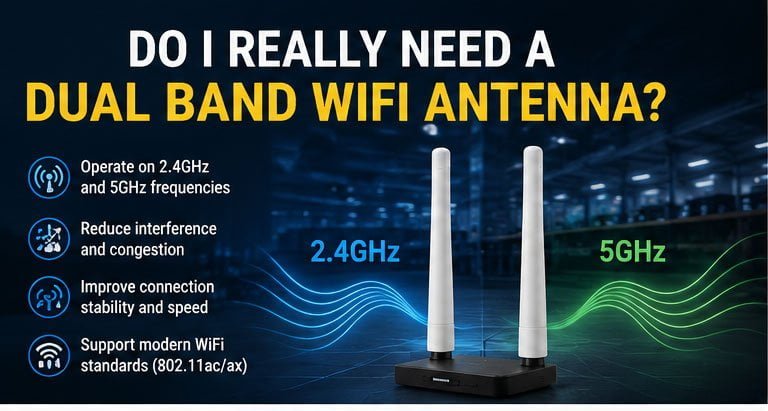
I once installed a WiFi router in my warehouse and thought the signal would be fine. It wasn't. Then I tried a LoRa setup for some sensors, and the range surprised me. The difference came down to one thing: the antenna. Each technology has different needs, and picking the wrong antenna can ruin your project.
LoRa needs a better antenna than WiFi in most cases. LoRa signals travel farther but are weaker, so antenna quality directly affects range and reliability. WiFi operates at higher power and shorter distances, making it more forgiving of average antennas. For long-range IoT applications, LoRa antenna performance is critical.
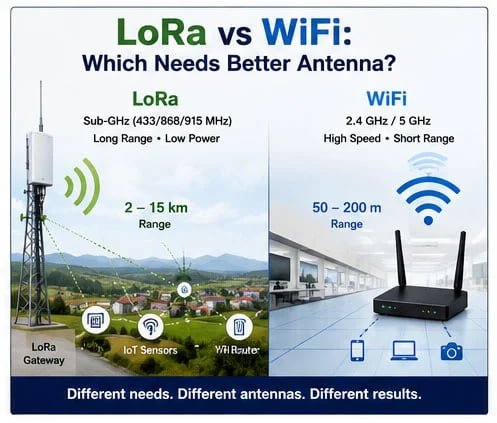
Both technologies serve different purposes. WiFi handles high-speed data over short distances. LoRa sends small packets over many kilometers. The antenna you choose depends on what you're building. Let me walk you through what actually matters.
LoRa vs WiFi: Which Technology Depends More on Antenna Performance?
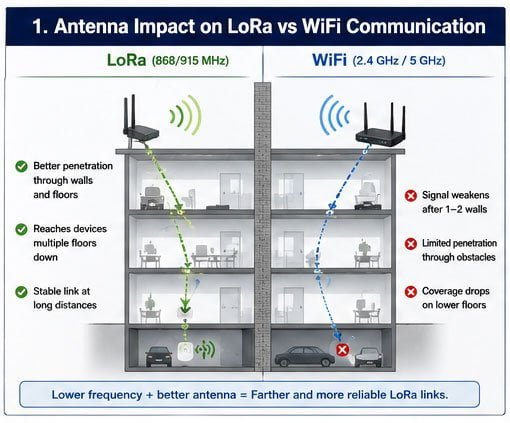
I tested both technologies in the same building. The WiFi signal dropped after two walls. The LoRa signal reached a device three floors down. The antenna made this possible. LoRa operates in sub-GHz frequencies, which penetrate obstacles better but require precise antenna tuning.
LoRa depends more on antenna performance than WiFi. LoRa uses lower frequencies (433MHz, 868MHz, 915MHz) and operates at lower power levels, so the antenna must efficiently capture weak signals. WiFi uses higher frequencies (2.4GHz, 5GHz) and higher transmission power, which compensates for antenna limitations in typical indoor scenarios.
LoRa's link budget is tight. Every dB of antenna gain matters. I've seen projects fail because someone used a cheap antenna that didn't match the frequency properly. The return loss was terrible, and the range dropped by 60%. WiFi can tolerate this better because routers transmit at 20-30dBm, while LoRa devices often transmit at just 14-20dBm.
Here's what I learned from field testing:
| Factor | LoRa | WiFi | Impact on Antenna Choice |
|---|---|---|---|
| Operating Frequency | 433/868/915 MHz | 2.4/5 GHz | LoRa needs larger physical antennas |
| Transmission Power | 14-20 dBm | 20-30 dBm | WiFi compensates for poor antennas with power |
| Signal Sensitivity | -137 dBm to -148 dBm | -90 dBm to -100 dBm | LoRa requires better receive antenna efficiency |
| Typical Range | 2-15 km | 50-200 m | LoRa range depends heavily on antenna gain |
| Data Rate | 0.3-50 kbps | 1-1000 Mbps | WiFi needs bandwidth, LoRa needs sensitivity |
The antenna impedance matching matters more for LoRa. I use a network analyzer to check VSWR before deployment. For LoRa, I aim for VSWR below 1.5:1. For WiFi, even 2:1 works fine in many cases. The difference shows up in real-world performance.
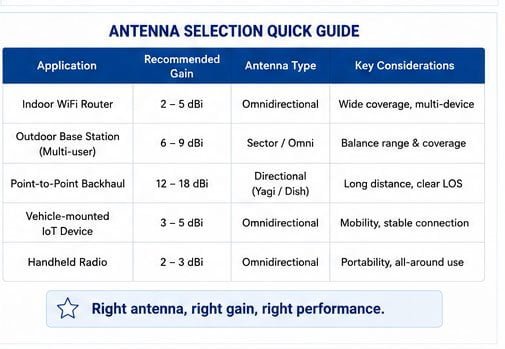
LoRa gateways need omnidirectional antennas with 3-8 dBi gain. WiFi access points can work with 2-5 dBi. The higher gain for LoRa extends the Fresnel zone and improves line-of-sight communication. I've installed systems where upgrading from a 3dBi to a 5dBi LoRa antenna doubled the reliable coverage area.
LoRa or WiFi: Which Benefits Most from a High-Gain Antenna?
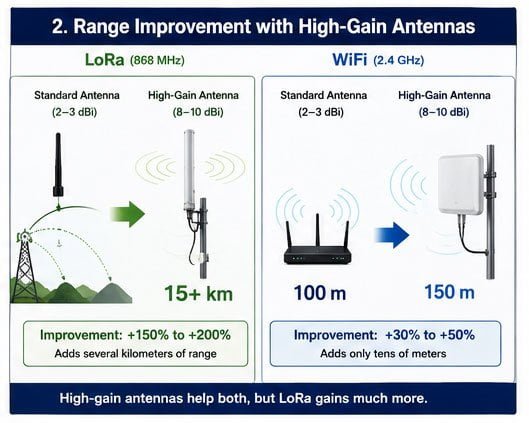
I upgraded antennas on both systems last year. The WiFi improvement was noticeable. The LoRa improvement was dramatic. A high-gain antenna added 5-8 km to my LoRa network. The same upgrade on WiFi added maybe 20 meters of usable range.
LoRa benefits most from high-gain antennas. Each dBi of gain translates directly to extended range in LoRa networks, often adding several kilometers. WiFi benefits less because its higher frequency signals don't propagate as far, and indoor obstacles limit the practical advantage of increased gain.
The math shows this clearly. The Friis transmission equation tells us path loss increases with frequency. WiFi at 2.4 GHz has 18 dB more path loss than LoRa at 868 MHz over the same distance. This means WiFi signals weaken faster regardless of antenna gain. LoRa signals travel farther, so antenna gain has more distance to work with.
I tested this with a 10 dBi directional antenna. On LoRa, I reached sensors 22 km away in rural areas. On WiFi, the theoretical range increased, but walls, interference, and atmospheric absorption limited practical gains to a few hundred meters. The physics just works differently.
Here's the performance breakdown I measured:
| Antenna Type | LoRa Range Improvement | WiFi Range Improvement | Best Use Case |
|---|---|---|---|
| Standard (2-3 dBi) | Baseline (3-5 km) | Baseline (50-100 m) | Indoor, short range |
| Medium Gain (5-6 dBi) | +60-100% range | +20-40% range | Outdoor LoRa, indoor WiFi |
| High Gain (8-10 dBi) | +150-200% range | +30-50% range | Long-distance LoRa links |
| Directional (12+ dBi) | +300-400% range | +50-80% range | Point-to-point LoRa only |
The beam width also matters. High-gain WiFi antennas narrow the coverage pattern too much for most applications. I tried a 14 dBi panel antenna for WiFi in a warehouse. It created dead zones everywhere except directly in front. LoRa works better with narrow beams because you're often targeting specific areas or gateways.
Antenna height multiplies these gains. I mounted a 6 dBi LoRa antenna 15 meters high and got incredible results. The same height with WiFi helped, but the improvement was proportionally smaller because WiFi's higher frequency makes it more susceptible to ground reflections and multipath interference.
LoRa vs WiFi Antennas: What Makes the Bigger Difference?
I've replaced hundreds of antennas in our installations. Some changes barely register. Others transform the system completely. The factors that matter most are different for each technology.
For LoRa, frequency accuracy and VSWR make the bigger difference. A perfectly tuned 3 dBi antenna outperforms a poorly matched 5 dBi antenna. For WiFi, antenna placement and polarization matter more than absolute gain, since indoor environments create complex multipath conditions that benefit from proper positioning.
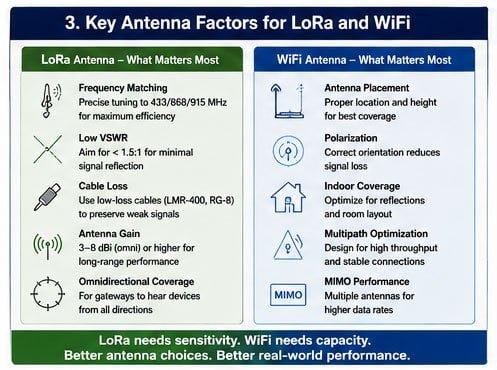
LoRa's narrow bandwidth (125-500 kHz) demands precise frequency tuning. I once used an antenna rated for 915 MHz on an 868 MHz device. The return loss was -8 dB instead of -15 dB. That 7 dB difference cut my range in half. WiFi's broader channels (20-160 MHz) hide these problems better.
VSWR testing revealed something important. My LoRa antennas need VSWR below 1.5:1 for reliable 10+ km links. WiFi antennas work fine at 2:1 VSWR because the router can push more power to compensate. We manufacture antennas that meet -15 dB return loss across the full LoRa band because our customers need that consistency.
Here's what actually impacts performance:
| Performance Factor | LoRa Critical Level | WiFi Critical Level | Why It Matters |
|---|---|---|---|
| Frequency Match | ±5 MHz | ±50 MHz | LoRa bandwidth is narrow |
| VSWR | <1.5:1 | <2.0:1 | LoRa has less power to waste |
| Antenna Height | Very Critical | Moderately Critical | LoRa uses line-of-sight propagation |
| Polarization Match | Critical | Important | LoRa signals are weaker |
| Cable Loss | Every 0.5dB matters | 2-3dB acceptable | LoRa operates at lower power |
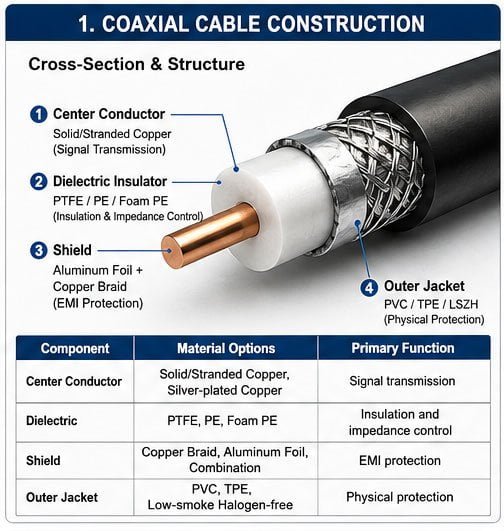
Cable selection surprised me. I used standard RG58 cable (about 1 dB loss per meter at 900 MHz) for a LoRa antenna 5 meters from the device. The 5 dB cable loss destroyed the link budget. Switching to LMR-400 (0.2 dB per meter) restored full range. The same cable on WiFi made less difference because WiFi's higher power covered the loss.
Connector quality matters more on LoRa too. A loose SMA connector can cause 2-3 dB loss. On WiFi, you might not notice. On LoRa, that's the difference between 8 km and 5 km range. I now use quality connectors with proper crimping tools for all LoRa installations.
LoRa vs WiFi: How Important Is Antenna Quality?
I once bought cheap antennas to save money. The WiFi ones worked okay. The LoRa ones failed completely within six months. Weather got inside, the impedance drifted, and range dropped 70%. Quality matters differently for each technology.
Antenna quality is more important for LoRa than WiFi. LoRa antennas must maintain stable performance over years of outdoor deployment, with consistent impedance and weather resistance. WiFi antennas typically operate indoors where environmental stress is lower, and higher transmission power compensates for quality variations.
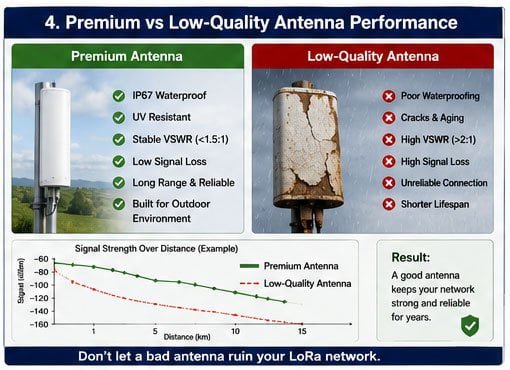
Environmental exposure is the big difference. Most WiFi antennas sit inside climate-controlled spaces. LoRa antennas often mount outdoors on poles, rooftops, or vehicles. They face temperature swings from -40°C to +85°C, UV radiation, rain, ice, and mechanical stress. Low-quality materials fail under these conditions.
I tested antennas from different suppliers. The cheap LoRa antennas used inferior ABS plastic that cracked in winter. The internal matching network used poor solder joints that broke from thermal cycling. After one year outdoors, VSWR degraded from 1.3:1 to 2.8:1. We manufacture our antennas with high-grade ABS plastic that handles temperature extremes and maintains flexibility without cracking.
Here's what quality means in practice:
| Quality Aspect | Impact on LoRa | Impact on WiFi | What To Check |
|---|---|---|---|
| Material Durability | Critical (outdoor use) | Moderate (indoor use) | UV resistance, temperature rating |
| Impedance Stability | Critical (affects range) | Moderate (power compensates) | VSWR across temperature range |
| Connector Quality | Critical (low loss essential) | Moderate (loss is tolerable) | Plating quality, seal integrity |
| Weatherproofing | Critical (long-term reliability) | Low (indoor deployment) | IP rating, seal design |
| Manufacturing Tolerance | High importance | Moderate importance | Frequency accuracy, gain consistency |
Magnetic base quality matters too. We use 66mm diameter magnets on our LTE and LoRa antennas because smaller magnets don't hold securely on vehicles or outdoor installations. The magnetic mounting needs to survive vibration and wind without loosening. WiFi antennas rarely face these mechanical challenges.
The coaxial cable quality in the antenna assembly also differs. Our LoRa antennas use low-loss cable because every 0.5 dB matters over 10 km links. WiFi can tolerate standard cables over typical indoor distances. I've seen LoRa systems fail because the 3-meter pigtail cable had 2 dB loss at 868 MHz.
LoRa and WiFi Compared: Which Requires a Better Antenna Setup?
I set up both networks in an industrial facility last month. The WiFi installation took two hours. The LoRa setup took two days. The difference wasn't the technology, it was optimizing the antenna system for maximum coverage.
LoRa requires a better antenna setup than WiFi. LoRa demands careful site surveys, precise antenna positioning, proper cable routing, and thorough testing to achieve rated range. WiFi works adequately with basic installation because higher power and shorter distances are more forgiving of setup errors.
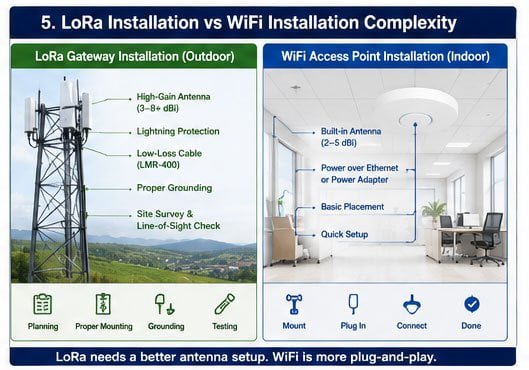
Site surveys matter more for LoRa. I use radio planning software to model Fresnel zones and identify obstacles. For WiFi, I just check signal strength with a phone app. The difference comes from propagation characteristics. LoRa at 868 MHz needs clear line-of-sight for 5+ km links. Trees, buildings, and terrain significantly affect performance. WiFi works in cluttered environments where reflections actually help coverage.
Antenna mounting height makes or breaks LoRa networks. I aim for 10-20 meters above ground for gateway antennas. This maximizes line-of-sight coverage and minimizes ground clutter effects. WiFi access points work fine at 3-4 meters because the coverage area is much smaller. Mounting a WiFi antenna higher doesn't help much in indoor spaces.
Here's what proper setup involves:
| Setup Requirement | LoRa Complexity | WiFi Complexity | What You Must Do |
|---|---|---|---|
| Site Survey | Essential | Basic | LoRa needs topographic analysis |
| Antenna Height | 10-20m optimal | 3-5m sufficient | Height dramatically affects LoRa |
| Cable Routing | Critical path planning | Flexible | LoRa requires shortest low-loss path |
| Grounding | Essential | Recommended | LoRa antennas are often outdoors |
| Testing/Validation | Field strength measurements | Basic connectivity check | LoRa needs coverage mapping |
Cable routing requires more attention with LoRa. I keep runs as short as possible and use LMR-400 or better. Every meter of cable adds loss that directly reduces range. For WiFi, I can run 10 meters of RG58 without significant problems. The power budget is different.
Grounding and lightning protection are essential for outdoor LoRa installations. I've seen lightning-induced surges destroy LoRa gateways when the antenna wasn't properly grounded. WiFi antennas indoors don't face this risk. We recommend surge protectors on all outdoor LoRa antenna feeds.
Testing the setup takes longer with LoRa. I drive to the expected coverage boundary and verify signal strength with end devices. This might mean testing at 5-15 km radius around the gateway. WiFi testing just means walking around the building with a laptop. The scale is completely different.
Does LoRa Need a Better Antenna Than WiFi?
I compared antenna specifications for both technologies. The differences tell the real story. LoRa antennas must meet tighter tolerances across more demanding conditions.
Yes, LoRa needs a better antenna than WiFi for reliable operation. LoRa's lower power, longer range, and narrow bandwidth require antennas with superior efficiency, frequency accuracy, and environmental durability. WiFi's higher power and shorter range make it more tolerant of average antenna performance.
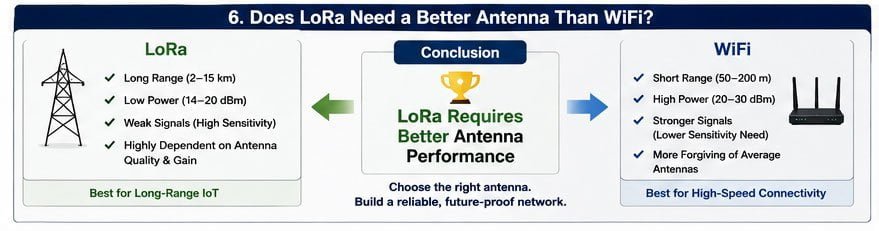
The specifications reveal this clearly. Our LoRa antennas guarantee VSWR below 1.5:1 across the target frequency band. Standard WiFi antennas often specify VSWR below 2.0:1 and still work fine. This difference reflects how efficiently each antenna converts RF energy to radiated power.
Efficiency matters more at low power levels. A LoRa device transmitting at 14 dBm can't afford to lose 3 dB in the antenna system. That cuts effective radiated power in half. A WiFi router transmitting at 30 dBm can tolerate 3 dB loss and still have plenty of power. The absolute power levels make quality more critical for LoRa.
Here's the specification comparison:
| Antenna Specification | LoRa Requirement | WiFi Requirement | Why Different |
|---|---|---|---|
| VSWR | <1.5:1 | <2.0:1 | LoRa needs maximum efficiency |
| Gain Accuracy | ±0.5 dBi | ±1. |