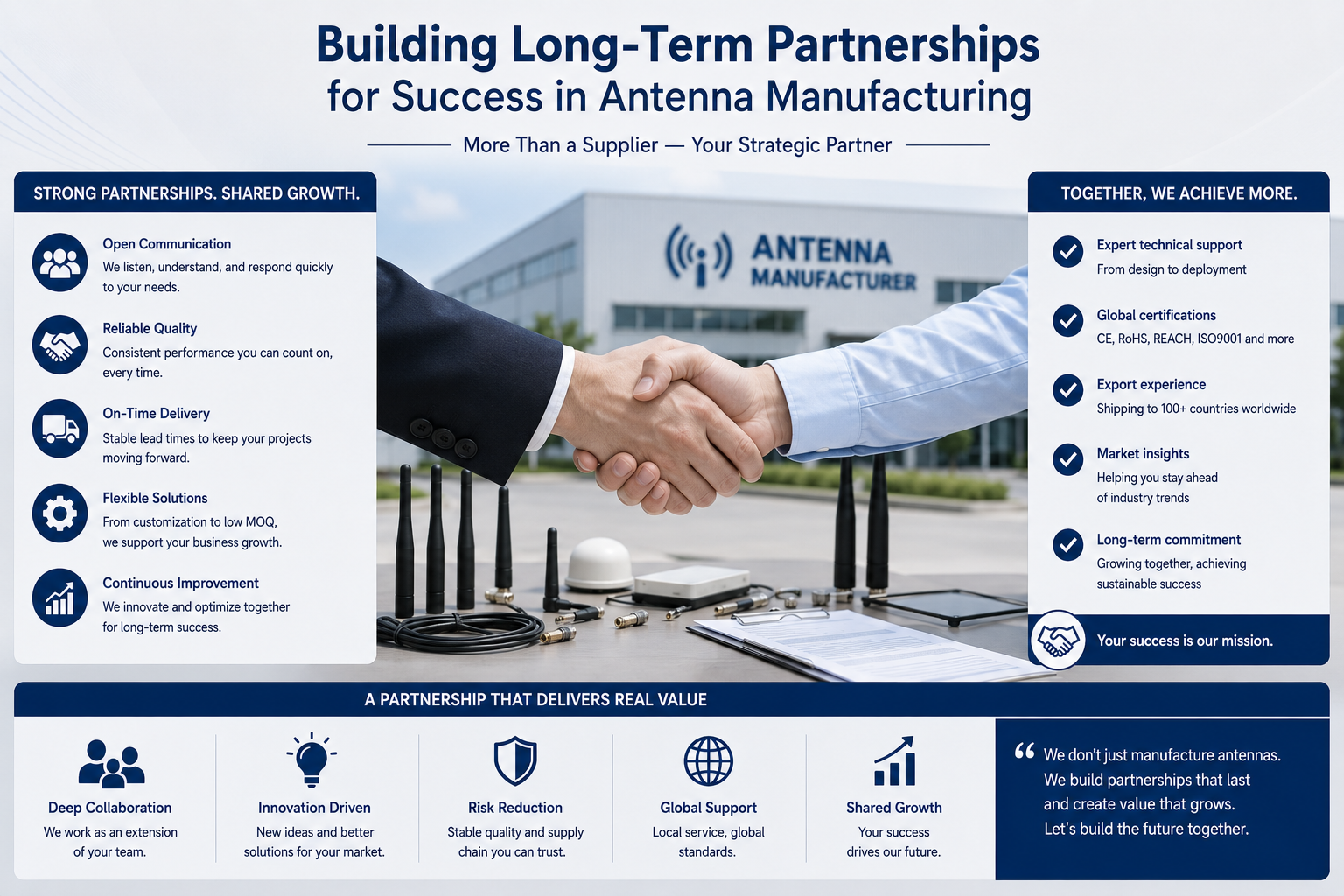
I've been in the antenna manufacturing business for over 17 years. I've seen hundreds of customers struggle with choosing the right supplier. Many of them wasted time and money on the wrong partners. The problem is real. You need reliable products, fast delivery, and stable quality. But how do you know which manufacturer can deliver? The answer lies in understanding what truly matters.
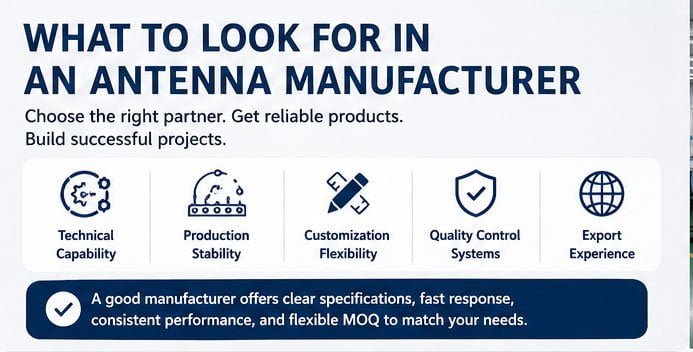
When choosing an antenna manufacturer, focus on five key areas: technical capability, production stability, customization flexibility, quality control systems, and export experience. A good supplier should offer clear specifications, fast response times, consistent product performance, and flexible MOQ options that match your project needs.
Let me walk you through exactly what you should look for. I'll share the criteria that separate reliable manufacturers from those who can't deliver. These insights come from years of working with customers across 100+ countries. By the end of this guide, you'll know how to evaluate any antenna supplier confidently.
How to Choose the Right Antenna Manufacturer for Your Project?
Choosing the right manufacturer starts with understanding your project requirements. Many customers skip this step. They contact suppliers without knowing what they actually need. This leads to confusion and delays.
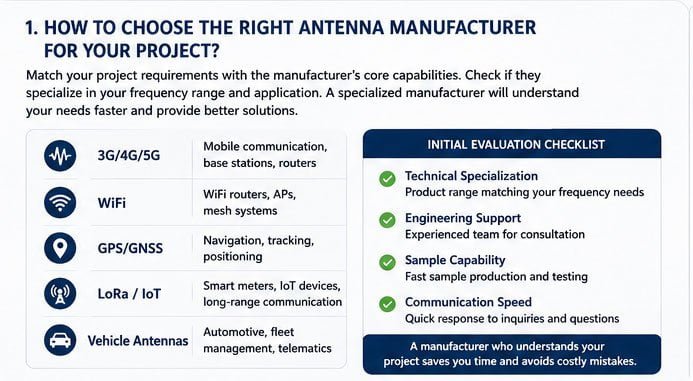
Match your project requirements with the manufacturer's core capabilities. Check if they specialize in your frequency range (3G/4G/5G, WiFi, GPS, or LoRa). Verify their experience with your application type, whether it's IoT devices, routers, vehicle systems, or base stations. A specialized manufacturer will understand your needs faster and provide better solutions.
Start by listing your technical specifications. Write down the frequency range you need. Note the required gain level. Specify the VSWR value you can accept. Include the connector type and cable length. Mention any environmental requirements like waterproofing or temperature range.
I remember a customer who came to us needing antennas for smart meters. They had already contacted five suppliers. None of them understood the specific requirements for low-power, long-range communication. We specialized in LoRa antennas. We knew exactly what parameters mattered. We delivered samples within one week. They became our long-term partner.
Here's what matters most in the initial evaluation:
| Evaluation Area | What to Check | Why It Matters |
|---|---|---|
| Technical Specialization | Product range matching your frequency needs | Faster development, better optimization |
| Engineering Support | Availability of technical team for consultation | Quick problem-solving, custom solutions |
| Sample Capability | Speed of sample production and testing | Validates quality before bulk orders |
| Communication Speed | Response time to inquiries and technical questions | Indicates service quality and efficiency |
The manufacturer should ask you detailed questions. They should want to understand your end application. They should suggest alternatives if your initial specs don't match real-world requirements. This shows they have real experience, not just catalog products.
Don't rush this stage. A manufacturer who understands your project from the start will save you months of back-and-forth communication later. They'll spot potential problems early. They'll recommend the right antenna type. They'll help you avoid costly mistakes.
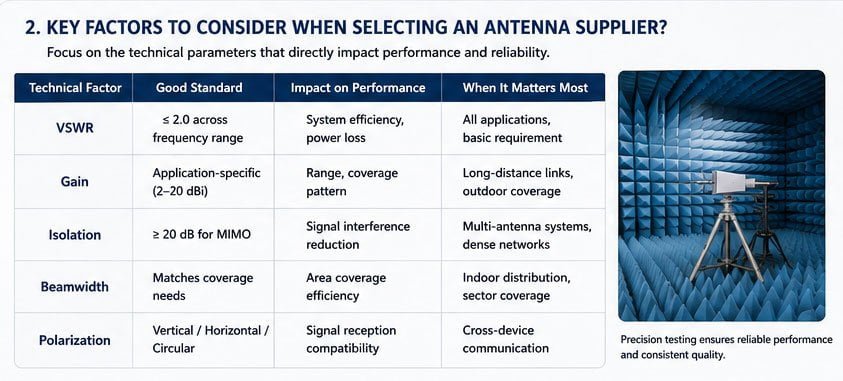
Key Factors to Consider When Selecting an Antenna Supplier?
Technical specifications look impressive on paper. But real performance comes from understanding what each parameter means. I've seen customers focus on the wrong numbers. They chase high gain values without considering their actual application. This wastes money.
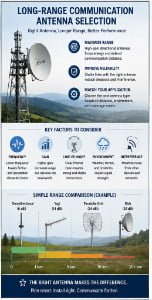
VSWR determines if your antenna can work at all. Gain determines how far your signal can reach. Isolation determines how stable your connection stays. Beamwidth determines how wide an area you can cover. Polarization determines if your antenna can "understand" the other side. Prioritize these parameters based on your specific application needs.
Let me explain why each parameter matters. VSWR shows how much signal reflects back instead of radiating out. A VSWR of 1:1 means perfect matching. In reality, we aim for 2:1 or better. If VSWR exceeds 3:1, you'll lose significant power. Your device might overheat. Your range will drop dramatically.
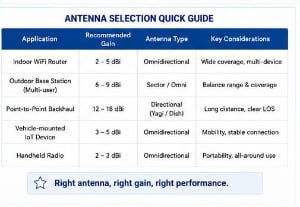
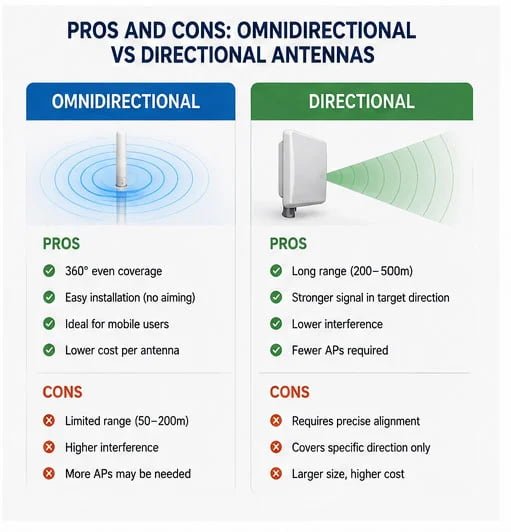
Gain determines transmission distance. Higher gain focuses energy in specific directions. This increases range but narrows coverage. For a router antenna, you might want 2-5 dBi for wide coverage. For a point-to-point link, you might need 15+ dBi for long distance. Many customers want maximum gain without understanding the trade-off.
Here's a practical breakdown of key factors:
| Technical Factor | Good Standard | Impact on Performance | When It Matters Most |
|---|---|---|---|
| VSWR | ≤2.0 across frequency range | System efficiency, power loss | All applications, basic requirement |
| Gain | Application-specific (2-20 dBi) | Range, coverage pattern | Long-distance links, outdoor coverage |
| Isolation | ≥20 dB for MIMO | Signal interference reduction | Multi-antenna systems, dense networks |
| Beamwidth | Matches coverage needs | Area coverage efficiency | Indoor distribution, sector coverage |
| Polarization | Vertical/Horizontal/Circular | Signal reception compatibility | Cross-device communication |
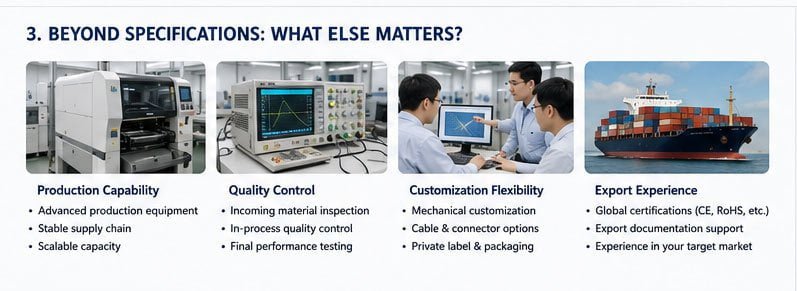
Beyond technical specs, check production capability. Can they handle your order volume? What's their typical lead time? Do they have component inventory? We maintain stock of common materials. This lets us deliver standard products within 3-5 days. Custom products take 15-20 days.
Quality consistency matters more than single-sample performance. Ask about their testing procedures. Request test reports from previous batches. Check if they perform 100% testing or sample testing. We test every antenna before shipping. This catches defects early.
Consider their customization flexibility. Can they modify connector types? Can they adjust cable length? Can they tune frequency ranges? We offer OEM/ODM services. We've customized antennas for over 500 different applications. Some manufacturers only sell catalog products. They can't adapt to your specific needs.
What Makes a Reliable Antenna Manufacturing Partner?
Reliability means more than just good products. It means consistent quality across thousands of units. It means meeting deadlines even when problems arise. It means honoring commitments when market conditions change.
A reliable manufacturing partner combines three elements: proven production systems, transparent communication, and long-term thinking. Look for ISO9001 certification, documented quality control processes, regular production capacity, and willingness to support small test orders before large commitments. These indicate a manufacturer who values customer relationships over quick sales.
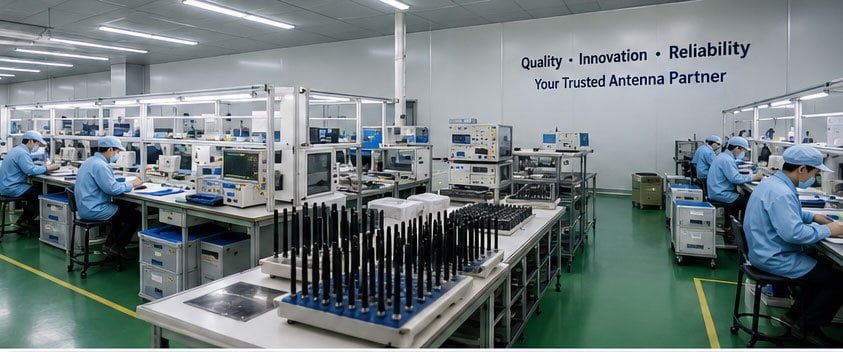
Production stability separates good manufacturers from great ones. Visit their facility if possible. If you can't visit, ask for facility photos and videos. Check if they own their production equipment or outsource. We have our own production lines. We control every step from raw materials to final testing.
Ask about their quality management system. Do they have documented procedures? How do they handle defective products? What's their defect rate? We maintain less than 0.5% defect rate across all products. This comes from strict process control and continuous improvement.
Here's what to evaluate in their operations:
| Reliability Indicator | How to Verify | What It Tells You |
|---|---|---|
| Production Capacity | Monthly output numbers, equipment list | Can they scale with your growth? |
| Quality System | ISO9001 or similar certification | Documented processes and consistency |
| Supply Chain | Component sourcing, inventory levels | Protection against delays and shortages |
| Testing Equipment | Network analyzer, anechoic chamber | Ability to verify specifications |
| Export Experience | Countries served, shipping methods | Understanding of international standards |
Communication transparency builds trust. A good manufacturer explains problems honestly. They don't make promises they can't keep. They update you proactively when issues arise. We provide production updates every three days for custom orders. We share test data before shipping. We photograph packaging to confirm quality.
Long-term thinking shows in their policies. Do they push for the largest possible order? Or do they accept small test batches? We offer flexible MOQ. We understand you need to test before committing to large volumes. We've started with 100-piece orders and grown to 10,000+ piece monthly shipments with many customers.
Customer support matters after the sale. Who handles technical questions? How fast do they respond? What happens if products fail in the field? We provide lifetime technical support. Our engineering team responds to technical questions within 24 hours. We help troubleshoot installation and integration issues.
A Complete Guide to Evaluating Antenna Manufacturers?
Evaluation should follow a systematic process. Many customers make decisions based on price alone. This leads to problems later. I've seen customers return to us after trying cheaper suppliers. They wasted three months and lost money.
Evaluate manufacturers in three stages: initial screening based on capabilities and certifications, technical evaluation through samples and testing, and operational evaluation through small trial orders. This approach minimizes risk and confirms the supplier can deliver on promises before major commitments.
Stage one is initial screening. Create a list of potential suppliers. Check their websites for product range. Verify they serve your industry. Look for certifications like ISO9001, CE, RoHS. These show basic quality standards. Contact 5-8 manufacturers. See who responds fastest. Who asks the right questions? Who provides detailed information?
Stage two involves technical evaluation. Request quotations with full specifications. Compare not just price but also technical parameters. Ask for datasheets and test reports. Request samples if specifications look promising. Test samples in your actual application. Don't just check specifications in the lab.
Here's a detailed evaluation framework:
| Evaluation Stage | Key Activities | Success Criteria | Timeline |
|---|---|---|---|
| Initial Screening | Capability review, certification check, initial contact | 3-5 qualified suppliers identified | Week 1 |
| Technical Evaluation | Specification comparison, sample testing, engineering discussion | 2-3 suppliers pass technical requirements | Weeks 2-3 |
| Trial Order | Small batch order, real-world testing, delivery performance | 1-2 suppliers demonstrate reliability | Weeks 4-8 |
| Partnership Decision | Contract negotiation, long-term terms, support agreement | Final supplier selection | Week 9-10 |
Stage three is the trial order. Place a small production order, maybe 100-500 units. This reveals the manufacturer's true capabilities. Check if quality matches samples. Verify delivery time accuracy. Evaluate packaging quality. Test their communication during production. See how they handle any issues that arise.
During trial orders, document everything. Record delivery time. Note any communication gaps. Check if actual products match specifications. Test a random sample from the batch. Compare these results with initial samples. Variation indicates inconsistent production.
I remember a customer who skipped the trial order stage. They placed a 5,000-unit order based only on samples. The actual products had 15% defect rate. The manufacturer blamed "acceptable variation." The customer lost two months and significant money. They came to us for replacement products. Now they always follow the three-stage evaluation.
Consider the total cost of ownership, not just unit price. A cheaper antenna that fails after six months costs more than a reliable one at slightly higher price. Factor in shipping costs, customs duties, and potential replacement costs. Include the value of your time spent on quality issues and returns.
Top Criteria for Choosing an Antenna Manufacturer?
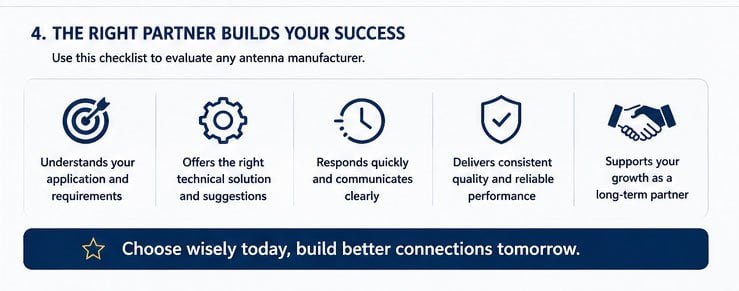
After evaluating hundreds of supplier relationships, I've identified the criteria that matter most. These separate manufacturers who become long-term partners from those who cause headaches. Different criteria carry different weight depending on your situation.
Prioritize technical capability, quality consistency, and responsiveness. Technical capability ensures they can meet your specifications. Quality consistency guarantees every batch performs the same. Responsiveness indicates they value your business and will support you through challenges. These three criteria predict long-term success better than any other factors.
Technical capability goes beyond having products in your frequency range. It means understanding the physics of antenna design. It means having experienced engineers who can optimize for your application. We employ engineers with 10+ years of antenna design experience. They've solved problems across dozens of industries.
Ask technical questions during your evaluation. How does antenna length affect frequency response? What causes impedance mismatch? How does the ground plane affect radiation pattern? A capable manufacturer answers these easily. They explain trade-offs between different design choices. They suggest improvements to your requirements based on real-world experience.
Here's how to weight different criteria:
| Criterion | Weight | How to Assess | Red Flags |
|---|---|---|---|
| Technical Capability | 30% | Engineering team depth, R&D facility, design tools | Vague answers, no technical staff, catalog-only products |
| Quality Consistency | 25% | Batch testing data, certification, defect rate | No testing equipment, no quality documentation |
| Responsiveness | 20% | Response time, communication clarity, problem-solving | Slow replies, generic answers, avoiding questions |
| Production Capacity | 15% | Monthly output, equipment, scalability | Outsourced production, no capacity information |
| Flexibility | 10% | MOQ terms, customization options, payment terms | Rigid requirements, no customization, high MOQ |
Quality consistency requires systematic processes. Ask how they maintain consistency across batches. What quality checkpoints exist in production? How do they calibrate testing equipment? We calibrate all test equipment monthly. We maintain statistical process control charts. We track performance trends across batches.
Responsiveness shows respect for your time. How fast do they answer questions? Do they provide detailed responses or generic statements? Can you reach them outside normal business hours for urgent issues? We provide phone and WhatsApp contact for urgent technical support. We understand that your projects don't wait for business hours.
Production capacity affects your growth potential. Can they scale with your business? What's their maximum monthly output? Do they have backup suppliers for critical components? We produce 50,000+ antennas monthly. We maintain relationships with multiple component suppliers. This protects our customers from supply chain disruptions.
Flexibility matters for growing businesses. Can they start with small orders? Can they adjust production as your needs change? Do they require long-term commitments? We accept orders as small as 100 units. We understand you need to test market demand before large commitments. Many of our biggest customers started with small trial orders.
How to Find the Best Antenna Supplier for Long-Term Success?
Finding a supplier is easy. Finding a partner for long-term success requires different thinking. You need a manufacturer who grows with your business. Who invests in improving their capabilities. Who treats your success as their success.
Look beyond current capabilities to future potential. The best long-term suppliers invest in R&D, expand product lines, improve processes continuously, and maintain financial stability. They should demonstrate growth in their own business while maintaining quality. Ask about their development roadmap and how they plan to serve your future needs.

Start by understanding their business strategy. Are they focused on growth or just maintaining current operations? Do they invest profits back into equipment and development? We reinvest 15% of revenue into new equipment and R&D. This year we added a new anechoic chamber for more precise testing.
Ask about their product development plans. What new products are they developing? How do they decide what to develop next? Do they listen to customer needs? We develop new products based on customer feedback and market trends. Last year we added three new 5G antenna models based on customer requests.
Consider their industry reputation. Search for reviews from other customers. Check industry forums and trade websites. Ask for customer references. Contact their existing customers. Ask about their experience. What problems occurred? How did the manufacturer handle them? We provide references from customers in different regions and industries.
Here's what indicates long-term potential:
| Long-Term Indicator | What to Look For | Why It Matters |
|---|---|---|
| R&D Investment | New product development, testing facilities, patent applications | Innovation capability, future competitiveness |
| Financial Stability | Years in business, facility ownership, equipment investment | Ability to weather market changes |
| Customer Retention | Long-term customer relationships, repeat business rate | Service quality and reliability over time |
| Market Position | Market share, industry recognition, certifications | Industry standing and credibility |
| Team Stability | Employee tenure, engineering team growth | Knowledge retention, consistent quality |
Financial stability protects your supply chain. A manufacturer in financial trouble might cut corners on quality. They might struggle to buy components. They might go out of business mid-project. Check how long they've been in business. Do they own their facility? We've operated from the same location for 17 years. We own our facility and equipment.
Team stability indicates a good working environment. High turnover means problems. Experienced employees mean consistent quality and accumulated knowledge. Our core engineering team has worked together for 8+ years. This continuity shows in our ability to solve complex problems quickly.
Customer retention tells you what others experience. If a manufacturer has many long-term customers, they must be doing something right. Ask about their oldest customers. How long have they worked together? What keeps those relationships going? Some of our customers have worked with us for over 10 years. They stay because we consistently deliver quality and support their growth.
Essential Questions to Ask Before Choosing an Antenna Manufacturer?
The right questions reveal a manufacturer's true capabilities. Generic questions get generic answers. Specific technical and operational questions expose strengths and weaknesses. I've compiled the most revealing questions based on what