Choosing between a panel antenna and a Yagi antenna can feel overwhelming when you're setting up a wireless communication system. I've watched countless customers struggle with this decision, only to realize later they picked the wrong type for their needs. The difference isn't just technical—it directly impacts your signal quality, coverage area, and installation complexity.
Both panel antennas and Yagi antennas are directional antennas designed for specific communication scenarios, but they serve fundamentally different purposes. Panel antennas offer wide-beam coverage ideal for base stations and multi-user environments, while Yagi antennas provide narrow-beam, long-distance point-to-point connections at lower cost. The choice depends on whether you need broad area coverage or focused directional reach.
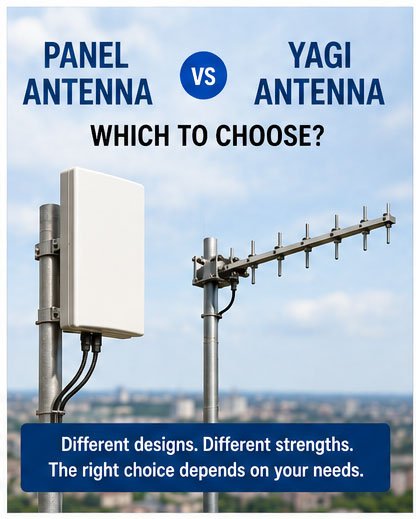
Understanding the core differences between these two antenna types will save you time, money, and frustration. In this guide, I'll walk you through everything you need to know—from technical specifications to real-world applications—so you can make the right choice for your specific situation.
Panel Antenna vs Yagi Antenna: What's the Difference?
Have you ever wondered why some antennas look flat and wide while others have that distinctive "fishbone" appearance? The physical design actually tells you everything about how each antenna works.
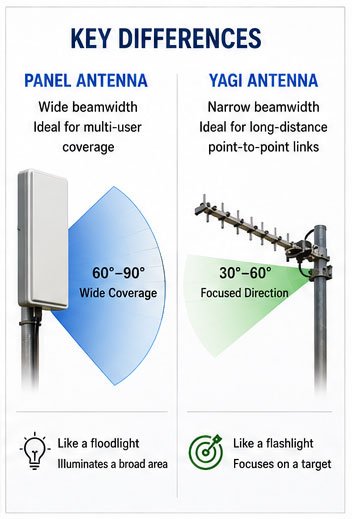
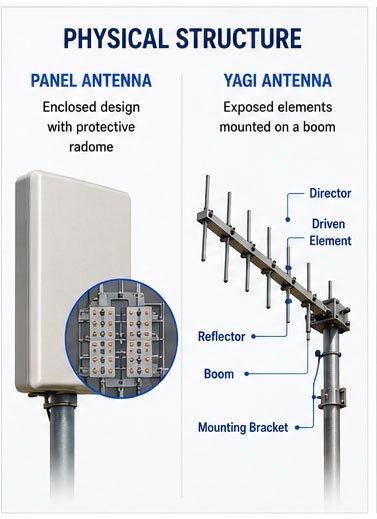
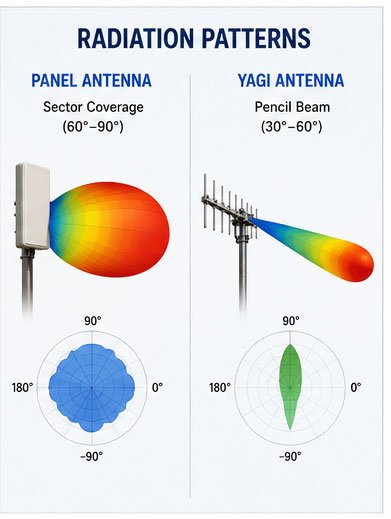
A panel antenna is a flat, enclosed directional antenna with a wide beamwidth (typically 60-90 degrees horizontal), functioning like a "floodlight" that illuminates a sector. A Yagi antenna features a linear array of metal elements along a boom, creating a narrow beam (typically 30-60 degrees) that works like a "flashlight" focused on a specific direction.
Let me break down the fundamental architectural differences that drive their performance characteristics.
Physical Construction
Panel antennas consist of multiple radiating elements housed within a flat, weather-resistant radome (protective cover). The elements are typically arranged in a matrix pattern behind the panel face. This enclosed design protects the delicate components from environmental damage while presenting a clean, professional appearance.
Yagi antennas, by contrast, expose their functional elements directly to the environment. They feature:
- Driven element: The primary radiating component connected to the feedline
- Reflector: A slightly longer element behind the driven element that bounces signals forward
- Directors: Multiple shorter elements in front that focus the beam
This exposed structure makes Yagi antennas more vulnerable to weather but also significantly lighter and more cost-effective to manufacture.
Radiation Pattern Characteristics
The radiation pattern—how an antenna distributes signal energy in space—represents the most critical functional difference.
Panel antennas create a sector-shaped coverage pattern. Imagine standing with a wide-beam flashlight that illuminates a broad area in front of you. The typical beamwidth ranges from 60 to 90 degrees horizontally, with 15 to 25 degrees vertically. This wide horizontal coverage makes them perfect for serving multiple users across a broad area.
Yagi antennas generate a pencil-beam pattern. Think of a laser pointer versus that wide flashlight. With beamwidths typically between 30 and 60 degrees horizontally (narrowing further with more elements), Yagi antennas concentrate energy into a tighter focus, achieving greater forward gain and longer range in that specific direction.
| Feature | Panel Antenna | Yagi Antenna |
|---|---|---|
| Physical Form | Flat, enclosed box | Linear boom with exposed elements |
| Horizontal Beamwidth | 60-90° (wide sector) | 30-60° (narrow beam) |
| Typical Gain | 12-18 dBi | 8-20 dBi (depending on element count) |
| Coverage Type | Area coverage | Point-to-point |
| Wind Load | Low (flat profile) | Moderate to high (exposed elements) |
| Weather Resistance | Excellent (enclosed) | Good (exposed, may corrode) |
Polarization Options
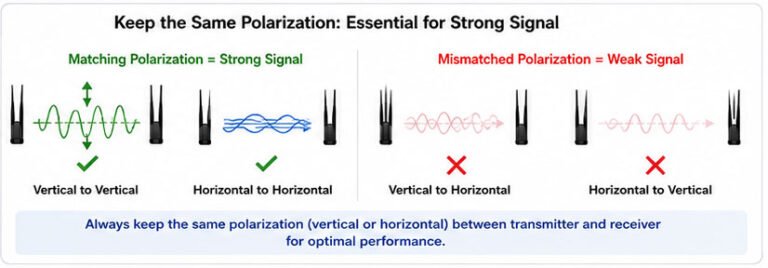
Panel antennas commonly support dual polarization (±45° slant or vertical/horizontal), making them ideal for modern cellular systems like LTE and 5G that use MIMO (Multiple Input Multiple Output) technology. Some advanced panel antennas even offer cross-polarization capabilities to maximize spectral efficiency.
Yagi antennas typically operate with single linear polarization—either vertical or horizontal. While this limits their MIMO capability, it also simplifies design and reduces cost for applications that don't require dual-polarization performance.
Frequency Band Coverage
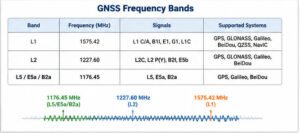
Panel antennas often feature wideband or multi-band capability, covering entire frequency ranges like 698-2700 MHz in a single unit. This versatility makes them attractive for operators running multiple services (2G, 3G, 4G, 5G) from the same installation.
Yagi antennas are generally frequency-specific, designed for narrower bands like 850-960 MHz or 1710-1880 MHz. The element lengths must be precisely tuned to the operating frequency, which limits bandwidth but optimizes performance within that specific range.
I've personally seen operators struggle with Yagi antennas when they needed to add new frequency bands later—they simply had to install additional antennas. Panel antennas avoid this issue but at a higher initial cost.
Yagi Antenna vs Panel Antenna: Which Performs Better?
Performance isn't a simple "better or worse" question—it depends entirely on your definition of performance. Are you measuring coverage area, signal strength at distance, or cost-effectiveness?
Neither antenna performs universally "better"—they excel in different scenarios. Panel antennas deliver superior performance for wide-area coverage, serving multiple users simultaneously with consistent signal distribution across a sector. Yagi antennas achieve better performance for long-distance point-to-point links, concentrating signal energy into a narrow beam for maximum range in a specific direction.
Let's examine the key performance metrics that matter in real-world deployments.
Gain and Directivity
Gain measures how effectively an antenna concentrates radio frequency energy in a particular direction compared to a theoretical isotropic radiator.
Panel antennas typically achieve 12-18 dBi gain. This moderate gain balances directivity with coverage width. The gain increases with the number of internal elements and the panel's physical size, but there's a practical limit before the panel becomes too large and heavy for standard mounting systems.
Yagi antennas offer a wider gain range of 8-20 dBi, depending on the number of director elements. A basic 3-element Yagi might provide 8-10 dBi, while a 10-element Yagi can reach 16-18 dBi or higher. More elements mean narrower beamwidth and greater forward gain—but also longer physical length.
Here's the critical insight: High gain doesn't automatically mean better performance. A 18 dBi Yagi with a 30-degree beamwidth will outperform an 18 dBi panel with a 90-degree beamwidth for point-to-point links, but the panel will serve far more area for base station applications.
Front-to-Back Ratio
The front-to-back ratio (F/B ratio) indicates how well an antenna rejects signals from behind while focusing energy forward. Higher F/B ratios reduce interference from unwanted directions.
Panel antennas achieve excellent F/B ratios of 20-25 dB thanks to their enclosed design and integrated ground plane. This superior rejection is crucial in dense deployment scenarios where multiple base stations operate near each other.
Yagi antennas typically deliver F/B ratios of 15-20 dB. While respectable, the exposed element design allows more signal leakage from the rear and sides compared to the enclosed panel structure.
VSWR and Impedance Matching
VSWR (Voltage Standing Wave Ratio) measures how efficiently the antenna accepts power from the transmission line. Lower VSWR means better impedance matching and less reflected power.
Both antenna types can achieve excellent VSWR performance:
- Panel antennas: Typically ≤1.5:1 across their operating bandwidth
- Yagi antennas: Usually ≤2:1, sometimes ≤1.5:1 with careful design
Panel antennas maintain better VSWR consistency across wider bandwidths due to their more complex matching networks. Yagi antennas show narrower bandwidth with optimal VSWR, though this is acceptable for frequency-specific applications.
Wind Loading and Structural Performance
This often-overlooked factor dramatically impacts long-term reliability and installation costs.
Panel antennas present a flat profile to wind, significantly reducing wind load compared to their physical size. A typical panel antenna might have 0.5-1.5 square meters of effective wind area, but their aerodynamic design keeps loading manageable. I've installed panels that survived typhoons without issue.
Yagi antennas with their exposed elements create higher wind resistance per gain unit. A high-gain Yagi with many elements can develop substantial wind loading, requiring stronger mounting hardware and more robust towers. I once had to reinforce a tower structure specifically because a customer wanted to add three more Yagi antennas.
Environmental Durability
Panel antennas' enclosed radome design provides superior weather protection. The internal elements remain shielded from rain, salt spray, ice, and UV exposure. Most quality panel antennas carry IP65 or IP67 ingress protection ratings.
Yagi antennas with exposed elements face greater environmental challenges:
- Corrosion: Metal elements can corrode, especially in coastal environments
- Ice loading: Ice buildup on elements affects tuning and adds mechanical stress
- Physical damage: Birds can perch on elements; debris can accumulate
I've seen Yagi antennas fail after just two years in harsh coastal conditions, while panel antennas at the same site remained fully operational after five years.
Multi-Band and MIMO Capability
Modern wireless systems increasingly demand multi-band operation and MIMO technology for capacity enhancement.
Panel antennas excel here, often supporting:
- Multiple frequency bands in a single unit (700/800/900/1800/2100/2600 MHz)
- Dual or quad-polarization for 2×2, 4×4, or even 8×8 MIMO configurations
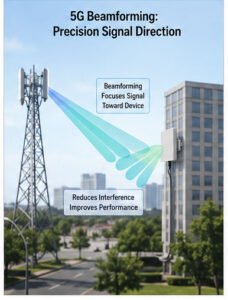
- Beamforming capability in advanced models
Yagi antennas remain fundamentally single-band, single-polarization devices. While you can stack multiple Yagis to create MIMO arrays, this approach becomes mechanically complex and increases wind loading significantly.
Cost-Performance Ratio
Here's where the comparison gets interesting from a business perspective.
Initial cost:
- Panel antenna: $50-200 depending on specifications
- Basic Yagi: $15-40
- High-gain Yagi: $40-100
For pure long-distance point-to-point links, Yagi antennas offer unbeatable value. You get excellent focused gain at a fraction of the panel antenna cost.
For base station deployments serving multiple users, panel antennas deliver better total cost of ownership despite higher initial cost. One panel replaces multiple Yagis, reducing installation complexity, mounting hardware, feedlines, and tower space requirements.
Panel vs Yagi Antenna: Which Is Best for Your Application?
Matching antenna type to application is where theory meets practical engineering. The "best" antenna is the one that solves your specific communication challenge most effectively.
Panel antennas are best for base station applications, cellular networks, Wi-Fi distribution, and any scenario requiring broad sector coverage with multiple simultaneous users. Yagi antennas are best for point-to-point backhaul links, rural internet access, long-distance fixed wireless connections, and applications where narrow-beam focus maximizes range to a single remote location.
Let me walk you through the most common application scenarios so you can see which antenna fits your needs.
Cellular Base Station Deployment
This is panel antenna territory, no question.
Why panel antennas dominate base stations:
- Sector coverage: A single panel covers a 60-90° sector, efficiently serving all users within that zone
- Capacity: Dual-polarization supports MIMO, doubling data capacity
- Multi-band: One antenna serves multiple cellular bands (2G/3G/4G/5G)
- Aesthetic: Flat profile is less visually intrusive than multiple Yagi arrays
- Regulatory: Many jurisdictions prefer fewer, cleaner-looking antennas
I worked with a rural cellular operator who initially tried using Yagi antennas to save costs. They needed six Yagi antennas per site to achieve equivalent coverage to two panels—and the mounting complexity made installation costs triple what they saved on antennas. They switched to panels after the first three sites.
Typical configuration: Three panel antennas arranged in a triangle (each covering 120°) provide full 360° coverage around a tower site.
Point-to-Point Wireless Backhaul
This is where Yagi antennas shine brilliantly.
When you need to connect two fixed locations—say, linking a remote facility back to your main network—a Yagi antenna at each end creates a highly efficient, low-cost solution.
Advantages for point-to-point links:
- Focused energy: Narrow beam maximizes signal strength at the distant endpoint
- Interference rejection: Narrow beamwidth ignores off-axis signals
- Cost-effective: Two Yagi antennas cost less than two panels with equivalent gain
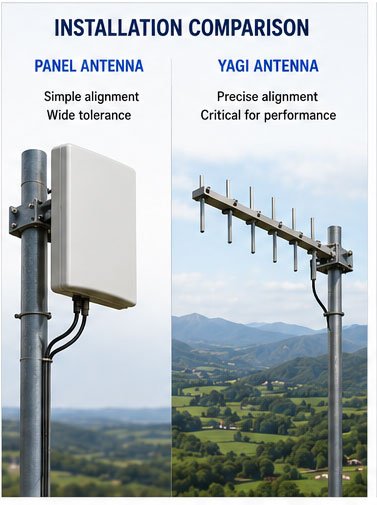
- Easy alignment: Visible elements make physical aiming straightforward
I've successfully used Yagi antenna pairs for links up to 10 kilometers in rural environments with excellent results. The key is ensuring clear line-of-sight and precise alignment—just a few degrees off-target significantly degrades performance.
Wi-Fi Distribution and Access Points
Panel antennas are the standard choice for Wi-Fi access point deployments in:
- Outdoor venues: Stadiums, parks, outdoor malls
- Campus networks: Universities, hospitals, corporate campuses
- Public Wi-Fi: Downtown areas, transportation hubs
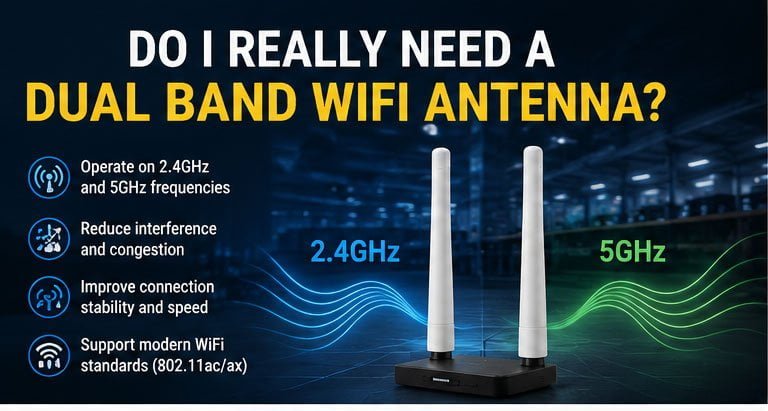
The wide beamwidth ensures good coverage for devices anywhere in the sector, and dual-polarization supports modern Wi-Fi's MIMO capabilities (2×2 or 4×4).
Yagi antennas work for Wi-Fi in specific scenarios:
- Point-to-point Wi-Fi bridges: Connecting buildings without running cable
- Extending Wi-Fi to remote buildings: Barns, outbuildings, detached facilities
- Directional coverage: Covering a long narrow area like a pathway or parking lot
Rural Internet Access
Both antenna types play important roles in rural connectivity solutions.
For the service provider's base station: Panel antennas on a central tower create sector coverage reaching multiple subscribers within a broad area.
For subscriber equipment: Yagi antennas mounted at subscriber homes point back toward the provider's tower, maximizing received signal strength. The narrow beam also reduces interference from other directions.
This hybrid approach—panels at the hub, Yagis at the endpoints—is the standard architecture for WISP (Wireless Internet Service Provider) networks serving rural communities.
IoT and LoRaWAN Networks
Panel antennas are preferred for LoRaWAN gateways positioned to serve large areas with many distributed sensors. The wide coverage ensures sensors throughout the sector can connect reliably.
Yagi antennas can extend LoRaWAN coverage in specific directions—perhaps toward an industrial facility or agricultural area—without wasting energy on empty spaces.
I've seen smart agriculture deployments use both: panel antennas at central gateway locations, with supplemental Yagi antennas aimed at distant fields containing sensor clusters.
Vehicle and Mobile Applications
This becomes more nuanced based on the vehicle's purpose.
Panel antennas (typically smaller, lower-profile models) work well for:
- Mobile base stations: Emergency response vehicles providing Wi-Fi
- Transit Wi-Fi: Buses and trains offering passenger connectivity
Yagi antennas suit:
- Direction-finding: Search and rescue, wildlife tracking
- Long-distance mobile links: Connecting moving vehicles to distant fixed stations
One customer operates a fleet of service vehicles in remote mining operations. They use roof-mounted Yagi antennas pointed toward the mine's central communication tower, maintaining connectivity up to 15 kilometers away while driving between sites.
Building-to-Building Connections
When you need reliable wireless connectivity between buildings on a campus or across short urban distances, your antenna choice depends on the environment.
For short distances with high reliability needs (up to 2-3 km):
- Panel antennas offer robust performance and tolerance for minor alignment errors
For longer distances or budget-constrained projects (3-10 km):
- Yagi antennas provide excellent point-to-point performance at minimal cost
For urban environments with interference:
- Panel antennas with superior F/B ratios better reject signals from other buildings and sources