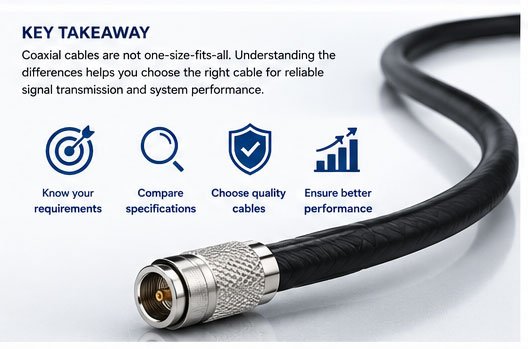
Yes, I've worked with over a dozen types of coaxial cables in my 17 years in the RF industry. Each type serves specific frequency ranges, power levels, and application needs.
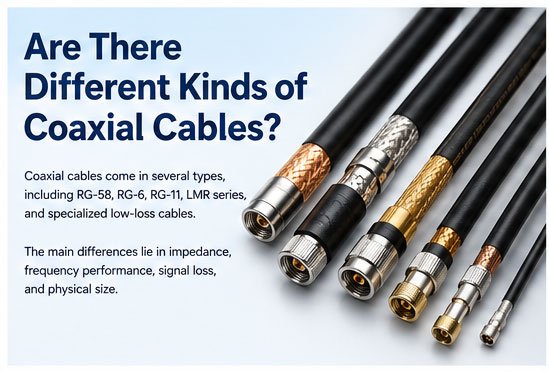
Coaxial cables come in several types, including RG-58, RG-6, RG-11, LMR series, and specialized low-loss cables. The main differences lie in impedance (50Ω or 75Ω), frequency performance, signal loss, and physical size. Choosing the right type depends on your application requirements.
I remember when a client came to us needing a cable for their 5G base station project. They initially thought all coaxial cables were the same. After I explained the differences, they realized their original choice would have caused 40% signal loss. Let me walk you through everything you need to know about coaxial cable types.
What Are the Different Types of Coaxial Cables?
Coaxial cables vary by construction, impedance, and performance characteristics. I see confusion about this almost daily from customers who contact us for antenna solutions.
The primary types include RG series (RG-58, RG-6, RG-11), LMR series (LMR-195, LMR-400), Times Microwave cables, and specialized types like semi-rigid and flexible cables. Each type has distinct impedance ratings, typically 50Ω for RF applications or 75Ω for video transmission.
Let me break down the most common categories I work with. The RG series represents "Radio Guide" cables. These were the original military specifications. RG-58 is thin and flexible, perfect for short connections between equipment. RG-6 dominates cable TV installations. RG-11 offers better performance over longer distances.
The LMR series from Times Microwave represents "Low Loss Microwave" technology. I recommend these for professional RF applications. LMR-195 works well for portable devices. LMR-400 suits base station installations where signal quality matters most.
Semi-rigid cables use a solid outer conductor. We manufacture these for applications requiring stable, unchanging performance. They cannot bend easily after installation. Flexible cables allow repeated bending. I suggest these for test equipment and applications requiring frequent reconnection.
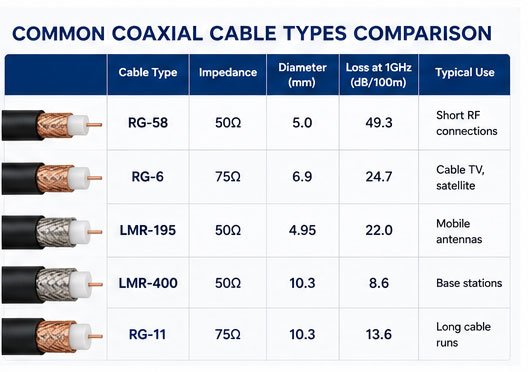
Here's a comparison table of common types:
| Cable Type | Impedance | Diameter | Loss at 1GHz | Typical Use |
|---|---|---|---|---|
| RG-58 | 50Ω | 5mm | High | Short RF connections |
| RG-6 | 75Ω | 6.9mm | Medium | Cable TV, satellite |
| LMR-195 | 50Ω | 4.95mm | Low | Mobile antennas |
| LMR-400 | 50Ω | 10.3mm | Very Low | Base stations |
| RG-11 | 75Ω | 10.3mm | Low | Long cable runs |
How Many Types of Coaxial Cables Are There?
The number depends on how you classify them. I count over 100 distinct specifications when including all variations and manufacturer-specific designs.
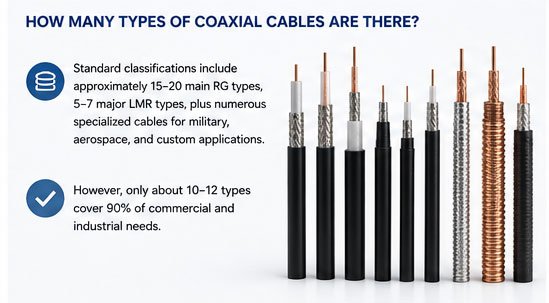
Standard classifications include approximately 15-20 main RG types, 5-7 major LMR types, plus numerous specialized cables for military, aerospace, and custom applications. However, only about 10-12 types cover 90% of commercial and industrial needs.
The RG designation system alone includes more than 20 numbered types. Not all remain in common use today. Some became obsolete as technology improved. I rarely see requests for RG-8 anymore, though it was popular decades ago.
When customers ask me "how many types exist," I first ask about their application. This matters more than knowing every variant. For wireless communication projects, I focus on 50Ω cables. For video transmission, 75Ω cables dominate.
Manufacturers also create proprietary types. Times Microwave makes LMR series. Andrew (now CommScope) produces Heliax. Belden has their own numbering system. Each manufacturer optimizes different characteristics.
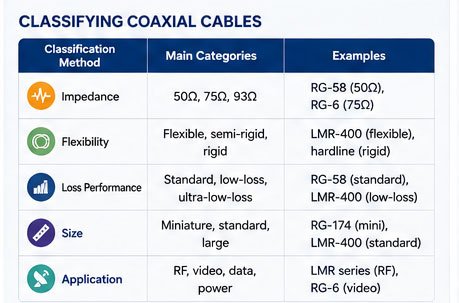
I categorize cables by these key factors:
| Classification Method | Main Categories | Examples |
|---|---|---|
| Impedance | 50Ω, 75Ω, 93Ω | RG-58 (50Ω), RG-6 (75Ω) |
| Flexibility | Flexible, semi-rigid, rigid | LMR-400 (flexible), hardline (rigid) |
| Loss Performance | Standard, low-loss, ultra-low-loss | RG-58 (standard), LMR-400 (low-loss) |
| Size | Miniature, standard, large | RG-174 (mini), LMR-400 (standard) |
| Application | RF, video, data, power | LMR series (RF), RG-6 (video) |
In my factory, we stock about 12 main types. These handle 95% of customer orders. Special requests require custom manufacturing runs. We can produce almost any specification, but standard types ship faster.
Which Coaxial Cable Type Is Right for Your Application?
Selecting the correct cable prevents signal loss, interference, and system failure. I've seen projects fail because someone chose based on price alone rather than specifications.
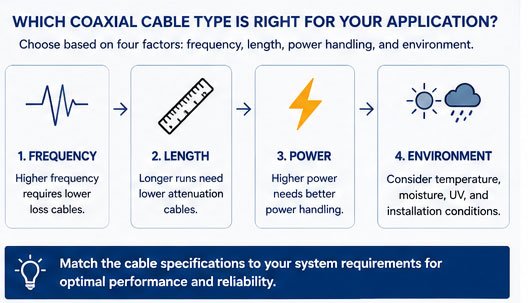
Choose based on four factors: operating frequency, required cable length, power handling needs, and environmental conditions. For 5G applications under 6GHz, LMR-400 works well for runs up to 30 meters. For GPS antennas with short connections, RG-174 or RG-316 suffices.
Frequency determines everything. Higher frequencies suffer more loss. A cable performing well at 900MHz might fail at 5GHz. I always check the attenuation specifications at your actual operating frequency.
Cable length multiplies signal loss. A cable with 0.5dB loss per meter loses 5dB over 10 meters. This can destroy weak GPS signals. For runs over 20 meters, I recommend upgrading to thicker, lower-loss cables like LMR-400.
Power handling matters for transmitter connections. High-power base stations require cables that won't overheat or break down. RG-58 handles only a few watts safely. LMR-400 handles hundreds of watts at VHF/UHF frequencies.
Environmental factors include temperature, moisture, UV exposure, and flexibility requirements. Outdoor installations need UV-resistant jackets. Mobile applications need highly flexible cables that survive repeated bending. We manufacture cables with different jacket materials for different environments.
Here's my selection framework:
| Application | Distance | Frequency | Recommended Type | Why |
|---|---|---|---|---|
| WiFi router to antenna | <3m | 2.4-5GHz | RG-316 | Flexible, adequate performance |
| 4G/5G base station | 10-30m | <6GHz | LMR-400 | Low loss, good power handling |
| GPS antenna connection | <5m | 1.5GHz | RG-174 | Cost-effective for low power |
| Cable TV distribution | 50-100m | <1GHz | RG-11 | 75Ω impedance, low loss |
| IoT gateway to antenna | <10m | <1GHz | RG-58 | Balance of cost and performance |
I also consider connector compatibility. Your equipment uses specific connector types. SMA connectors typically attach to smaller cables like RG-316 or LMR-195. N-type connectors suit larger cables like LMR-400 or LMR-600.
Cost matters for large deployments. RG-58 costs much less than LMR-400. For short, low-frequency connections, the cheaper cable works fine. For critical applications where signal quality determines system success, I always recommend better cables.
Understanding the Different Kinds of Coaxial Cables
Coaxial cable construction determines performance characteristics. I explain this structure to help customers understand why prices and capabilities differ.
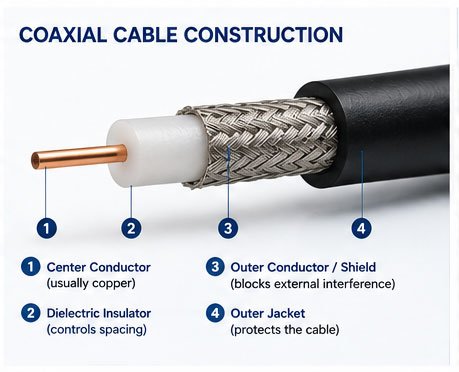
All coaxial cables share the same basic structure: center conductor, dielectric insulator, outer conductor (shield), and protective jacket. Variations in materials, dimensions, and manufacturing precision create different performance levels and price points.
The center conductor carries your signal. It can be solid copper wire or stranded copper. Solid conductors perform better at high frequencies but break easily with repeated bending. Stranded conductors offer flexibility but slightly higher loss. I choose solid for permanent installations and stranded for mobile applications.
The dielectric material separates the center conductor from the shield. This insulation directly affects signal speed and loss. Solid polyethylene costs less but performs adequately for most applications. Foam polyethylene reduces loss significantly. PTFE (Teflon) offers the best performance and temperature resistance but costs more.
The outer conductor shields the signal from interference. It also completes the electrical circuit. Basic cables use aluminum foil. Better cables add braided copper. Premium cables combine foil and braid for maximum shielding. In our factory, we use double-shielded construction for most RF cables.
The jacket protects everything inside. PVC works indoors and costs less. UV-resistant polyethylene suits outdoor installations. Special applications need flame-retardant or oil-resistant materials.
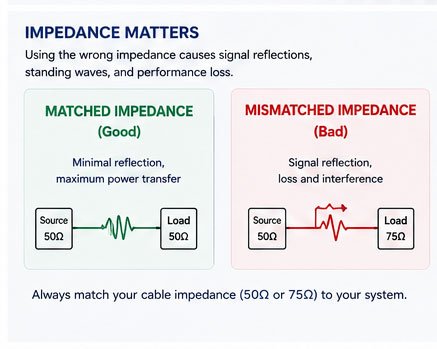
Cable impedance comes from the ratio between conductor diameter and dielectric thickness. This ratio creates either 50Ω or 75Ω impedance. You cannot mix impedances without causing signal reflections.
Here's how construction variations affect performance:
| Component | Standard Grade | Premium Grade | Performance Impact |
|---|---|---|---|
| Center Conductor | Copper-clad steel | Solid copper | Better conductivity, lower loss |
| Dielectric | Solid PE | Foam PE or PTFE | Lower loss, higher speed |
| Shield | Single braid | Double braid + foil | Better interference rejection |
| Jacket | Basic PVC | UV-resistant PE | Longer outdoor life |
| Manufacturing | Standard tolerance | Precision controlled | More consistent impedance |
Coaxial Cable Types Explained: A Complete Guide
Different cable series serve different markets and applications. I'll explain the main families you'll encounter when sourcing RF cables.
RG series cables follow military specifications, making them widely available and standardized. LMR series cables offer superior performance for professional RF applications. Specialized cables like semi-rigid and corrugated hardline serve specific technical requirements in base stations and test equipment.
The RG series dominated for decades. These cables follow military specifications originally developed in the 1940s. The numbers (like RG-58, RG-6) reference specific military standards. This standardization means you can buy RG-58 from any manufacturer and expect similar performance.
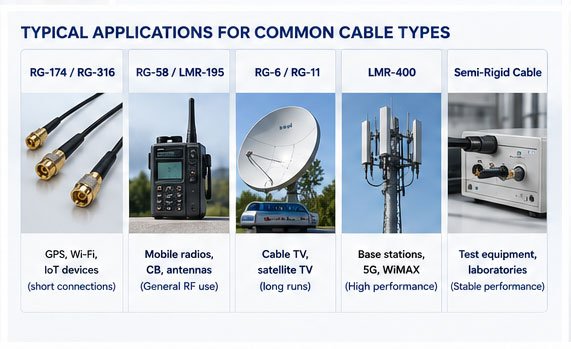
RG-58 became popular for 50Ω applications. Its thin diameter (about 5mm) makes it easy to route. Loss is acceptable for short runs under 10 meters. I use RG-58 for test equipment connections and short antenna feedlines in WiFi routers.
RG-6 dominates cable TV installations. Its 75Ω impedance matches video equipment. The thicker diameter provides better shielding and lower loss than older RG-59. Most satellite TV and cable internet use RG-6.
LMR series represents modern low-loss technology. Times Microwave developed these cables to outperform RG types at higher frequencies. LMR stands for "Low Loss Microwave." We manufacture cables compatible with LMR specifications for customers who need guaranteed performance.
LMR-195 serves as a flexible, low-loss alternative to RG-58. Same diameter, much better performance. I recommend this for mobile antennas and portable equipment where size matters but you need better signal quality.
LMR-400 has become the standard for professional wireless installations. Its larger diameter (about 10mm) reduces loss significantly. Base stations, repeaters, and serious wireless systems use LMR-400. The improved performance justifies the higher cost and less flexible cable.
Semi-rigid cables use a solid copper or aluminum tube as the outer conductor. This construction provides excellent, stable performance. However, you must form bends during installation using special tools. After installation, the cable cannot move. I specify semi-rigid cables for critical RF paths inside equipment where performance stability matters most.
Corrugated hardline cables serve large base stations. These cables use corrugated copper tubes for flexibility during installation while maintaining low loss. Their large diameter (often 1/2 inch or larger) provides excellent performance for high-power, long-distance runs.
Here's a practical comparison:
| Cable Family | Best Use Case | Key Advantage | Limitation |
|---|---|---|---|
| RG Series | General purpose, short runs | Widely available, standardized | Higher loss at high frequencies |
| LMR Series | Professional RF systems | Excellent loss performance | Higher cost |
| Semi-Rigid | Internal equipment connections | Stable, low loss | Cannot bend after installation |
| Hardline | Base station feedlines | Lowest loss, high power | Expensive, requires special installation |
| Flexible Precision | Test equipment | Repeatable bending | Very expensive |
What's the Difference Between Coaxial Cable Types?
The key differences lie in electrical performance, physical characteristics, and cost. I evaluate these factors when recommending cables to customers.
Main differences include signal loss (attenuation), power handling capacity, frequency range, physical flexibility, environmental resistance, and price. Premium cables like LMR-400 have 30-50% less signal loss than RG-58 at 1GHz but cost three times more.
Signal loss varies dramatically between types. At 1GHz, RG-58 loses about 0.7dB per meter. LMR-400 loses only 0.22dB per meter. Over a 10-meter run, that's 7dB versus 2.2dB. This difference can determine whether your system works at all.
Loss increases with frequency. The same cables at 5GHz show even larger differences. This explains why 5G installations require better cables than older 4G systems.
Power handling depends on cable size and loss. Small cables heat up quickly with high power. RG-58 safely handles about 50 watts at 450MHz. LMR-400 handles 500 watts at the same frequency. For transmitter applications, I always check power ratings carefully.
Physical flexibility affects installation and reliability. Highly flexible cables bend easily but often have slightly higher loss. Stiffer cables perform better but can break if bent too sharply. I match flexibility to application needs. Test equipment needs very flexible cables. Fixed installations can use stiffer, lower-loss options.
Environmental resistance determines outdoor lifespan. Basic PVC jackets degrade under UV exposure within 2-3 years. UV-resistant jackets last 10+ years outdoors. We manufacture cables with different jacket materials based on installation environment.
Price differences reflect performance and materials. RG-58 costs about $0.50 per meter. LMR-400 costs $2-3 per meter. For critical applications, the performance improvement justifies the cost. For non-critical short connections, cheaper cables work fine.
Here's a detailed comparison:
| Performance Factor | RG-58 | RG-6 | LMR-195 | LMR-400 |
|---|---|---|---|---|
| Loss at 1GHz | 0.7 dB/m | 0.4 dB/m | 0.45 dB/m | 0.22 dB/m |
| Loss at 5GHz | 1.8 dB/m | N/A | 1.0 dB/m | 0.5 dB/m |
| Power at 450MHz | 50W | 80W | 100W | 500W |
| Impedance | 50Ω | 75Ω | 50Ω | 50Ω |
| Min. bend radius | 25mm | 35mm | 25mm | 50mm |
| Relative cost | 1x | 1.2x | 1.8x | 3x |
How Do Different Coaxial Cables Compare?
Direct comparison helps you make informed decisions. I created comparison frameworks based on common selection criteria from thousands of customer projects.
Comparing cables requires evaluating multiple factors simultaneously. The "best" cable depends on your specific priorities: lowest loss, lowest cost, most flexible, or most durable. No single cable type excels in all categories.
For loss performance, LMR-400 and LMR-600 lead in commonly available cables. They use superior dielectric materials and precise manufacturing.