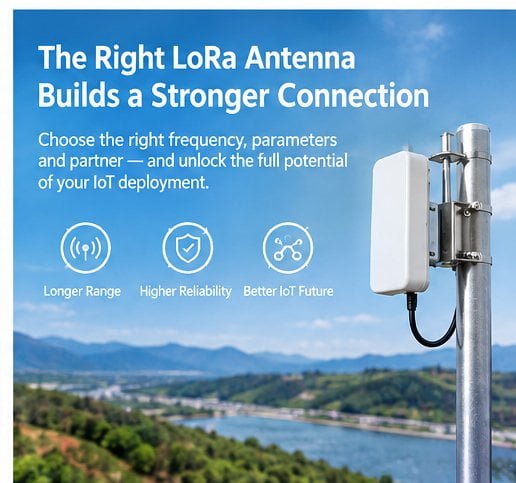
Are you struggling to optimize your long-range wireless communication or IoT deployments? Choosing the right LoRa antenna is paramount, yet the array of frequencies (433/868/915MHz), types, and specifications can be overwhelming, leading to suboptimal performance or costly redesigns.
To choose the optimal LoRa antenna, consider your operating frequency (433, 868, or 915MHz) based on regional regulations, then evaluate critical factors like communication distance, installation environment, required gain, and impedance matching to ensure both signal performance and engineering stability. Partnering with an experienced manufacturer for custom solutions can further optimize your deployment.
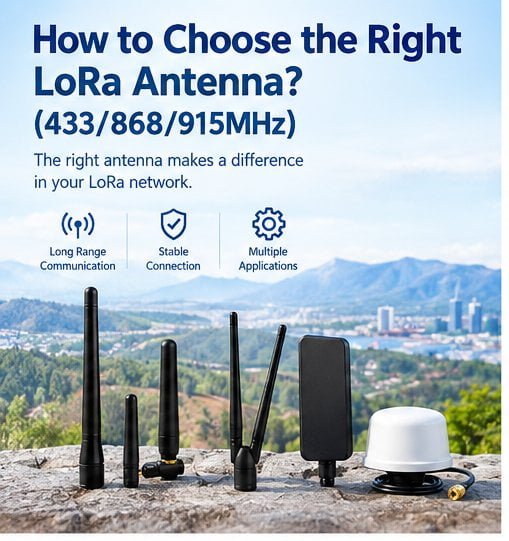
Navigating the complexities of LoRa antenna selection doesn't have to be a shot in the dark. Let's delve deeper into the specific considerations that will guide your decision, from understanding frequency bands to assessing technical specifications and installation challenges.
How Do LoRa Frequencies (433/868/915MHz) Impact Your Antenna Choice?
Selecting the correct operating frequency for your LoRa system is not just a technical choice; it's often a regulatory necessity. Incorrect frequency selection can lead to poor performance or, worse, legal issues.
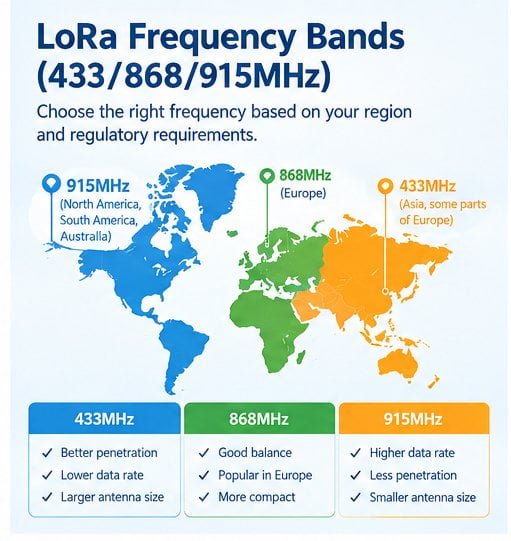
The choice between 433MHz, 868MHz, and 915MHz LoRa antennas is primarily dictated by regional radio frequency regulations and your specific application's environmental conditions. Lower frequencies (like 433MHz) offer better penetration through obstacles but have slower data rates, while higher frequencies (868/915MHz) provide faster data transmission but are more susceptible to obstruction.
Dive Deeper: Regional Regulations and Performance Trade-offs
When we talk about LoRa antenna selection, the first and most critical step is to align with the permitted frequency band in your target region. LoRa technology operates within sub-gigahertz (sub-GHz) ISM (Industrial, Scientific, and Medical) bands, which vary significantly worldwide. This directly influences the choice of your LoRa antenna.
-
433MHz Band: This frequency is globally available, often used in regions like Asia (e.g., China, India) and parts of Europe, though typically with lower power limits compared to other bands. It's known for its excellent penetration capabilities, making it suitable for applications where signals need to pass through multiple walls or dense foliage. However, its larger wavelength means that antennas tend to be physically larger, and data rates are generally lower. For example, if I'm deploying a sensor network deep inside an industrial facility with thick concrete walls, a 433MHz LoRa antenna might be my first consideration for signal reliability.
-
868MHz Band: This is the primary band for LoRaWAN deployments in Europe. It offers a good balance between penetration and data rates, making it a popular choice for a wide range of IoT applications across the continent. Compared to 433MHz, 868MHz antennas can be more compact, which is beneficial for smaller devices.
-
915MHz Band: Predominantly used in North America, South America, and Australia, the 915MHz band provides higher data rates than the lower frequencies. While it offers less penetration through obstacles than 433MHz, it still provides excellent long-range capabilities suitable for smart cities, agriculture, and utility metering. The antennas are generally smaller than those for 433MHz, allowing for more discreet integration.
Key Regulatory Considerations: It's not just about the frequency; regulatory bodies in each region also define:
- Maximum Transmit Power (EIRP): This impacts the maximum permissible signal strength and, consequently, the achievable range.
- Duty Cycle: Some bands (especially 868MHz in Europe) impose duty cycle limitations (e.g., 1% duty cycle), meaning the device can only transmit for a small percentage of the time. This affects how frequently your LoRa device can send data.
- Channel Spacing and Hopping: Regulations may specify allowed channel bandwidths and whether frequency hopping is mandatory.
Choosing a compliant LoRa antenna is non-negotiable. As a manufacturer specializing in RF solutions for over 17 years, we understand the nuances of these global regulations. We ensure our antennas, whether for 433MHz, 868MHz, or 915MHz, meet relevant international standards like CE and RoHS for export to over 100 countries, helping our clients navigate these complex requirements. Always verify the specific regulations for your deployment area to prevent any compliance issues.
What Key Technical Specifications Should You Prioritize for a LoRa Antenna?
Beyond frequency, the technical specifications of a LoRa antenna are crucial determinants of its performance in the field. Understanding these parameters helps you match the antenna to your specific application requirements.
When selecting a LoRa antenna, prioritize specifications such as gain for signal strength, Voltage Standing Wave Ratio (VSWR) for impedance matching and efficiency, and input impedance (typically 50 Ohms) for optimal power transfer. These metrics directly influence the antenna's ability to effectively transmit and receive LoRa signals over long distances.

Dive Deeper: Gain, VSWR, Impedance, and More
Optimizing the performance of your LoRa system hinges on a deep understanding of antenna specifications. Let's break down the most critical ones:
Antenna Gain
Antenna gain is often the first specification people look at because it directly relates to how "far" your signal can go. It's a measure of how efficiently an antenna converts input power into radio waves in a specific direction.
- Measured in dBi (decibels relative to an isotropic radiator) or dBd (decibels relative to a dipole). An isotropic radiator is a theoretical antenna that radiates power equally in all directions. A dipole antenna is a real-world reference. 0 dBd = 2.15 dBi.
- Higher gain does not mean more power output overall. Instead, it means the antenna focuses the available power into a narrower beam, enhancing signal strength in that direction at the expense of other directions.
- Trade-offs: A high-gain omnidirectional LoRa antenna (e.g., 5dBi or 8dBi) will project a flatter, more pancake-shaped radiation pattern, excellent for covering a wide area horizontally but potentially weak directly above or below. A lower-gain antenna (e.g., 2dBi) offers a more spherical pattern, useful when devices might be at varying heights.
- Application-specific: For long-range, line-of-sight communication over flat terrain, a higher-gain antenna is often beneficial. For urban environments with multi-path reflections and devices at different elevations, a moderate gain might be more suitable. Our fiberglass antennas are designed with various gain options to suit diverse long-range applications.
Voltage Standing Wave Ratio (VSWR)
VSWR is a crucial indicator of how well an antenna is matched to the transmission line (cable) and the radio.
- Definition: It represents the ratio of the maximum to minimum voltage in a standing wave pattern on a transmission line.
- Interpretation:
- 1:1 (or 1.0): Perfect match, all power transmitted to the antenna.
- < 1.5:1: Excellent match, typically acceptable for most applications. This means over 96% of the power is transmitted.
- < 2.0:1: Good match, usually acceptable, with around 90% power transmitted.
- > 2.0:1: Poor match, significant power reflected back to the radio, leading to reduced range and potentially damaging the radio's output stage.
- Importance: A low VSWR ensures maximum power transfer from your LoRa module to the LoRa antenna, optimizing range and efficiency. Poor VSWR means lost power as heat, which impacts overall system performance. When evaluating an antenna, I always check the VSWR curve across the operating frequency band.
Input Impedance
- Standard: Nearly all RF communication equipment, including LoRa modules, operate with a standard impedance of 50 Ohms.
- Matching: The LoRa antenna must also have an input impedance of 50 Ohms to ensure efficient power transfer. Any mismatch leads to reflections and poor VSWR. Our engineering team meticulously designs and tests our antennas to ensure precise 50 Ohm impedance matching across their specified frequency ranges.
Other Critical Specifications:
- Polarization: Most LoRa deployments use vertical polarization for omnidirectional antennas. Ensure your antenna's polarization matches that of the receiving antenna for optimal signal reception.
- Radiation Pattern: This describes how the antenna radiates or receives energy in different directions. Understanding the pattern (e.g., omnidirectional, directional) helps predict coverage.
- Bandwidth: The range of frequencies over which the antenna maintains acceptable performance (e.g., VSWR < 2.0:1). This is vital for multi-band LoRa systems or systems that might drift slightly in frequency.
- Material and Durability: For outdoor or industrial applications, the physical construction, UV resistance, and waterproofing (IP rating) of the LoRa antenna are as important as its RF performance. Our fiberglass antennas, for example, are designed for harsh outdoor environments, reflecting our focus on stable product quality.
As a manufacturer with ISO9001 quality management certification, we provide detailed specifications for all our antennas, including precise gain measurements, VSWR curves, and environmental ratings. We emphasize that these parameters must be rigorously tested and verified, not just theoretical claims.
How Do Installation Environment and Antenna Type Influence LoRa Performance?
The physical environment where a LoRa antenna is deployed, along with its specific type and form factor, profoundly impacts its real-world performance, often more so than theoretical specifications alone.
The installation environment dictates the optimal LoRa antenna type – omnidirectional for wide-area coverage in open spaces, directional for point-to-point links, or specialized antennas like patch or PCB for integrated devices. Factors like line of sight, obstacles, and weather exposure will significantly influence antenna choice and mounting strategy to maximize LoRa signal range and reliability.

Dive Deeper: Matching Antenna Type to Application and Environment
The "best" LoRa antenna isn't just about gain; it's about fitting the antenna to its operational context. Different environments present unique challenges, and selecting the right antenna type can dramatically improve system performance.
Common LoRa Antenna Types:
-
Omnidirectional Antennas:
- Characteristics: Radiate and receive signals almost equally in all horizontal directions (360 degrees). They typically have a "doughnut" or "pancake" shaped radiation pattern.
- Applications: Ideal for gateways or end-nodes that need to communicate with devices spread out around them, such as in smart cities, agricultural fields, or general IoT networks where devices are mobile or their precise location isn't known.
- Examples: Dipole antennas, whip antennas, and our fiberglass LoRa antennas. Fiberglass antennas are particularly popular for outdoor omnidirectional use due to their durability and weather resistance. We offer various lengths and gains to suit different coverage requirements.
-
Directional Antennas:
- Characteristics: Focus the signal into a narrow beam in a specific direction, achieving higher gain than omnidirectional antennas with the same physical size.
- Applications: Suited for point-to-point communication links where the locations of the transmitting and receiving devices are fixed and known. This could be linking two distant buildings, monitoring specific assets from a central point, or overcoming interference from other directions.
- Examples: Yagi antennas, panel antennas. While less common for general LoRaWAN, they are valuable in specialized long-range scenarios.
-
Embedded/Internal Antennas (PCB, Chip, FPC):
- Characteristics: Compact antennas integrated directly onto a Printed Circuit Board (PCB), as small ceramic chips, or flexible printed circuits (FPC).
- Applications: Used in compact devices where space is at a premium, such as smart sensors, wearables, or very small IoT modules.
- Trade-offs: Generally offer lower gain and are more susceptible to performance degradation from surrounding components or the device's enclosure. Careful design and testing are crucial to ensure adequate performance. Our OEM/ODM capabilities include designing custom PCB or FPC antennas for precise integration into client devices.
Environmental Considerations:
- Line of Sight (LoS) vs. Non-Line of Sight (NLoS):
- LoS: When there's a clear, unobstructed path between the LoRa antenna and the receiving device, higher frequencies (868/915MHz) and higher gain antennas generally perform best.
- NLoS: In urban canyons, dense forests, or inside buildings, obstacles cause signal attenuation, reflection, and diffraction. Lower frequencies (433MHz) with their better penetration, and antennas with more robust radiation patterns (e.g., moderate gain omnidirectional), can be more effective.
- Obstacles: Buildings, hills, trees, and even dense crowds can block or attenuate LoRa signals. Consider the "Fresnel Zone" – an elliptical area around the line of sight that should be clear of obstructions for optimal signal propagation.
- Interference: Other RF devices operating in the same or adjacent frequency bands can cause interference. Choosing a highly selective antenna or a directional antenna to minimize unwanted signals can be beneficial.
- Weather and Durability: For outdoor deployments, the LoRa antenna must withstand extreme temperatures, UV radiation, wind, rain, and snow. Materials like fiberglass and robust mounting hardware are essential. Our products are engineered for stability in diverse outdoor conditions, a testament to our focus on durable design and manufacturing.
- Mounting Location and Height:
- Height: Mounting an antenna as high as possible, free from immediate obstructions, generally improves range.
- Ground Plane: Many antennas (like quarter-wave whips) require a proper ground plane to function optimally. Ensure the installation provides this, or choose a ground plane independent antenna (like a dipole).
- Proximity to Metal: Metal objects near the antenna can detune it or distort its radiation pattern, severely impacting performance. Maintain adequate clearance.
My experience has shown that even a high-quality antenna can perform poorly if not installed correctly or if the environment hasn't been considered. This is why we often work closely with clients to recommend not just the antenna, but also optimal installation guidelines based on their specific deployment scenarios. Our over 17 years in the industry give us a unique perspective on real-world application challenges.
Why is Supplier Expertise Crucial When Choosing a LoRa Antenna for Industrial IoT?
In the demanding world of Industrial IoT (IIoT) and critical wireless communication, merely selecting an antenna based on datasheet specifications isn't enough. The expertise and capabilities of your LoRa antenna supplier play a pivotal role in the success and longevity of your deployment.
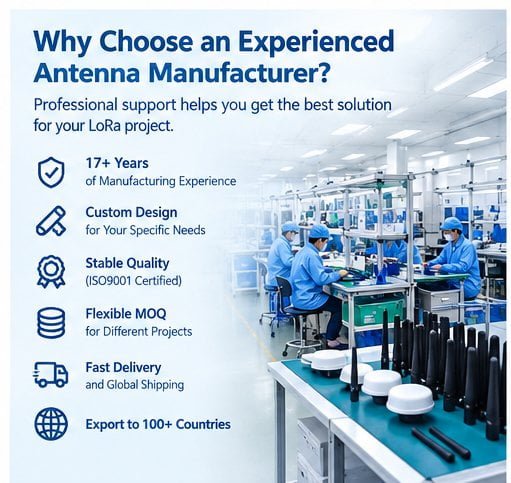
Supplier expertise is crucial for LoRa antenna selection, especially for industrial IoT, because it ensures robust product performance, supports critical customization needs, and guarantees stable, long-term supply. An experienced manufacturer provides validated specifications, rigorous quality control, flexible OEM/ODM services, and responsive technical support for reliable integration into complex systems.
Dive Deeper: Customization, Quality, and Long-Term Partnership
For businesses deploying LoRa solutions in areas like smart factories, utility monitoring, or remote asset tracking, the stakes are high. Product reliability and performance are paramount. This is where a knowledgeable and capable LoRa antenna manufacturer becomes an invaluable partner.
Customization and OEM/ODM Capabilities
Every IIoT deployment often has unique requirements. A standard off-the-shelf LoRa antenna might not perfectly fit.
- Frequency Tuning: While 433/868/915MHz are common, some regions or niche applications might require slight frequency adjustments for optimal performance.
- Connector Types & Cable Lengths: Matching the antenna to existing hardware (e.g., SMA, N-Type, U.FL connectors) and ensuring appropriate cable lengths to minimize signal loss are critical.
- Housing & Mounting: Custom enclosures for harsh environments, specific mounting brackets, or aesthetics for branded products are common requests.
- Integration: For embedded solutions, the ability to design custom PCB or FPC antennas that seamlessly integrate with your device's form factor and internal components, while maintaining optimal performance, is a significant advantage.
- Prototyping & Testing: An expert supplier can offer rapid prototyping and thorough testing services, ensuring the customized LoRa antenna meets all performance parameters before mass production.
- Here at our Shenzhen facility, with over 17 years of experience, we pride ourselves on our robust OEM/ODM capabilities. We can take your specific requirements – whether it's a unique frequency, a specialized connector, or a custom housing – and turn them into a reliable antenna solution, often with flexible Minimum Order Quantities (MOQ) to support testing and smaller batch orders.
Product Performance and Quality Assurance
The datasheet gain and VSWR are theoretical maximums. Real-world performance depends heavily on manufacturing consistency and rigorous quality control.
- Reliable Performance Parameters: A reputable manufacturer provides validated performance data, not just theoretical numbers. This includes real-world gain measurements, VSWR plots across the full operating band, and radiation pattern analysis. We validate our LoRa antenna designs through comprehensive testing in our own facilities.
- Manufacturing Consistency: For large-scale deployments, every LoRa antenna needs to perform identically. ISO9001 certification indicates a commitment to quality management systems that ensure consistency from batch to batch. We have maintained ISO9001 certification for years, a testament to our stable production system.
- Durability and Environmental Robustness: Especially for industrial and outdoor applications, the antenna must withstand harsh conditions. Quality materials, proper sealing (IP ratings), and robust construction are non-negotiable. Our fiberglass antennas, for example, are engineered for long-term stability outdoors.
- Certifications: Products complying with international standards like CE, RoHS, and others relevant to specific regions demonstrate a commitment to safety, environmental responsibility, and market access. Our products carry these certifications, making global deployment easier for our clients.
Supply Chain Stability and Support
- Fast Response and Delivery: In fast-paced IoT markets, quick turnaround times for samples and production batches are vital. A supplier with efficient processes and a mature supply chain can offer faster delivery capabilities.
- Flexible MOQ: Especially for smaller companies or pilot projects, the ability to order flexible MOQs (Minimum Order Quantities) allows for easier testing and iteration.
- Technical Support: Post-purchase technical support, troubleshooting assistance, and expert advice for integration challenges are invaluable. This is where the long-term experience of an engineering team truly shines.
- Long-Term Partnership: Establishing a relationship with a reliable manufacturer fosters trust and ensures continuous product improvement and support for future projects. We aim to be a long-term, reliable antenna supplier for our global clients, offering not just products but a complete solution and partnership.
In essence, choosing a LoRa antenna from an experienced manufacturer like us means you're investing in more than just hardware; you're securing expertise, reliability, and a partner capable of adapting to your evolving IIoT needs. This minimizes risk and accelerates your time to market.
Frequently Asked Questions
Which LoRa frequency is best for long range?
Generally, lower frequencies offer better penetration and signal propagation over long distances, making 433MHz a strong contender in environments with many obstacles. However, 868MHz and 915MHz also provide excellent long-range capabilities, especially in line-of-sight scenarios, and benefit from smaller antenna sizes and often higher data rates.
Can I use a WiFi antenna for LoRa?
No, you should not use a WiFi antenna for LoRa. WiFi operates at 2.4GHz or 5GHz, while LoRa operates in the sub-gigahertz bands (433/868/915MHz). Antennas are frequency-specific; using a WiFi antenna for LoRa would result in severe impedance mismatch and extremely poor signal performance, rendering your LoRa system ineffective.
How important is LoRa antenna gain?
LoRa antenna gain is very important as it determines how effectively the antenna focuses radio frequency energy. Higher gain can extend communication range by concentrating power in a specific direction, but it also creates a narrower radiation pattern. The ideal gain depends on your specific application's coverage area and line-of-sight conditions.
What is the typical impedance of a LoRa antenna?
The typical impedance of a LoRa antenna, along with most RF communication systems, is 50 Ohms. Maintaining this impedance match with the LoRa module and coaxial cable is crucial for efficient power transfer, minimizing signal reflections (as indicated by a low VSWR), and optimizing the overall performance of your LoRa system.
Do I need a ground plane for my LoRa antenna?
It depends on the antenna type. Many common LoRa antenna designs, such as quarter-wave whip antennas, rely on a conductive ground plane to function correctly and achieve their specified radiation pattern. Other designs, like dipoles or ground plane independent antennas, do not require an external ground plane. Always check the manufacturer's specifications for your chosen LoRa antenna.
Conclusion
Choosing the right LoRa antenna (433/868/915MHz) is a critical decision that directly impacts the success of your wireless communication and IoT deployments. It requires a thoughtful evaluation of regional frequency regulations, key technical specifications like gain and VSWR, and careful consideration of your specific installation environment and application needs. Partnering with a manufacturer offering proven expertise in design, customization, and quality control is essential for ensuring optimal performance and long-term reliability.
Ready to optimize your LoRa communication? Explore our range of high-quality communication antennas and RF coaxial cable assemblies, designed for stability and performance. Our 17+ years of industry experience, ISO9001 certification, and comprehensive OEM/ODM capabilities mean we can provide the reliable, custom LoRa antenna solutions your project demands. Contact us today to discuss your specific requirements and find the perfect antenna for your industrial IoT application.