
Struggling with unreliable data transmission or limited coverage in your Internet of Things (IoT) deployments? The challenge of achieving robust, long-range connectivity often boils down to a critical component: the antenna. Choosing the right LoRa antenna for long-range IoT communication is paramount to the success and efficiency of your entire system, directly impacting data reliability and operational costs.
To choose the best LoRa antenna for long-range IoT communication, prioritize high-gain antennas optimized for your specific LoRaWAN frequency band, ensuring low VSWR for maximum power transfer, and considering environmental factors like installation location and potential cable loss. Verify compatibility with your LoRa module and look for robust construction to withstand diverse operating conditions, ultimately maximizing range and data integrity.
Navigating the myriad of antenna specifications can be complex, but understanding the key factors will empower you to make informed decisions. We will explore the critical aspects of antenna selection, from technical parameters to practical deployment considerations, helping you achieve optimal performance for your IoT network.
How to Choose the Right LoRa Antenna for Long-Range IoT Applications?
Are your LoRa IoT devices failing to reach their full potential, hampered by limited signal strength or intermittent connections? In the vast landscape of IoT, the antenna often acts as the unsung hero, and an ill-suited choice can severely undermine the reliability and reach of your long-range applications.
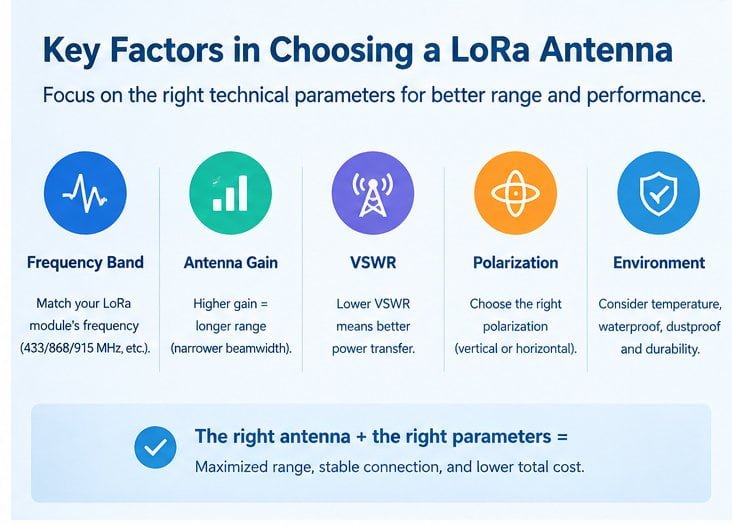
Selecting the right LoRa antenna for long-range IoT applications requires a methodical approach, focusing on crucial technical specifications like gain, frequency, VSWR, and polarization, while also matching the antenna's physical characteristics to its intended environment and integrating seamlessly with your LoRa module.
When I speak with manufacturers and system integrators, a common misconception is that all antennas are "good enough." However, for critical long-range IoT deployments, "good enough" simply isn't an option. Let's dive deeper into the technical aspects that define a high-performing LoRa antenna.
Dive Deeper: Understanding Core Antenna Parameters
The foundation of a successful long-range LoRa deployment lies in a deep understanding of antenna characteristics. As a manufacturer with over 17 years of experience in communication antennas, I’ve seen firsthand how carefully matching these parameters to the application makes all the difference.
H3: Frequency Band Compatibility
LoRa operates on unlicensed sub-GHz frequency bands, which vary significantly by region. Choosing an antenna designed for your specific operating frequency is non-negotiable. Using an antenna tuned for 915 MHz in an 868 MHz region, for instance, will lead to significant signal loss and dramatically reduced range.
- Europe (EU): Primarily 863-870 MHz (often referred to as 868 MHz).
- North America (NA): Primarily 902-928 MHz (often referred to as 915 MHz).
- Asia: Varies, but commonly 433 MHz, 470-510 MHz (China), and 920-923 MHz (Korea, Japan).
- Australia/New Zealand: 915-928 MHz.
It is crucial to confirm the exact frequency band your LoRaWAN module operates on and ensure your chosen antenna is tuned for that same range. Many antennas are designed for a specific sub-band (e.g., 868 MHz or 915 MHz) or are broadband enough to cover a wider range (e.g., 860-930 MHz). For optimal performance, a narrow-band antenna specifically tuned to your region's center frequency is usually preferred over a wide-band option.
H3: Antenna Gain (dBi)
Antenna gain is arguably the most critical factor for long-range communication. Measured in decibels isotropic (dBi), gain describes an antenna's ability to focus RF energy in a particular direction, effectively amplifying the signal in that direction while reducing it in others.
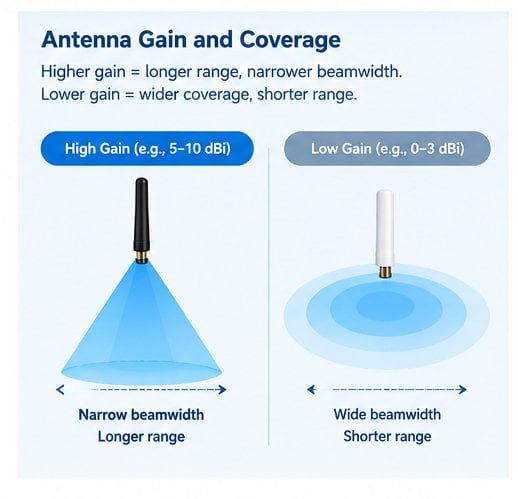
- Higher gain antennas focus energy more tightly, resulting in a narrower beamwidth but a significantly longer range in the primary direction. This is ideal for point-to-point or point-to-multipoint applications where devices are relatively static and their positions known.
- Lower gain antennas have a wider beamwidth, providing more omnidirectional coverage but at a shorter range. These are often used for mobile applications or in environments where node positions are unpredictable.
For maximizing LoRa range, a higher gain antenna (e.g., 5 dBi, 8 dBi, or even 10 dBi+) is generally desired. However, be aware that regulatory limits exist on effective radiated power (ERP/EIRP) in most regions. Combining a high-power LoRa module with an overly high-gain antenna can exceed these limits, so always check local regulations. For example, some regions might cap EIRP at 14 dBm for LoRaWAN. If your module transmits at +10 dBm, you could use an antenna up to 4 dBi gain. My team often works with customers to balance desired range with regulatory compliance.
H3: Voltage Standing Wave Ratio (VSWR)
VSWR indicates how well an antenna is matched to the transmission line and the LoRa module's impedance (typically 50 Ohms). A perfect match would have a VSWR of 1:1, meaning all power is transmitted. Any mismatch causes some RF power to be reflected back to the transmitter, leading to power loss, reduced range, and potential damage to the module over time.
- Ideal VSWR: 1.0:1 (perfect match)
- Excellent VSWR: < 1.5:1 (less than 4% power reflection)
- Acceptable VSWR: < 2.0:1 (less than 11% power reflection)
- Poor VSWR: > 2.0:1 (significant power loss and reflections)
When evaluating antennas, always look for a VSWR specification below 1.5:1 for optimal long-range performance. A lower VSWR ensures that the maximum possible power from your LoRa module is radiated by the antenna. Our engineering team always rigorously tests VSWR across the specified frequency band to ensure robust performance.
H3: Polarization
Polarization refers to the orientation of the electric field of the radio wave emitted by the antenna. Most LoRa antennas are linearly polarized, typically vertically.
- Vertical Polarization: Most common for IoT devices and base stations, especially for outdoor deployments. Ensure your node antennas and gateway antennas have the same polarization for maximum signal strength.
- Horizontal Polarization: Less common for LoRa but used in specific scenarios.
- Circular Polarization: Offers benefits in environments with multi-path fading or when relative orientation between antennas is constantly changing (e.g., mobile assets), but they are generally more complex and expensive.
For typical long-range LoRa applications, maintaining consistent vertical polarization between all transmitting and receiving antennas is the best practice.
H3: Antenna Type and Form Factor
The physical design of the antenna also plays a crucial role in its performance and suitability for long-range IoT communication.
| Antenna Type | Description | Pros | Cons | Ideal Use Case |
|---|---|---|---|---|
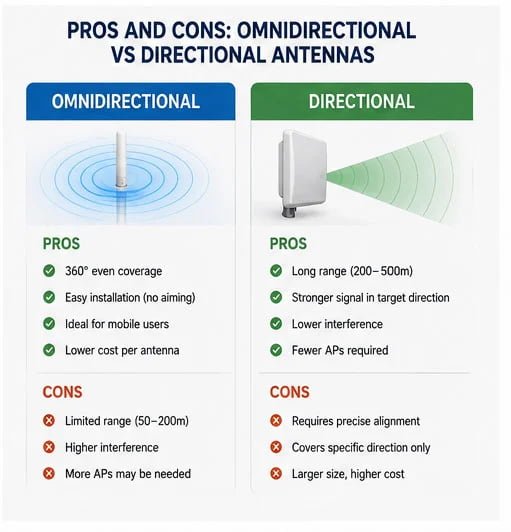
| Omnidirectional | Radiates signal in a 360-degree pattern horizontally. Examples: Whip, dipole. | Easy to deploy, covers wide area. | Lower gain, shorter range than directional. | Indoor/Outdoor base stations, mobile nodes, widespread coverage. |
| Directional | Focuses signal in a specific direction. Examples: Yagi, Patch, Panel. | Higher gain, much longer range in a specific direction. | Requires careful alignment, limited coverage angle. | Point-to-point links, long-distance remote sensors. |
| Fiberglass | Omnidirectional antennas encased in a durable fiberglass radome. | High gain, weather-resistant, durable, often used for base stations. | Larger size, typically vertical outdoor installation. | Outdoor LoRaWAN gateways, long-range fixed nodes. |
| PCB/FPC | Small antennas integrated directly onto a circuit board or flexible circuit. | Compact, low cost, easy integration. | Low gain, performance sensitive to board layout and enclosure. | Small IoT devices, short to medium range. |
| Chip Antenna | Tiny ceramic antennas for ultra-compact devices. | Smallest form factor, low cost. | Very low gain, extremely sensitive to environment and placement. | Very short-range, highly space-constrained devices. |
For long-range IoT, fiberglass antennas are often the preferred choice for gateways and fixed, high-performance nodes due to their higher gain and robust construction. For end devices, a well-designed whip or external omnidirectional antenna generally offers the best balance of range and ease of deployment compared to integrated PCB or chip antennas.
How to Select a LoRa Antenna for Reliable Long-Range IoT Connectivity?
Are you consistently facing signal drops, data loss, or connectivity dead zones in your LoRa IoT network, even after choosing an antenna with good technical specs? The performance of a LoRa antenna for reliable long-range IoT connectivity isn't just about its inherent design; it's also heavily influenced by its environment, installation quality, and the components that connect it to your device.
To select a LoRa antenna for reliable long-range IoT connectivity, you must meticulously assess the installation environment (indoor/outdoor, line of sight), account for signal attenuation due to cable length and type, ensure robust physical mounting, and verify that the antenna’s operating conditions align with the product’s environmental ratings for consistent, long-term performance.

Many of our customers, especially those deploying in harsh industrial or remote agricultural settings, quickly realize that an antenna's datasheet doesn't tell the whole story. The real-world performance depends heavily on how it's integrated and protected. Let's delve into these crucial practical considerations.
Dive Deeper: Environmental & Installation Considerations
Even the best-performing antenna will fail if it's not suited to its operational environment or installed correctly. My insights tell me that considering the actual communication distance, operating frequency, and installation environment are paramount.
H3: Installation Environment (Indoor vs. Outdoor)
The operating environment dictates the physical characteristics and ruggedness required for your LoRa antenna.
- Outdoor Environments:
- Exposure: Antennas must withstand UV radiation, rain, snow, ice, wind, extreme temperatures, and corrosive elements. Look for high IP ratings (e.g., IP67 for dust and water immersion), UV-resistant materials (fiberglass radomes are excellent), and robust mounting hardware. Our fiberglass antennas, for example, are specifically designed for long-term outdoor reliability.
- Line of Sight (LOS): For maximum range, especially with higher gain directional antennas, achieving clear LOS between the transmitting and receiving antennas is ideal. Obstacles like buildings, trees, and terrain can severely attenuate LoRa signals, even in the sub-GHz band.
- Mounting Height: Elevating antennas, particularly for gateways, can significantly extend range by clearing obstacles. Pole-mounted or mast-mounted solutions are common.
- Indoor Environments:
- Aesthetics: Size and appearance might be more critical. Small whip, patch, or even integrated antennas might be preferred.
- Obstacles: Walls, furniture, and human bodies can cause signal reflection and absorption. Omnidirectional antennas are generally better for indoor coverage.
- Interference: Indoor environments can be electromagnetically noisy. While LoRa's spread spectrum modulation helps, quality antenna design can offer better immunity.
When I advise clients on new projects, I always emphasize a thorough site survey. Understanding the physical layout and potential obstructions is just as important as the antenna's gain.
H3: Cable Loss (Feeder Loss)
The coaxial cable connecting your LoRa antenna to its module introduces signal loss, which directly impacts your effective radiated power and, consequently, your range. This loss increases with cable length and frequency, and varies significantly by cable type.
- Cable Type:
- RG174: Thin, flexible, high loss, only suitable for very short runs (e.g., a few centimeters).
- RG58: Common, moderate loss, acceptable for short to medium runs (e.g., 1-3 meters).
- LMR-195/LMR-200: Low loss, good for medium runs (e.g., 3-5 meters).
- LMR-400/RG213: Very low loss, ideal for longer runs (e.g., 5-10+ meters).
- Length: Keep cable runs as short as possible. Every meter adds attenuation. For instance, an LMR-400 cable at 915 MHz loses about 0.22 dB per meter. A 10-meter run means 2.2 dB of loss, effectively negating the benefit of a 2.2 dBi gain antenna!
- Connectors: Connectors (like SMA, N-type, U.FL) also introduce minor losses. Ensure high-quality connectors are used and properly installed to minimize signal degradation.
Our company specializes in RF coaxial cable assemblies, and we understand the critical role of low-loss cables. We can provide customized cable lengths and connector types, ensuring minimal feeder loss for your specific setup.
H3: Mounting Options and Mechanical Stability
The physical mounting of the antenna must be robust and secure, especially for outdoor, long-range applications.
- Mounting Brackets: Choose brackets made from durable, corrosion-resistant materials (e.g., stainless steel, galvanized steel). They should securely hold the antenna even in high winds.
- Orientation: Ensure the antenna can be easily oriented for optimal signal. For directional antennas, this means precise aiming. For omnidirectional, it means vertical alignment.
- Grounding: For outdoor antennas, proper grounding is essential for lightning protection and to ensure the antenna's radiation pattern is not distorted.
- Vibration: In industrial settings, vibrations can loosen connections or damage the antenna over time. Consider anti-vibration mounts or robust industrial-grade solutions.
A properly installed antenna will provide consistent performance for years, while a poorly mounted one can lead to intermittent connectivity, premature failure, and costly maintenance.
H3: Environmental Ratings and Durability
The antenna's specifications should align with the environmental stresses it will face.
- Temperature Range: Ensure the antenna operates reliably across your expected temperature extremes.
- IP Rating: For outdoor use, an ingress protection (IP) rating indicates its resistance to dust and water. IP65 (dust tight, protected against water jets) is a minimum for many outdoor applications, with IP67 (dust tight, protected against immersion) being even better for harsh conditions.
- Wind Loading: High-gain outdoor antennas can be large, making them susceptible to wind damage. Check the antenna's wind load rating and ensure your mounting structure can handle it.
As a manufacturer of fiberglass antennas and RF solutions, we rigorously test our products to ensure they meet stringent environmental standards. This includes temperature cycling, humidity tests, and vibration tests, to guarantee reliable operation in challenging conditions.
LoRa Antenna Selection Guide: How to Maximize IoT Communication Range?
Are you aiming to extend your LoRa IoT network's reach to its absolute limits, pushing beyond typical connectivity boundaries? Maximizing IoT communication range with LoRa isn't solely about the antenna's raw specifications; it also hinges on strategic supplier selection, robust quality control, and the ability to customize solutions to fit unique application demands.
To maximize LoRa IoT communication range, strategically select a supplier that offers high-gain, low-VSWR antennas tailored to your frequency and environment, prioritizes stringent quality control through ISO-certified processes and comprehensive testing, and provides flexible OEM/ODM customization services to optimize the antenna for your specific LoRa module and deployment scenario.
In my experience working with global equipment manufacturers and system integrators, customers often overlook the profound impact a reliable, quality-focused supplier can have on their project's long-term success. It's not just about buying a product; it's about securing a consistent, high-performance solution. Let's delve into how to choose a partner that truly helps you maximize your LoRa range.
Dive Deeper: Supplier Selection, Customization, and Quality Assurance
Beyond the technical merits of an antenna, the process of procuring it and the reliability of its source are critical for long-range IoT projects. This is where evaluating potential suppliers becomes paramount. My company, based in Shenzhen, China, prides itself on being a partner in this journey, offering comprehensive support from design to delivery.
H3: The Importance of a Reputable Manufacturer
Choosing a manufacturer with a proven track record is crucial. A reputable supplier offers more than just products; they provide expertise, consistency, and support.
- Experience: Look for manufacturers with extensive industry experience. With over 17 years in communication antenna and RF solutions, we have accumulated deep knowledge in antenna design, material science, and manufacturing processes. This experience translates directly into reliable, high-performance products.
- R&D Capabilities: A strong R&D team can offer innovative solutions and adapt to new technological demands. Our engineering team is adept at rapid prototyping and custom design, ensuring your LoRa antenna is perfectly matched to your evolving IoT needs.
- Comprehensive Product Portfolio: A diverse range of antennas (3G/4G/LTE/5G/LORA, WiFi, GPS/GNSS, fiberglass) indicates broad expertise and the ability to offer integrated solutions.
- Global Export Experience: For overseas customers, a supplier with extensive export experience (like ours, serving 100+ countries) understands international logistics, customs, and compliance requirements, simplifying your procurement process.
H3: OEM/ODM Customization Capabilities
One of the most powerful ways to maximize LoRa range is through antenna customization. While off-the-shelf antennas can work, a custom-designed antenna can be precisely tuned and optimized for your specific LoRa module, enclosure, and deployment environment.
- Tailored Frequencies: Fine-tuning an antenna for a very specific sub-band (e.g., 868.1 MHz instead of a broad 863-870 MHz) can yield small but significant gains.
- Optimized Gain and Pattern: Custom designs can achieve specific gain patterns, directing energy exactly where it's needed.
- Integrated Solutions: Custom antennas can be designed to fit seamlessly into your device's enclosure, minimizing performance degradation due to physical constraints. This includes custom cable lengths, connector types, and mounting solutions.
- Flexible MOQ: We understand that IoT projects often start with prototyping and small-batch testing. Our flexible MOQ (Minimum Order Quantity) allows customers to test customized solutions without large initial commitments, reducing risk and accelerating product development.
From initial design and prototyping to rigorous testing and mass production, our one-stop service capability ensures that your customized LoRa antenna perfectly meets your performance requirements.
H3: Quality Control and Certifications
Consistent, stable product quality is non-negotiable for reliable long-range IoT communication.
- ISO 9001 Certification: This internationally recognized quality management system demonstrates a company's commitment to consistent product quality and continuous improvement. My company is ISO 9001 certified, providing assurance of our manufacturing processes.
- Product Certifications (CE, RoHS): Compliance with international standards like CE (for products sold in the European Economic Area) and RoHS (Restriction of Hazardous Substances) is vital for market access and demonstrates adherence to safety and environmental regulations. Many of our products meet these standards.
- Patents: Over 40 invention and appearance patents demonstrate a commitment to innovation and proprietary technology, often leading to unique performance advantages.
- Rigorous Testing: Beyond standard certifications, inquire about a manufacturer's internal testing procedures. This includes VSWR testing, gain measurements, radiation pattern analysis in an anechoic chamber, and environmental stress testing. Our in-house testing facilities ensure every batch meets specified performance parameters.
We believe in transparency and welcome customers to verify our certifications and quality processes. Stable product quality is one of our core advantages, ensuring your LoRa devices perform reliably in the field for years.
H3: Supply Chain Stability and Fast Delivery
For manufacturers and integrators, the ability to source components reliably and quickly is as important as the product's quality.
- Stable Production System: A mature and stable production system ensures consistent output and minimal delays. Our established processes allow us to quickly respond to customer orders.
- Inventory Management: A well-managed supply chain can mitigate risks associated with component shortages.
- Logistics Expertise: Efficient global logistics ensure timely delivery, which is critical for meeting project deadlines. Our experience in exporting to over 100 countries means we navigate international shipping with ease.
Our commitment to fast delivery capacity is a key reason why global customers choose us as their long-term, reliable antenna supplier. We help you accelerate product development and market entry.
Frequently Asked Questions
What is the ideal gain for a LoRa antenna for long-range communication?
The ideal gain for a LoRa antenna typically ranges from 5 dBi to 10 dBi or higher for long-range communication, especially for gateways or fixed nodes. Higher gain offers extended range by focusing the signal, but always ensure compliance with local regulatory EIRP limits to avoid exceeding permitted transmission power.
How does VSWR affect LoRa communication range?
VSWR (Voltage Standing Wave Ratio) indicates how efficiently power is transferred from your LoRa module to the antenna. A high VSWR means significant power is reflected back, leading to reduced effective radiated power, decreased range, and potential module damage. Aim for a VSWR below 1.5:1 for optimal long-range performance.
Can I use any LoRa antenna for any frequency band?
No, you cannot use any LoRa antenna for any frequency band. LoRa antennas are specifically tuned to operate efficiently within narrow sub-GHz bands (e.g., 433 MHz, 868 MHz, 915 MHz). Using an antenna outside its designed frequency range will result in very poor performance, high VSWR, and significantly reduced communication range.
Are customized LoRa antennas better than off-the-shelf options for long-range IoT?
For maximizing long-range IoT performance, customized LoRa antennas are often superior. They can be precisely tuned to your specific frequency, LoRa module, enclosure, and environmental conditions, leading to optimized gain patterns, lower VSWR, and seamless integration that off-the-shelf solutions may not achieve.
How important is the coaxial cable for long-range LoRa deployments?
The coaxial cable is critically important for long-range LoRa deployments. Every meter of cable introduces signal loss, which directly reduces your effective range. For longer runs, use high-quality, low-loss cables (e.g., LMR-400) and keep cable lengths as short as possible to minimize attenuation and preserve signal strength.
Conclusion
Choosing the best LoRa antenna for long-range IoT communication is a multi-faceted decision that profoundly impacts your network's reliability and reach. By prioritizing high gain, low VSWR, and frequency compatibility, while meticulously considering environmental factors, cable loss, and robust installation, you can significantly extend your IoT communication range. Partnering with an experienced manufacturer that offers comprehensive R&D, OEM/ODM customization, and stringent quality control further ensures your success. Our 17 years of expertise in communication antennas positions us to be your trusted supplier.
Ready to enhance your LoRa IoT communication range with high-quality, customized antenna solutions? Contact us today to discuss your specific project needs and explore how our expertise in LoRa antennas and RF cable assemblies can help you achieve unparalleled connectivity and reliability.