
Choosing the right communication antenna is a critical decision, and for many industrial and IoT applications, the robust "nut-style antenna" or threaded-base antenna is a common choice. Many buyers assume that a physically larger antenna automatically translates to higher gain, but what about the sophisticated engineering inside—does the internal structure, like a copper tube or a spring, truly dictate its performance more than its size? We're going to explore this common question.
A larger nut-style antenna often correlates with higher gain for a specific frequency due to physical principles that dictate antenna efficiency and effective aperture. While internal structures like copper tubes or springs optimize performance, matching the antenna's physical dimensions to the wavelength is typically more critical for maximizing gain than the specific conductor shape, though robust internal design ensures consistent performance and durability.
This answer provides a high-level view, but the nuances of antenna design are complex. The interplay between physical size, material science, and precision engineering inside the housing is what truly defines an antenna's capability. Let's dive deeper into how these factors contribute to the actual gain and reliability of these crucial components.

Copper Tube vs. Spring Antenna: Which Nut-Style Design Delivers Better Performance?
You're evaluating threaded-base antennas and wondering about internal construction. Is a copper tube or a spring design inherently superior? This choice significantly impacts an antenna's performance characteristics, manufacturing consistency, and overall cost-effectiveness. Understanding these differences is crucial for making an informed procurement decision.
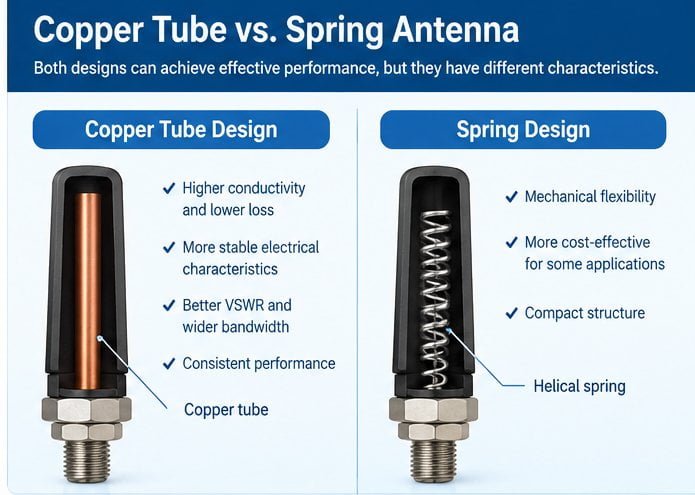
While both copper tube and spring designs can achieve effective operation in a nut-style antenna, copper tubes generally offer higher conductivity and greater stability in their electrical characteristics, potentially leading to more consistent performance and wider bandwidth. Spring designs, however, provide mechanical flexibility and can be more cost-effective for certain applications.
Understanding the Electrical Differences
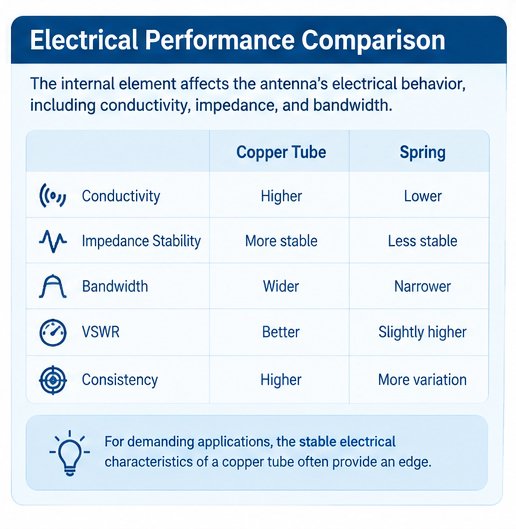
When we talk about the internal elements of a nut-style antenna, the choice between a solid copper tube and a helical spring isn't just aesthetic; it's fundamental to its electrical behavior. Copper, being an excellent conductor, allows for minimal resistive losses. A solid copper tube maintains a consistent cross-section, which contributes to a predictable electrical path for radio frequency (RF) currents. This stability is particularly important for maintaining a consistent impedance across the operating frequency band, leading to better voltage standing wave ratio (VSWR) and efficient power transfer.
A helical spring, on the other hand, essentially 'compresses' a longer wire into a smaller physical space. Electrically, this creates an inductive element. While springs can be effectively tuned to resonate at a desired frequency, their geometry means the current path is longer and less uniform than a solid tube. This can lead to slightly higher resistive losses and potentially a narrower bandwidth. The inductive nature of the spring can also make it more sensitive to manufacturing variations in pitch and diameter, impacting the consistency of performance from one unit to the next. In my experience, for demanding applications where precise frequency response and maximum efficiency are paramount, the stable electrical characteristics of a well-designed copper tube element often provide an edge.
Mechanical Considerations and Durability
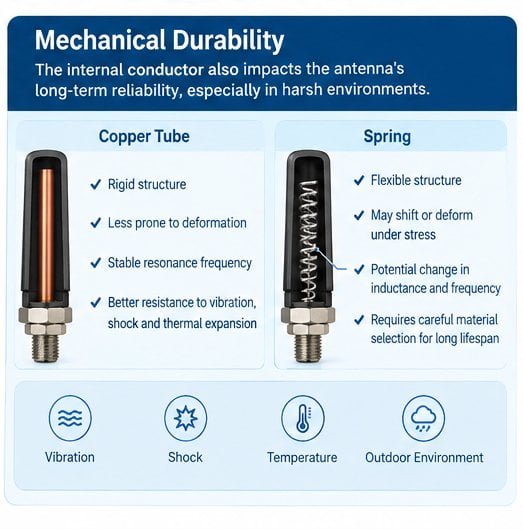
Beyond electrical performance, the mechanical properties of the internal conductor are vital for the long-term reliability of a threaded-base antenna, particularly in industrial or outdoor environments. Copper tubes offer inherent rigidity. This rigidity means the radiating element's physical dimensions are less prone to change due to vibration, shock, or thermal expansion. This mechanical stability directly translates to electrical stability—if the antenna's physical form factor doesn't warp, its electrical properties (like resonance frequency and impedance) remain consistent.
Spring designs, while offering a compact form factor, introduce mechanical flexibility. While this can be an advantage in applications requiring impact absorption, it also means the spring's coils can shift or deform under stress, potentially altering the antenna's electrical properties. For instance, if a spring gets slightly compressed or stretched, its inductance and resonant frequency might change, impacting gain or VSWR. Furthermore, the longevity of the spring material, especially concerning fatigue from repeated environmental stresses like wind or vibration, needs careful consideration during design and material selection. We always subject our antennas to rigorous vibration and environmental testing to ensure they maintain their integrity, regardless of the internal element.
Manufacturing Complexity and Cost Implications
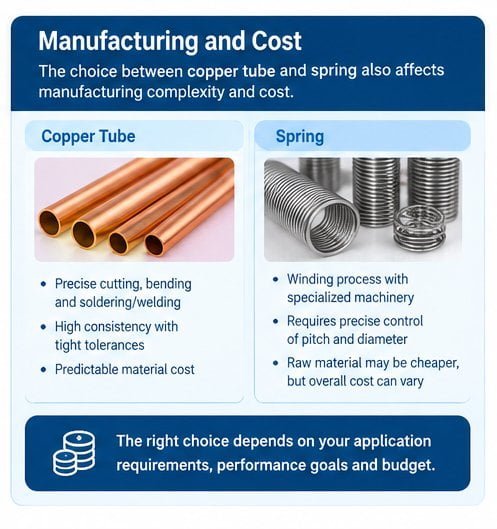
The choice between copper tube and spring also has significant implications for manufacturing processes and, consequently, cost. Manufacturing a copper tube antenna typically involves precise cutting, bending, and soldering or welding of pre-formed tubes. This process, when managed with tight tolerances, can produce highly consistent radiating elements. The material cost for standard copper tubing is generally predictable.
Spring antennas, however, involve winding a wire into a specific helix. While the raw wire material might be less expensive than a solid tube, the winding process requires specialized machinery and precise control over parameters like wire diameter, coil pitch, and overall length. Achieving high consistency across large production batches can be more challenging with springs, as slight variations can lead to noticeable performance differences. From a quality control perspective, ensuring the uniformity of spring-based elements often requires more stringent in-process checks. For manufacturers like us, who prioritize stable product quality and performance consistency across all batches, the precision inherent in working with copper tubing often lends itself better to reliable, high-volume production, though we also design spring-based solutions for specific customer requirements where their characteristics are advantageous.
How Does Internal Structure Affect the Gain of a Threaded-Base Antenna?
Beyond just the conductive element, how do the subtle internal structural choices within a threaded-base antenna truly influence its ability to amplify signals? It's not just about what's inside, but how it's engineered and integrated. The internal architecture orchestrates how RF energy is captured and radiated, directly shaping the antenna's overall efficiency and, consequently, its gain.
The internal structure of a threaded-base antenna significantly impacts its gain by determining the efficiency of energy radiation, impedance matching, and bandwidth. Well-designed internal components, such as baluns, matching networks, and the precise geometry of the radiating element, minimize losses and optimize signal transfer, directly contributing to higher effective gain.
The Role of Radiating Element Geometry
The geometry of the radiating element—whether it's a straight wire, a coiled spring, or a shaped copper tube—is paramount in determining a threaded-base antenna's gain. antennas operate on the principle of resonance, meaning their physical dimensions must be a fraction of the wavelength of the signals they are designed to transmit or receive. For instance, a quarter-wave monopole antenna performs optimally when its length is approximately one-quarter of the signal's wavelength. Deviations from this ideal length, or poor shaping of the element, can drastically reduce its efficiency and gain.
An antenna's radiating element isn't just a conductor; it's an intricately designed component whose shape and dimensions dictate its radiation pattern and efficiency. A well-designed internal structure ensures that the current distribution along the element is optimal, maximizing radiation in the desired direction and minimizing losses. For a given physical size of the antenna housing, engineers must carefully design the internal radiating element to resonate efficiently at the target frequency. While a larger physical size provides the potential for higher gain by offering a larger "effective aperture" to capture or radiate signals, it's the precision of the internal element's geometry that converts this potential into actual, measurable gain.
Impedance Matching Networks
Efficient power transfer from the radio or transceiver to the antenna is crucial for achieving high gain. This efficiency hinges on impedance matching. Every antenna has a characteristic impedance (typically around 50 ohms for most RF systems), and the transmission line (coaxial cable) and radio also have their own impedances. If these impedances don't match, a significant portion of the RF energy will be reflected back towards the source, leading to power loss and reduced gain. This is measured by the VSWR (Voltage Standing Wave Ratio).
Internal impedance matching networks, often comprising inductors and capacitors, are engineered within the nut-style antenna to transform the antenna's inherent impedance to match that of the transmission line. The design and quality of these internal components directly affect the antenna's ability to efficiently transfer power. A poorly designed or cheaply constructed matching network can introduce significant losses, even if the radiating element itself is well-designed. When we design our threaded-base antennas, our engineering team meticulously models and tests these matching networks to ensure optimal power transfer and minimal VSWR across the specified frequency band, thereby maximizing the antenna's effective gain.
Baluns and Current Distribution
A balun (a portmanteau of "balanced-unbalanced") is another critical internal component that profoundly affects antenna gain and radiation pattern. Many antennas, such as dipoles, are balanced structures, meaning current flows equally and oppositely in their two halves. Coaxial cables, however, are unbalanced transmission lines, with current flowing down the center conductor and returning via the outer shield. Connecting an unbalanced line directly to a balanced antenna can lead to common-mode currents flowing on the outside of the coaxial cable, which act as an unintended part of the antenna.
These common-mode currents distort the intended radiation pattern, reduce efficiency, and can lead to signal interference, effectively reducing the antenna's intended gain. An internal balun solves this problem by transforming the unbalanced signal from the coaxial cable into a balanced signal for the antenna element. A well-designed balun ensures that RF energy is concentrated solely in the radiating element, creating a cleaner, more predictable radiation pattern and preventing energy loss due to unintended radiation from the cable. This careful control over current distribution is a key factor in realizing the full potential gain of any threaded-base antenna.
Material Purity and Conductance
The choice and purity of conductive materials within the antenna are also non-negotiable for achieving optimal gain. High-quality copper, often with specific coatings like tin or silver for environmental protection and improved conductivity at RF frequencies (due to the skin effect), minimizes resistive losses. Every milliohm of resistance in the radiating element or matching network converts precious RF power into heat, reducing the power available for radiation and, consequently, reducing gain.
Beyond the primary conductor, the quality of dielectric materials (insulators) used in spacers or supports also plays a role. Poor quality dielectrics can absorb RF energy, again leading to losses. At our manufacturing facility, we ensure that all internal components, from the copper elements to the smallest dielectric spacers, meet stringent quality standards. This commitment to material purity and appropriate conductance ensures that the threaded-base antennas we produce achieve their maximum potential gain and deliver consistent performance in the field.
What Determines Nut-Style Antenna Gain? Size, Materials, and Internal Design Explained
When seeking optimal performance from a nut-style antenna, where should your focus truly lie? Is it simply about raw size, the materials used, or the intricate internal design? Unraveling these factors is key to informed procurement. The reality is that all three are interconnected and critical. Understanding their individual contributions helps procurement specialists evaluate options more effectively and ensure the chosen antenna meets specific application demands.
The gain of a nut-style antenna is determined by a complex interplay of its physical size relative to the operating wavelength, the efficiency and conductivity of its internal materials, and the precision of its internal design—including radiating element geometry, impedance matching, and balun effectiveness. Larger physical size generally provides the potential for higher gain, which is then realized through optimized materials and internal engineering.
The Fundamental Physics of Antenna Size and Wavelength
This is a fundamental truth in antenna design: for a single frequency antenna, a larger physical volume generally allows for better performance, assuming all other factors are equal and the design is optimized. The gain of an antenna is intrinsically linked to its "effective aperture" – essentially, how large an area it presents to an electromagnetic wave. A larger physical size allows for a larger effective aperture, which translates to the potential for higher gain.
Antennas are resonant devices; they work most efficiently when their physical dimensions are directly related to the wavelength of the radio frequency signal they handle. For example, a quarter-wave monopole antenna needs to be approximately one-quarter of the signal's wavelength long to achieve resonance. If you're designing for a lower frequency (longer wavelength), you inherently need a physically longer antenna to achieve quarter-wave resonance and thus optimal gain. A small antenna attempting to operate at a very low frequency will either be very inefficient (low gain) or will require significant electrical loading (using coils to "electrically lengthen" it), which often comes with a trade-off in bandwidth and efficiency. Therefore, while internal design optimizes how effectively an antenna utilizes its size, the fundamental limit for achievable gain at a given frequency is often set by the antenna's physical dimensions.
Impact of Material Quality
The quality of materials used throughout a nut-style antenna is a cornerstone of its performance and longevity. This extends beyond just the conductive elements. For the radiating element and matching network, high-purity copper or brass, sometimes plated with silver or tin, ensures minimal resistive losses and maintains excellent conductivity at RF frequencies. Inferior conductors increase ohmic losses, converting valuable RF power into wasted heat and reducing the overall gain.
However, material quality also encompasses the dielectric elements (insulators) and the protective housing. High-quality dielectric materials should have low loss tangents to prevent absorption of RF energy, which would otherwise diminish gain. The antenna's housing material, often UV-stabilized ABS or fiberglass, must provide robust mechanical protection without significantly interfering with RF signals. A sturdy housing ensures the internal components maintain their precise configuration, even under harsh environmental conditions, preserving the antenna's electrical performance over time. Our manufacturing process includes rigorous material selection and testing to ensure every component contributes to the antenna's stable, high-gain performance.
Precision in Internal Design and Manufacturing
Even with the right size and best materials, a nut-style antenna's gain can be compromised without precise internal design and manufacturing. This includes the exact spacing of elements, the quality of solder joints, the consistency of coil windings (if springs are used), and the accuracy of impedance matching circuits. Tiny deviations can lead to shifts in resonant frequency, increased VSWR, distorted radiation patterns, and ultimately, reduced gain.
At our Shenzhen facility, we combine over 17 years of experience with advanced manufacturing techniques to ensure this precision. Our engineering team meticulously designs each antenna, leveraging simulation software and extensive prototyping. During production, we employ stringent quality control measures, including automated testing and individual calibration checks, to ensure every threaded-base antenna consistently meets its specified gain and performance parameters. This commitment to precision is what allows us to deliver high-performance antennas that our customers can rely on.
Environmental Factors and Mounting Considerations
It's important to remember that an antenna's gain isn't solely an intrinsic property; it's also influenced by its operating environment and mounting configuration. The presence of nearby metallic objects, walls, or even the human body can detune an antenna, altering its impedance and radiation pattern, which can significantly reduce its effective gain. For nut-style antennas, which often mount directly to a device or a vehicle, the "ground plane" provided by the mounting surface is particularly critical.
Many antenna designs, especially monopole types, rely on an adequate ground plane to function correctly and achieve their specified gain. A small or poorly conductive ground plane can drastically reduce performance. Therefore, when evaluating a threaded-base antenna, consider not just its standalone specifications but also how it will interact with its intended mounting environment. Suppliers like us provide guidance on optimal mounting to help our customers achieve the specified gain in their real-world applications.
How to Choose a High-Gain Nut-Style Antenna for Reliable Wireless Communication
With so many factors influencing antenna performance, how do you navigate the selection process to ensure you choose a high-gain nut-style antenna that delivers reliable wireless communication? It can feel overwhelming to balance technical specifications with real-world needs, especially when your system's performance hinges on this critical component. Making an informed choice involves more than just looking at a single number.
To choose a high-gain nut-style antenna, prioritize models with specifications that precisely match your target frequency and application requirements, verifying stated gain figures through reputable suppliers. Evaluate the quality of internal materials and manufacturing consistency, look for customization options for impedance matching and connector types, and consider the supplier's testing capabilities and quality certifications like ISO9001.
Defining Your Application's Needs
Before even looking at antenna specifications, clearly define your application's requirements. What are the exact operating frequencies (e.g., 5G, LoRa, WiFi)? What bandwidth do you need? What kind of coverage area are you aiming for (e.g., omnidirectional for general coverage, or more directional for specific links)? What are the environmental conditions (temperature, humidity, vibration, UV exposure)? These parameters will dictate the type, size, and robustness required for your nut-style antenna. For instance, an antenna for a remote outdoor IoT sensor will have very different requirements than one for an indoor Wi-Fi router. Understanding these needs is the first step toward selecting an antenna that will genuinely deliver high gain and reliable communication in your specific scenario.
Evaluating Supplier Specifications and Verification
Always scrutinize antenna data sheets provided by suppliers. Look for clear, comprehensive specifications including frequency range, peak gain (dBi), VSWR, radiation pattern, polarization, and input impedance. Be wary of overly optimistic or incomplete specifications. A reliable supplier will provide supporting documentation, such as gain patterns (radiation plots) and VSWR graphs, and be transparent about their testing methodologies. For high-stakes applications, consider requesting test reports or even arranging for third-party verification of critical performance parameters. We, for example, encourage our clients to review our extensive test data and discuss their specific testing requirements with our engineering team, ensuring full confidence in the performance claims of our threaded-base antennas.
The Importance of Customization and Engineering Support
For many B2B applications, off-the-shelf antennas might not perfectly meet unique system requirements. This is where the ability to customize becomes invaluable. Can the supplier adjust the frequency, gain, connector type, cable length, or even the appearance of the nut-style antenna? Customization ensures optimal integration with your device, preventing performance compromises. Beyond customization, assess the supplier's engineering support. Do they offer design assistance, prototyping services, and technical consultation? Our company excels in OEM/ODM capabilities, working closely with clients from initial concept to final product, offering tailored solutions that optimize performance, including specific frequency tuning and impedance matching for unique integration challenges.
Quality Assurance and Manufacturing Consistency
The best-designed antenna is only as good as its manufacturing quality. For reliable wireless communication, consistent performance across all units in a batch and over long periods is paramount. Look for suppliers with robust quality management systems, such as ISO9001 certification, which demonstrates a commitment to consistent processes and continuous improvement. Inquire about their production testing protocols, material sourcing, and how they ensure batch-to-batch consistency. Our adherence to ISO9001, combined with over 17 years of industry experience and a stable production system, means we provide nut-style antennas that not only perform well initially but maintain that performance consistently over their operational lifetime, minimizing failure rates and ensuring reliable long-term supply for our global customers.
Cost-Benefit Analysis and Long-Term Reliability
While initial cost is always a factor, a comprehensive procurement strategy involves a cost-benefit analysis that considers the total cost of ownership. A cheaper antenna with inconsistent performance or a short lifespan can lead to higher long-term costs due to field failures, maintenance, and lost productivity. Evaluate the supplier's reputation for reliability, product warranties, and post-sales support. Prioritizing high-quality, stable performing threaded-base antennas from a trusted manufacturer like ours, with proven export experience to over 100 countries, can result in significant savings and greater operational efficiency in the long run. We focus on providing high-performance, cost-effective solutions that deliver genuine value.
Frequently Asked Questions
What is antenna gain, and why is it important for a nut-style antenna?
Antenna gain is a measure of an antenna's ability to direct radio frequency energy in a specific direction, effectively "amplifying" the signal in that direction compared to an isotropic (hypothetical, omnidirectional) antenna. For a nut-style antenna, higher gain means a stronger signal can be transmitted or received, leading to longer range, better penetration through obstacles, and more reliable wireless communication.
Can I increase the gain of my existing nut-style antenna?
Typically, you cannot increase the inherent gain of an existing nut-style antenna as its gain is fixed by its physical design and internal structure. However, you can optimize its effective performance by ensuring proper placement (adequate ground plane, clear line of sight), correct impedance matching to your radio, and using high-quality, low-loss coaxial cables.
Are there trade-offs between antenna size and performance?
Yes, there are significant trade-offs. While larger antennas generally have the potential for higher gain at a given frequency, they are less compact and can be more susceptible to environmental factors or damage. Smaller antennas are more discreet and durable but often achieve lower gain or narrower bandwidth, especially for lower frequencies, due to the physical limitations of wavelength resonance.
How does VSWR relate to a nut-style antenna's gain?
VSWR (Voltage Standing Wave Ratio) is an indicator of how well an antenna is matched to the transmission line and radio. A high VSWR (e.g., above 2:1) means a significant portion of the RF power is reflected back from the antenna, resulting in power loss and a reduction in the antenna's effective radiated power, thereby directly reducing its actualized gain.
What certifications should I look for in a nut-style antenna supplier?
For a nut-style antenna supplier, look for certifications like ISO9001 for quality management, ensuring consistent manufacturing processes. Product-specific compliance marks such as CE and RoHS are crucial for international markets, indicating adherence to safety and environmental standards. These certifications provide assurance of quality, reliability, and regulatory compliance.
Conclusion
The question of whether a nut-style antenna's gain primarily depends on its size or internal structure reveals a complex interplay of engineering principles. We've explored how a larger physical size often sets the fundamental potential for higher gain, particularly at lower frequencies, due to the physics of wavelength resonance. However, that potential is only realized and maintained through meticulous internal design—whether employing stable copper tubes or flexible springs—optimized materials, precision manufacturing, and effective impedance matching.
Ultimately, a high-gain nut-style antenna is a product of comprehensive engineering, where every detail, from the conductive element's geometry to the quality of its housing, contributes to its overall performance. For overseas communication equipment manufacturers, system integrators, and wholesalers, understanding these nuances is key to selecting robust and reliable components. With over 17 years of experience in Shenzhen, we specialize in manufacturing communication antennas with stable product quality, offering flexible OEM/ODM capabilities, competitive MOQs, and fast delivery. If you need a high-performance, custom-tailored threaded-base antenna solution for your next project, I invite you to connect with our expert team to discuss your specific requirements.